
📋 Table of Contents
When you’re comparing a seamless knit vs circular knit leggings manufacturer, the terminology alone can create confusion. Many factories label products as seamless when they’re really cut-and-sew with bonded seams or flatlock stitching. This mislabeling leaves buyers uncertain about what they’re actually ordering and how it will perform for their customers. Understanding the true construction differences, machine requirements, and design constraints helps you choose the right manufacturer and avoid costly sampling mistakes.
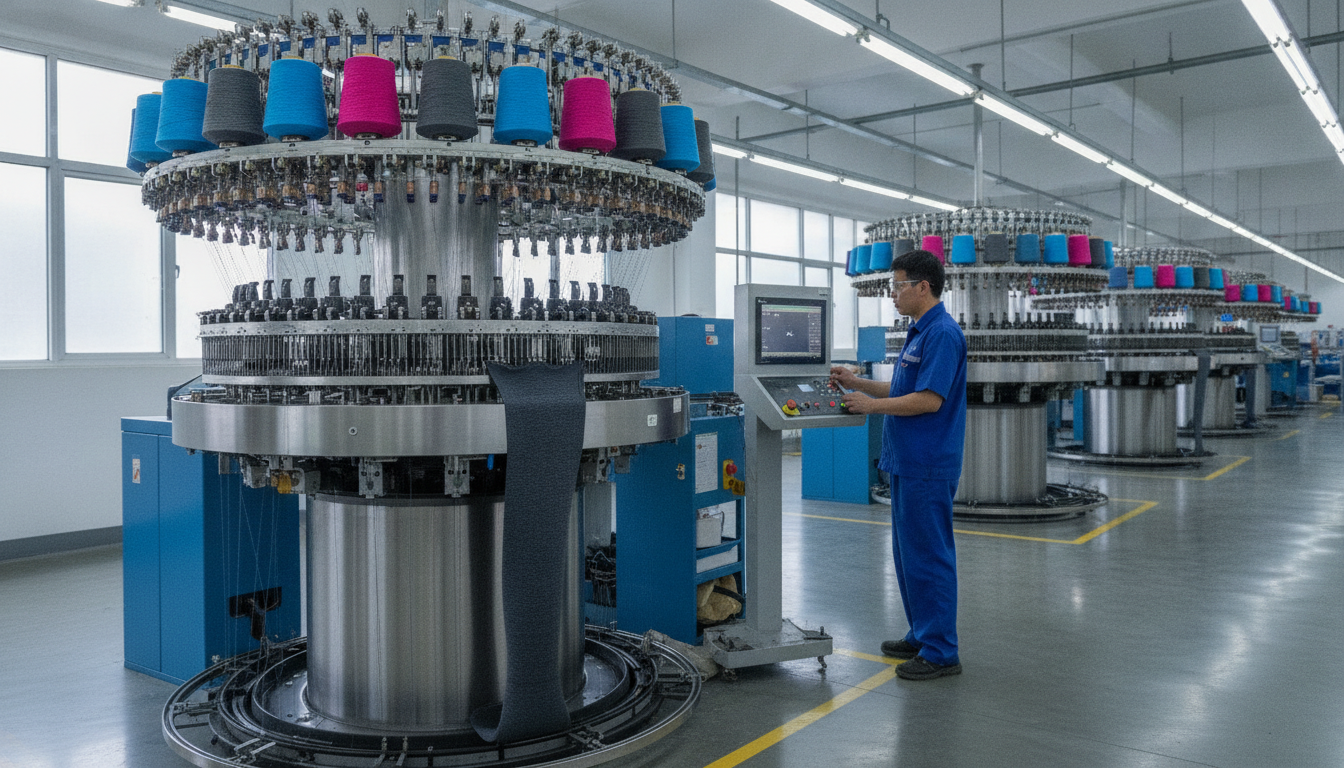
The confusion around seamless knit vs circular knit leggings manufacturer terminology starts with how factories define seamless. True seamless construction means the garment is knit in one continuous tubular piece on a circular knitting machine, with no cut edges or sewn seams. The waistband, body, and leg openings are all formed during the knitting process itself.
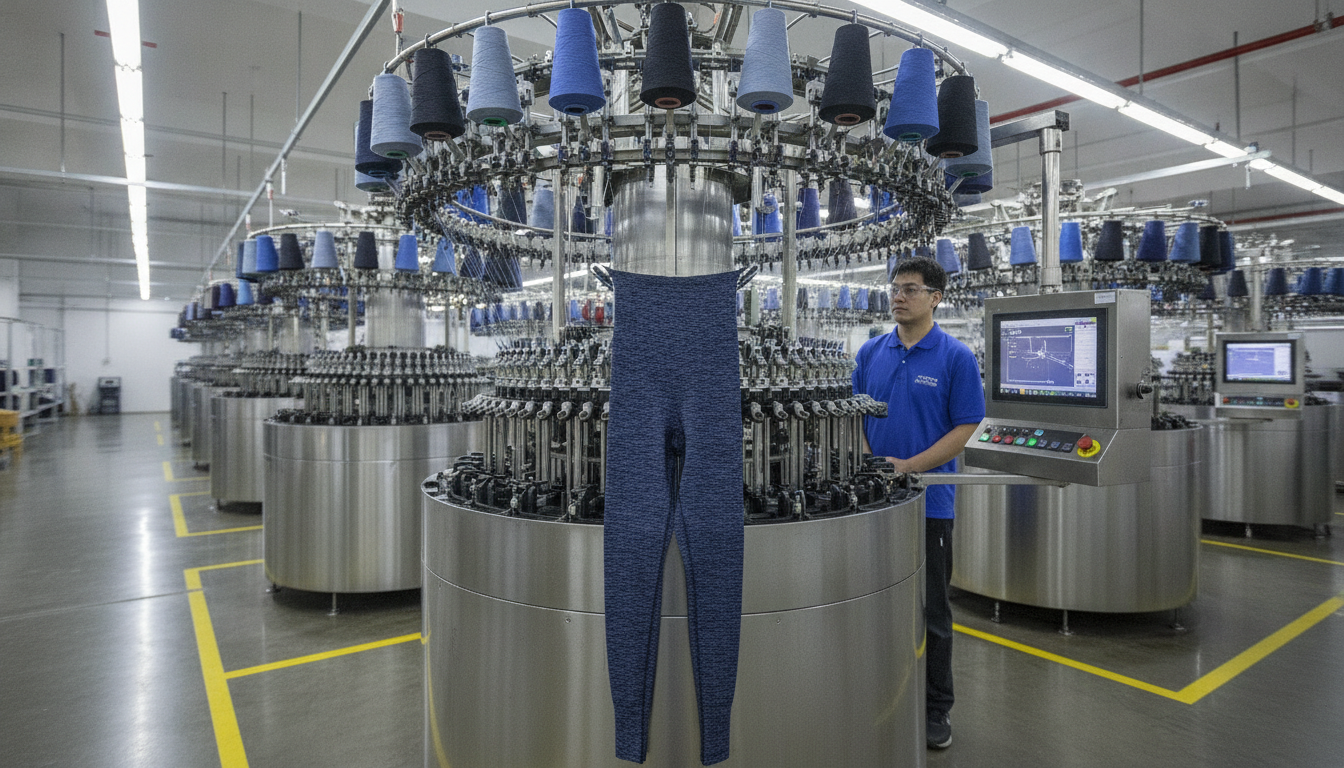
A true seamless legging is produced on a computerized circular knitting machine that creates a tubular fabric piece. The machine knits the garment from top to bottom in one pass, forming the waistband, body panels, and leg openings without cutting or sewing. The only finishing steps are trimming loose threads and heat-setting the shape. This construction eliminates all side seams, inseams, and gusset seams that can cause chafing or visible lines under tight clothing.
Many factories produce what they call seamless leggings using cut-and-sew construction with bonded or flatlock seams. These leggings are made from flat-knit or circular-knit fabric panels that are cut to pattern, then joined using ultrasonic bonding, laser welding, or flatlock stitching. The seams are flatter and less visible than traditional overlock seams, but they are not truly seamless. Buyers often discover this only after receiving samples, when they notice seam lines under tension or during wear testing.
Traditional cut-and-sew leggings use circular-knit or warp-knit fabric that is knit as yardage, then cut into pattern pieces and sewn together with overlock or coverstitch seams. This method offers the most design flexibility for shaping panels, mesh inserts, and color blocking, but creates visible seam lines and potential chafe points at inseams and side seams.
When evaluating a custom yoga apparel manufacturer, ask for construction photos showing the inside waistband and inseam area. True seamless construction will show continuous knit loops with no cut edges or seam allowances. Hybrid seamless will show bonded or flatlock seam lines. This visual check prevents the mislabeling issue that frustrates many buyers during the sampling phase.
The equipment a factory uses determines whether they can produce true seamless knit vs circular knit leggings manufacturer options. Machine type, gauge, and programming capability directly affect construction quality, lead time, and minimum order quantities.
True seamless leggings require computerized circular knitting machines with Jacquard or electronic selection capability. These machines knit in the round, forming a tubular garment from waistband to leg opening in one continuous process. The machine gauge (needles per inch) ranges from 18 to 28 gauge for activewear, with finer gauges producing smoother, more compressive fabrics. A single seamless legging can take 15 to 25 minutes to knit, depending on complexity and gauge.
Machine setup for a new style involves programming the knit structure, stitch density, and shaping zones into the machine controller. This programming step takes 2 to 4 hours per style, which is why seamless production typically requires higher MOQs to justify the setup time. Once programmed, the machine knits each piece automatically, with minimal operator intervention beyond yarn feeding and quality checks.
Cut-and-sew leggings use fabric knit as continuous yardage on large-diameter circular knitting machines or flat-knit machines. The fabric is then relaxed, dyed, and rolled onto bolts before being sent to the cutting room. This separation of knitting and garment assembly allows factories to produce multiple styles from the same fabric roll, reducing MOQs and speeding up style changes.
Circular-knit fabric for leggings is typically produced on machines with diameters of 30 to 40 inches, creating tubular fabric that is slit open and finished as flat yardage. The knit structure can be single jersey, double knit, or interlock, depending on the desired stretch, recovery, and opacity. Warp-knit fabrics, produced on Raschel or tricot machines, offer higher compression and shape retention but require different dyeing and finishing processes.
Factories producing hybrid seamless leggings use ultrasonic bonding machines or laser welding equipment to join cut panels without traditional stitching. Ultrasonic bonding uses high-frequency vibration to melt and fuse synthetic fabric edges, creating a flat, flexible seam. Laser welding uses focused heat to bond thermoplastic fibers along the seam line. Both methods require synthetic fiber content (polyester, nylon, or spandex) to work effectively and cannot be used on 100% natural-fiber fabrics.
Flatlock stitching, another common hybrid method, uses a specialized sewing machine that interlocks threads on both fabric surfaces, creating a flat seam with minimal bulk. Flatlock seams are more visible than bonded seams but offer better stretch recovery and are easier to repair if damaged.
Machine verification: Ask your manufacturer for photos of the actual knitting or bonding equipment used for your order. True seamless production requires computerized circular knitting machines, not just standard cut-and-sew lines with bonding stations.
Choosing between seamless knit vs circular knit leggings manufacturer options involves understanding the design constraints each construction method imposes. True seamless construction offers comfort and aesthetic benefits but limits your ability to add shaping features, complex branding, and targeted ventilation zones.
Cut-and-sew construction allows you to use different fabric weights and compression levels in different panels. You can specify a high-compression power mesh for the waistband and thigh area, a lighter-weight fabric for the lower leg, and a breathable mesh insert along the calf. Each panel is cut from the appropriate fabric and sewn together, giving you precise control over shaping and support.
True seamless construction knits the entire garment from a single yarn feed (or multiple feeds in the same machine pass), limiting your ability to vary fabric weight and compression by zone. You can program different stitch densities and structures into different areas, but the base yarn and knit method remain constant. This constraint makes it harder to achieve strong waistband compression or targeted thigh shaping in a seamless legging compared to a cut-and-sew design with engineered panels.
Cut-and-sew leggings allow you to place woven labels, heat-transfer logos, and embroidered branding on any panel before assembly. You can position a logo on the hip, thigh, or calf with precise placement control. Seamless leggings require logos to be added after knitting, typically through heat transfer, screen printing, or silicone printing on the finished garment. This post-production branding limits placement options and can affect the seamless aesthetic if the logo area shows visible texture or stiffness.
Some circular knitting machines offer Jacquard capability, allowing you to knit a logo or pattern directly into the fabric structure during production. This creates a truly integrated brand mark, but the logo must be designed within the constraints of the knit grid and cannot include fine detail or gradients. The setup cost for Jacquard programming is higher, and MOQs increase to justify the machine time.
Buyers often raise concerns about ventilation in seamless leggings, especially for high-intensity workouts. Cut-and-sew construction allows you to insert mesh panels along the inner thigh, behind the knee, or down the outer leg, providing targeted airflow in high-sweat zones. These mesh inserts are cut from a different fabric and sewn into the main panels during assembly.
Seamless construction can incorporate open-knit or mesh-structure zones by programming the machine to drop stitches or use a lighter yarn in specific areas. However, the ventilation effect is less pronounced than a true mesh insert, and the transition between solid and open knit can create weak points if not properly engineered. For high-sweat applications, cut-and-sew construction with mesh inserts often outperforms seamless options in breathability testing.
Seamless leggings are harder to repair or modify after production because the construction is knit-programmed rather than assembled from panels. If a seamless legging develops a hole or run, the damage can spread along the knit structure, and repair requires specialized knitting skills. Cut-and-sew leggings can be repaired by replacing a damaged panel or reinforcing a seam, making them more practical for buyers who need to offer repair services or warranty coverage.
In practice: A boutique yoga studio in Portland ordered 100 seamless leggings for their branded line, then discovered they couldn’t add a custom waistband pocket without disrupting the seamless construction. They switched to a hybrid seamless design with a cut-and-sew waistband panel, allowing pocket insertion while maintaining the seamless leg aesthetic.
Minimum order quantities and unit costs vary significantly between seamless knit vs circular knit leggings manufacturer options. Understanding the cost drivers for each construction type helps you plan your initial order and budget for sampling, tooling, and bulk production.
True seamless leggings require machine programming and setup time, which increases the MOQ threshold. Most factories producing genuine seamless activewear require 300 to 500 pieces per style per color to justify the setup cost. The programming time (2 to 4 hours per style) and the slower knitting speed (15 to 25 minutes per piece) mean the factory needs a larger order to cover fixed costs and maintain profitability.
Unit costs for seamless leggings range from $8 to $15 FOB for basic styles in standard synthetic blends (nylon-spandex or polyester-spandex). Costs increase with finer gauge knitting, Jacquard branding, or premium fiber blends like merino wool or recycled nylon. Sampling costs for seamless styles are higher because each sample requires a full machine setup, even for a single piece. Expect to pay $50 to $100 per sample for a true seamless legging, compared to $20 to $40 for a cut-and-sew sample.
Cut-and-sew leggings offer lower MOQs because the fabric is knit as yardage and can be used for multiple styles. A factory can produce 100 to 200 pieces per style per color, making this construction method more accessible for startup brands and small-batch testing. The separation of fabric production and garment assembly also speeds up sampling, since the factory can cut and sew a sample from existing fabric stock without waiting for custom knitting.
Unit costs for cut-and-sew leggings range from $6 to $12 FOB for standard styles in mid-weight circular-knit or warp-knit fabrics. Costs increase with panel complexity, mesh inserts, or premium finishing like silicone grippers or reflective trim. Sampling costs are lower ($20 to $40 per piece) because the factory can cut a single sample from yardage without machine setup.
Hybrid seamless leggings with bonded or flatlock seams fall between true seamless and cut-and-sew in both MOQ and unit cost. MOQs typically range from 200 to 300 pieces per style per color, since the fabric is still cut from yardage but the bonding or flatlock process requires specialized equipment and setup. Unit costs range from $7 to $13 FOB, depending on the number of seams, bonding method, and fabric type.
At Walundi, our vertically integrated facility in Yiwu allows us to offer low MOQ terms across construction types: 1 piece for sampling and 30 pieces per SKU for bulk orders. This flexibility helps startup brands test seamless knit vs circular knit leggings manufacturer options without committing to 300+ units before validating product-market fit.
Both seamless and cut-and-sew leggings must meet the same textile safety and environmental standards for export to the United States, European Union, and United Kingdom. Certification requirements do not vary by construction type, but the testing process and documentation differ slightly depending on whether the fabric is knit as yardage or as finished garments.
OEKO-TEX Standard 100 certification verifies that textile products are free from harmful substances. The standard screens fabrics and finished garments against more than 1,000 regulated and non-regulated chemicals, including formaldehyde, heavy metals, pesticides, and phthalates. For seamless leggings, the entire knit garment is tested as a single unit. For cut-and-sew leggings, each fabric component (body fabric, waistband elastic, mesh inserts) must be tested separately, then the finished garment is tested to confirm no contamination occurred during assembly.
OEKO-TEX certification is valid for one year and must be renewed annually with updated testing. Buyers should request a copy of the manufacturer’s current OEKO-TEX certificate and verify that the certificate number matches the product category (Class I for baby products, Class II for skin-contact apparel like leggings).
The Global Recycled Standard (GRS) certifies recycled content in textile products and tracks the chain of custody from recycled material source to finished garment. GRS requires a minimum of 20% recycled content before a product can carry the GRS label, with most activewear brands targeting 50% to 100% recycled polyester or nylon to support sustainability claims.
For seamless leggings, GRS certification requires the yarn supplier to provide certified recycled fiber, and the knitting factory must maintain chain-of-custody documentation showing the yarn was used in the certified product. For cut-and-sew leggings, both the fabric mill and the garment factory must be GRS-certified, and the fabric must carry a transaction certificate (TC) linking it to the recycled fiber source. This dual certification requirement can increase lead time and cost for cut-and-sew products compared to seamless construction, where the knitting and garment production occur in the same facility.
The Business Social Compliance Initiative (BSCI) audits factories for labor practices, working conditions, and social responsibility. BSCI certification is increasingly required by European buyers and larger US retailers. The audit covers the entire production facility, not individual product lines, so both seamless and cut-and-sew leggings produced in the same factory carry the same BSCI status.
Buyers should request a copy of the factory’s most recent BSCI audit report and verify the audit date (audits are valid for two years). Look for the overall compliance rating (A, B, C, or D) and check for any non-conformances related to working hours, wages, or health and safety. A rating of C or D indicates serious compliance issues that may require corrective action before placing an order.
Our 18,000m² Yiwu facility holds current GRS, OEKO-TEX, and BSCI certifications, covering both our seamless knitting lines and cut-and-sew production. We provide certification copies with every quote and can supply transaction certificates (TCs) for GRS-certified fabrics at the sampling stage, so you can validate compliance before committing to bulk production.
Selecting between seamless knit vs circular knit leggings manufacturer options depends on your brand positioning, target customer, and go-to-market strategy. Each construction type serves different product goals and buyer priorities.
In practice: A DTC activewear brand in Toronto launched with cut-and-sew leggings at 150 pieces per style to test three fabric blends and two fits. After validating customer preference for high-waist compression, they scaled to hybrid seamless construction at 250 pieces per style, reducing seam complaints by 40% while maintaining design flexibility for seasonal color drops.
When evaluating manufacturers, ask for construction photos, machine specifications, and sample lead times for each construction type. A private label manufacturer with in-house seamless knitting and cut-and-sew capabilities can offer side-by-side samples, helping you compare fit, comfort, and aesthetic before committing to bulk production.
Seamless knit leggings are produced in a single tubular piece on a circular knitting machine, with no cut edges or sewn seams. Circular knit refers to the fabric production method, where fabric is knit in a tube, then either used as-is for seamless garments or slit open and used for cut-and-sew construction. Many leggings labeled as seamless are actually cut-and-sew products made from circular-knit fabric with bonded or flatlock seams, not true seamless construction.
Seamless leggings offer superior comfort and zero chafe for yoga, Pilates, and low-impact activities, with no visible seam lines under tight clothing. Cut-and-sew leggings provide better design flexibility, allowing stronger shaping panels, mesh ventilation inserts, and targeted compression zones for high-intensity workouts. The best choice depends on your brand positioning, target activity, and customer priorities for comfort versus performance features.
True seamless leggings require computerized circular knitting machines with Jacquard or electronic selection capability. These machines knit the garment in the round from waistband to leg opening in one continuous process, taking 15 to 25 minutes per piece. Machine gauge ranges from 18 to 28 gauge for activewear, with finer gauges producing smoother, more compressive fabrics. Each new style requires 2 to 4 hours of programming time, which drives the higher MOQ requirements for seamless production.
The most common fabric blend for seamless leggings is 75% to 80% nylon with 20% to 25% spandex, offering excellent stretch, recovery, and opacity. Polyester-spandex blends (typically 88% polyester, 12% spandex) provide a more affordable option with good moisture-wicking but slightly less softness. For premium lines, recycled nylon or recycled polyester blends (certified under GRS) support sustainability claims while maintaining performance. Merino wool blends offer natural odor resistance but require specialized knitting and higher MOQs.
Seamless leggings can be customized with heat-transfer logos, screen printing, or silicone printing applied after knitting, but placement options are limited compared to cut-and-sew construction. Jacquard knitting allows logos to be knit directly into the fabric during production, but the logo must fit the knit grid and cannot include fine detail. Adding cut-and-sew panels like pockets or waistband inserts converts the product to hybrid seamless construction, which increases MOQ and unit cost but provides more branding and functional customization options.
Ready to compare seamless and cut-and-sew samples for your activewear line?
Request 1-piece samples with full specs →
Written by the Walundi Export Team.
Sample 1 piece · bulk from 30 · OEKO-TEX & GRS certified · reply in 24h. No gatekeeping.
Low MOQ. Sustainable fabrics. OEM ready. Tell us your vision.
Click the button below to open WhatsApp. If you're not logged in to WhatsApp Web yet, scan the QR code first — then come back here and copy the message into the chat.