
📋 Table of Contents
When validating your first yoga apparel line, the China vs Bangladesh activewear manufacturing quality comparison often determines whether your leggings pass squat tests or your sports bras hold compression through 50 wash cycles. Founders locking cash into 1,000-unit minimums before product-market fit discover too late that country choice affects more than price.
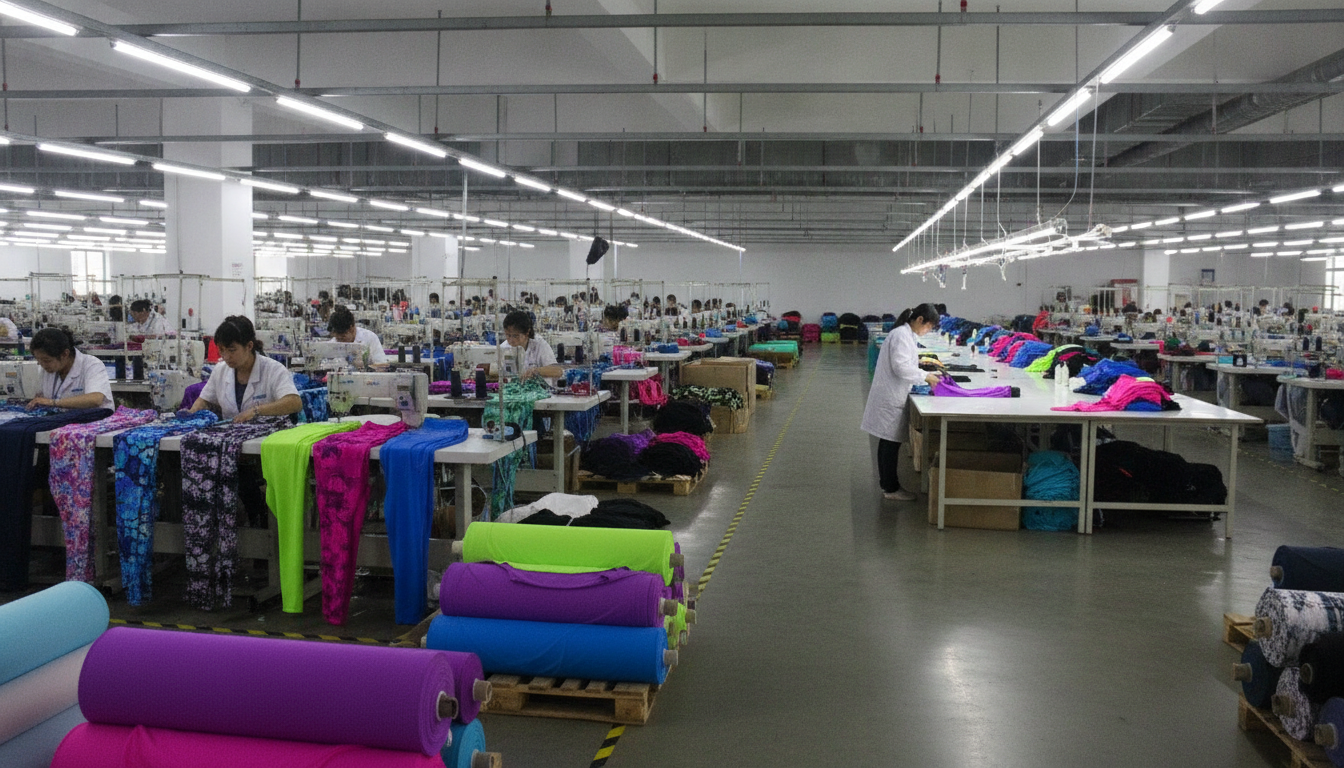
The China vs Bangladesh activewear manufacturing quality comparison diverges sharply when your product requires seamless construction, bonded hems, or multi-panel compression engineering. China’s Yiwu, Guangzhou, and Shenzhen clusters house factories with Santoni seamless knitting machines, ultrasonic bonding equipment, and CAD pattern studios under one roof. Bangladesh’s Dhaka and Chittagong regions excel at flatlock-stitched cotton-blend basics but lack the machinery depth for advanced technical garments.
Seamless sports bras and ribbed legging sets demand circular knitting machines that cost $150,000-$300,000 per unit. Chinese facilities in Yiwu and Dongguan operate 20-40 Santoni or Lonati machines per factory, enabling 1-piece sampling and 30-piece bulk runs. Bangladeshi factories import seamless blanks from China or Turkey, then cut and finish locally, which eliminates true seamless construction and adds a 10-15% markup to the blank cost.
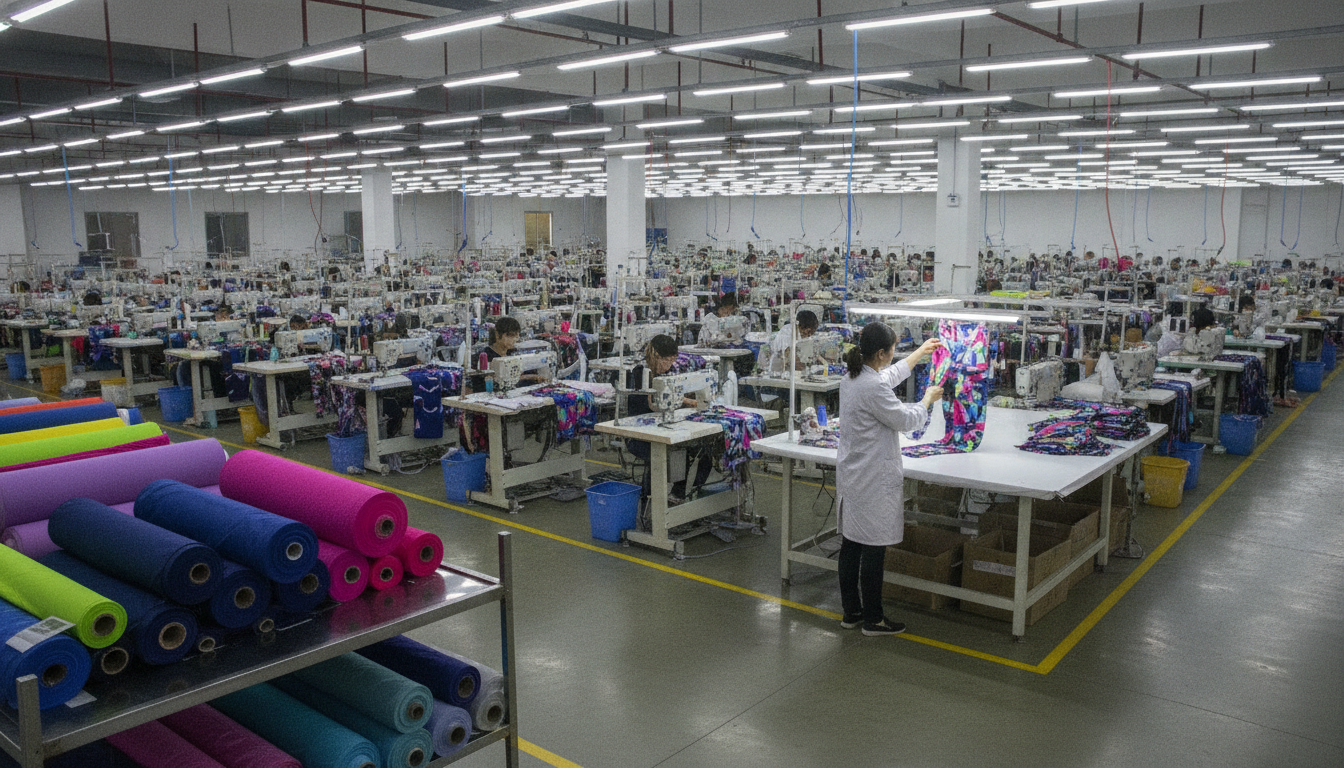
Yoga leggings combining compression panels, breathable mesh, and moisture-wicking gussets require pattern makers who understand fabric stretch ratios and recovery rates. Our 18,000m² Yiwu facility runs in-house pattern studios where technicians adjust seam allowances for four-way stretch fabrics with 40-60% elastane content. Bangladeshi cut-and-sew lines handle two-fabric combinations efficiently but struggle with three-plus fabric types in a single garment, leading to puckering at seam intersections or inconsistent compression zones.
When a DTC founder requests a gusset width change or strap length adjustment, turnaround time separates viable from stalled launches. Chinese factories with co-located fabric suppliers and pattern studios produce revised samples in 7-10 days. Bangladeshi factories waiting on imported fabric swatches or third-party pattern services extend revision cycles to 18-25 days, delaying your go-to-market by 4-6 weeks across three sample rounds.
In practice: A UK yoga brand founder tested 3 legging styles with different compression levels using 1-piece samples from a Yiwu factory, revised the waistband height twice in 14 days, then placed a 30-unit-per-SKU first order to validate product-market fit without locking $8,000 in inventory
Fabric availability within a 2-hour radius determines whether your sustainable recycled-polyester leggings ship in 35 days or 65 days. The China vs Bangladesh activewear manufacturing quality comparison tilts heavily toward China when your line requires GRS-certified recycled nylon, moisture-wicking blends with silver-ion antimicrobial finish, or custom-dyed four-way stretch ponte.
Zhejiang province hosts 12+ mills producing GRS-certified recycled polyester and nylon within 90 minutes of Yiwu garment factories. Founders spec’ing recycled content receive lab-dip color samples in 5-7 days and bulk yardage in 12-15 days. Bangladesh imports GRS-certified fabrics from China, South Korea, or Taiwan, adding 21-30 days to the timeline and requiring larger fabric minimums (300-500 kg per color) that lock cash before you validate demand.
Activewear brands differentiating on fabric hand-feel need access to brushed, slub, ribbed, and waffle-knit textures in matching color palettes. Guangdong and Jiangsu fabric markets stock 40+ performance-knit variations in ready-to-ship inventory. Bangladeshi fabric importers carry 8-12 standard textures, forcing you into plain interlock or jersey when your brand positioning requires visual texture differentiation.
Matching your brand’s Pantone 18-3838 (Ultra Violet) across leggings, sports bras, and tanks requires dye houses that process small lots (50-100 kg) with tight delta-E color tolerance. Chinese dye facilities in Shaoxing accept custom Pantone matching at 80 kg minimums with 10-12 day lead times. Bangladeshi dye houses serve large-volume clients with 500 kg minimums and 18-25 day timelines, making custom color programs unviable for startups testing seasonal palettes.
Founders with $5,000-$15,000 launch budgets discover that MOQ structure determines whether they test three styles or lock all capital into one unvalidated design. The China vs Bangladesh activewear manufacturing quality comparison on MOQ flexibility separates factories serving DTC startups from those built for wholesale volume.
Buyers report that most factories require 3-5 pieces per size for sampling, forcing a $300-$600 sample investment before seeing a single prototype. Chinese factories targeting DTC brands accept 1-piece sample orders, letting you test a high-waisted legging, mid-rise short, and racerback bra for under $200 total. Bangladeshi factories enforce 5-10 piece sample minimums per style, pushing your pre-validation spend to $800-$1,200 before you know if your sizing or compression level resonates with customers.
Bangladesh’s garment industry developed around large retailer orders (H&M, Zara, Uniqlo) with 5,000-10,000 unit purchase orders per style. Factories maintain efficiency at those volumes but struggle to profitably run 100-200 piece orders. Chinese factories in Yiwu and Shenzhen adapted to the DTC boom by engineering flexible production lines that switch between small-batch runs. Our facility accepts 30 pieces per SKU for bulk orders, enabling a founder to launch with 5 colors × 4 sizes × 30 units = 600 total pieces across a full size run, investing $4,500-$6,000 instead of $25,000-$35,000.
A common pain point surfaces when factories demand equal quantities per size (30 small, 30 medium, 30 large, 30 XL) despite your analytics showing 60% of sales concentrate in medium and large. Chinese custom yoga apparel manufacturers allow size-ratio flexibility (10 small, 25 medium, 25 large, 10 XL) within the 30-piece-per-SKU minimum, reducing dead stock. Bangladeshi factories enforce even distribution to simplify cutting-room efficiency, forcing you to carry 40% excess inventory in off-sizes.
Sample MOQ: 1 piece. Bulk MOQ: 30 pieces per SKU. Size-ratio flexibility: adjust quantities per size within the 30-piece minimum to match your sales data.
Squat-proof fabric, colorfast dyes, and consistent compression across production runs depend on in-house QC labs and third-party testing access. The China vs Bangladesh activewear manufacturing quality comparison reveals infrastructure gaps that turn into customer returns and brand-damaging reviews.
Activewear quality starts with fabric performance: four-way stretch recovery after 50 wear cycles, pilling resistance grade 4 or higher, and moisture-wicking rates above 0.2 seconds. Chinese facilities in Yiwu, Guangzhou, and Shanghai access OEKO-TEX and SGS testing labs within the same city, receiving stretch-recovery and pilling reports in 5-7 days. Bangladeshi factories ship fabric swatches to Dhaka-based third-party labs or overseas testing centers, extending fabric validation to 14-21 days and adding $150-$300 per test to your cost structure.
Defect rates below 2% require inspectors checking seam strength, stitch consistency, and fabric alignment at three checkpoints: post-cutting, mid-assembly, and final packing. Our Yiwu facility runs in-house QC with inspectors stationed at each checkpoint, catching tension issues or misaligned panels before they reach finished-goods inventory. Many Bangladeshi factories rely on end-of-line inspection only, allowing defects to compound through the production process and increasing your rejection rate from 2% to 8-12% when containers arrive.
Dark-colored leggings (black, navy, deep purple) bleeding onto lighter sports bras during the first wash cycle generates immediate returns. OEKO-TEX Standard 100 testing screens for dye migration and colorfastness to washing, perspiration, and light exposure. Chinese dye houses serving activewear factories pre-test colorfastness before bulk dyeing, ensuring ISO 105 grade 4 or higher. Bangladeshi dye facilities serving fast-fashion clients prioritize speed over testing, leading to inconsistent colorfastness that surfaces only after your customer’s first workout.
Buyers consistently report frustration when bulk production units vary from approved samples in fabric weight, color shade, or compression feel. Chinese factories photograph and archive approved samples with fabric-weight measurements (GSM), Pantone codes, and compression-grade notes, then reference these specs during bulk cutting. Bangladeshi factories working across multiple client programs sometimes mix up spec sheets, resulting in bulk goods that match a different client’s sample or use substitute fabrics when the original runs out mid-production.
In practice: An Australian DTC brand received 500 black leggings from a Bangladesh factory where the fabric GSM measured 220 instead of the approved 260, creating a see-through issue that forced a full product recall and $8,500 loss
FOB price tells only part of the story when duty rates, shipping timelines, and compliance documentation shift your true landed cost by 15-35%. The China vs Bangladesh activewear manufacturing quality comparison must account for your target market’s trade agreements and tariff structures.
US Customs applies Section 301 tariffs (16.5% on certain activewear categories) plus standard 16.5% duty on China-origin goods, adding $3.30-$4.95 per $20 FOB legging. Bangladesh ships duty-free under GSP (Generalized System of Preferences) when the product meets origin rules, saving $3.30 per unit. However, Bangladesh FOB prices run $2-$4 higher than China for comparable technical products due to imported fabric costs and lower production efficiency. A $20 China FOB legging lands in Los Angeles at $26.60 after duty and freight; a $23 Bangladesh FOB legging lands at $25.80 duty-free, narrowing the advantage to $0.80 per unit.
The EU applies 12% duty on China-origin activewear; the UK applies 12% post-Brexit. Bangladesh benefits from Everything But Arms (EBA) trade agreement, entering the EU and UK duty-free. A €18 China FOB sports bra lands in Hamburg at €22.32 after 12% duty and freight; a €21 Bangladesh FOB sports bra lands at €23.10 duty-free. The Bangladesh advantage shrinks to €0.78 per unit, and disappears entirely if your product requires seamless construction or technical fabrics that Bangladesh must import from China.
Canada applies 18% duty on China-origin activewear and grants duty-free access to Bangladesh under LDC (Least Developed Country) preferences. Australia applies 5% duty on China goods and 0% on Bangladesh under the Developing Country preference scheme. For Australian buyers, a $22 AUD China FOB legging lands at $24.65 AUD after 5% duty and freight; a $24 AUD Bangladesh FOB legging lands at $25.92 AUD duty-free, making China the lower landed-cost option despite higher duty.
Your product category determines which country delivers better quality outcomes and faster time-to-market. The China vs Bangladesh activewear manufacturing quality comparison breaks down clearly when mapped to specific garment types and construction methods.
Seamless sports bras, ribbed bike shorts, and bonded-hem crop tops require circular knitting machines and ultrasonic bonding equipment concentrated in China’s Guangdong and Zhejiang provinces. Bangladesh lacks the machinery infrastructure for true seamless production. Choose China for any product where “seamless” is a core brand claim or where bonded hems replace traditional stitching.
High-waisted leggings with flatlock seams, basic jersey tanks, and cotton-blend joggers fall within Bangladesh’s core competency when your MOQ exceeds 500 units per style and you prioritize cost over sampling speed. Choose Bangladesh for high-volume basics where you’ve already validated product-market fit and need the lowest possible FOB to compete on retail price.
Graduated-compression leggings, moisture-wicking long-sleeves with thumbholes, and sports bras with molded cups demand pattern precision and multi-fabric handling that Chinese factories execute consistently at low MOQ. Choose China when your product differentiation relies on performance claims (compression grade, moisture-wicking rate, UPF rating) that require fabric testing and spec consistency.
GRS-certified recycled leggings, OEKO-TEX Standard 100 sports bras, and organic-cotton lounge sets require certified fabric supply chains and testing-lab access. China’s Zhejiang province hosts GRS-certified mills and OEKO-TEX testing labs within 90 minutes of garment factories. Bangladesh imports certified fabrics and ships samples overseas for testing, adding 3-4 weeks to your certification timeline. Choose China when sustainability certifications are non-negotiable and speed-to-market matters.
Activewear sold in the US, EU, UK, Canada, and Australia must meet textile safety standards, labeling requirements, and performance claims. The China vs Bangladesh activewear manufacturing quality comparison extends to compliance infrastructure and testing-lab proximity.
OEKO-TEX Standard 100 certification confirms your fabric contains no harmful substances from a list of over 1,000 regulated chemicals. Chinese factories access OEKO-TEX testing labs in Guangzhou, Shanghai, and Hangzhou with 5-7 day turnaround and $180-$250 per test. Bangladeshi factories ship fabric swatches to Hong Kong or European labs, extending turnaround to 14-21 days and increasing cost to $300-$400 per test due to international courier and handling fees.
GRS certification requires at least 20% recycled content and tracks material from source through finished garment. Zhejiang mills hold GRS certification and issue Transaction Certificates (TCs) that transfer to garment factories within the same province. Bangladeshi factories sourcing GRS fabric from China must coordinate TC transfers across international borders, adding administrative complexity and 10-15 days to the certification timeline.
Yoga leggings marketed as “squat-proof” or “no-show-through” require opacity testing under stretch. Chinese QC labs measure fabric opacity at 40% stretch (simulating deep squat) and confirm readings above 85% opacity. Bangladeshi factories rarely perform opacity testing in-house, relying on visual inspection that misses marginal failures until customer complaints surface post-launch.
ISO 105 colorfastness testing measures dye stability through washing, perspiration, and light exposure. Chinese dye houses pre-test colorfastness before bulk dyeing, ensuring grade 4 or higher (minimal color change after 50 washes). Bangladeshi dye facilities prioritize turnaround speed over pre-testing, leading to inconsistent results where some dye lots pass and others fade noticeably after 10-15 washes.
US buyers must ensure activewear contains no lead, phthalates, or Prop 65-listed chemicals above threshold limits. Chinese factories serving US brands routinely test for CPSIA and Prop 65 compliance through SGS or Intertek labs. Bangladeshi factories less familiar with US-specific regulations may skip these tests unless the buyer explicitly requests them, creating customs-clearance risk when CBP (Customs and Border Protection) flags shipments for random testing.
In practice: A German DTC brand sourced GRS-certified leggings from a Yiwu factory with co-located GRS mills, received Transaction Certificates in 3 days, and launched their sustainable collection 4 weeks faster than competitors importing certified fabric into Bangladesh
In our 12+ years manufacturing yoga apparel in Yiwu, founders validating product-market fit consistently choose China for technical products requiring low MOQ, fast sampling, and performance testing. Brands scaling past $500K revenue and locking into 5,000+ unit orders per style find Bangladesh’s duty-free access and lower FOB compelling for basic cut-and-sew styles. The decision framework centers on your current revenue stage, product complexity, and target market’s duty structure.
When evaluating factories, request fabric test reports (OEKO-TEX, stretch recovery, pilling resistance), ask for sample-to-production consistency protocols, and confirm MOQ flexibility for size ratios. Factories claiming low MOQ yoga manufacturing should demonstrate 1-piece sampling and 30-50 piece bulk minimums in writing. Verify sustainable fabric certifications by requesting GRS Transaction Certificates or OEKO-TEX labels before placing deposits.
China excels at technical activewear requiring seamless construction, bonded hems, multi-fabric paneling, and low MOQ (30-50 pieces per SKU). Bangladesh offers lower FOB pricing and duty-free access to the US and EU for high-volume basic cut-and-sew styles with 500+ unit minimums. Choose China for DTC product validation and performance-driven products; choose Bangladesh for scaled basics after product-market fit.
China produces higher-quality technical leggings (compression, seamless, multi-panel) due to in-house pattern studios, co-located fabric mills, and testing-lab access within 5-7 days. Bangladesh handles basic flatlock-seam leggings efficiently at high volume but struggles with seamless construction and imported-fabric coordination. Quality depends more on factory selection and QC protocols than country, but China’s infrastructure supports complex products better.
Bangladesh FOB prices run $2-$4 lower than China for basic cut-and-sew garments, but technical activewear requiring imported fabrics or seamless construction narrows that gap. When duty is factored in, Bangladesh’s duty-free access to the US (GSP) and EU (EBA) saves $3-$5 per unit, making it cheaper for high-volume basics. China’s lower FOB on technical products and faster sampling often results in lower total landed cost for DTC brands under 1,000 units per order.
China is the best country for yoga apparel requiring seamless knitting, compression engineering, sustainable-fabric certification (GRS, OEKO-TEX), and low MOQ for DTC launches (1-piece samples, 30-piece bulk orders). Bangladesh suits high-volume basic yoga wear (jersey tanks, cotton-blend joggers) for brands prioritizing duty-free access and the lowest FOB after product-market fit is validated. Portugal and Turkey serve premium European brands needing near-shore production.
Request fabric test reports (OEKO-TEX, stretch recovery, pilling resistance), confirm sample MOQ in writing (target 1-3 pieces), verify bulk MOQ matches your budget (30-50 pieces per SKU for DTC, 500+ for wholesale), ask for sample-to-production consistency protocols, and check certifications (GRS Transaction Certificates, BSCI audit reports). Visit the factory or hire a third-party inspector before placing deposits above $5,000. Prioritize factories with in-house QC and co-located fabric suppliers for faster sampling.
Ready to validate your yoga apparel line with 1-piece samples and 30-piece bulk orders?
Request Your Sample Pack →
Written by the Walundi Export Team.
Sample 1 piece · bulk from 30 · OEKO-TEX & GRS certified · reply in 24h. No gatekeeping.
Low MOQ. Sustainable fabrics. OEM ready. Tell us your vision.
Click the button below to open WhatsApp. If you're not logged in to WhatsApp Web yet, scan the QR code first — then come back here and copy the message into the chat.