
📋 Table of Contents
Choosing the best country for manufacturing seamless activewear comes down to three variables: seamless knitting machine capacity, minimum order quantities that match your validation stage, and landed cost including duty and freight. Founders launching yoga or activewear brands often discover that general apparel factories cannot handle the performance requirements of seamless construction, such as consistent compression zones, stretch recovery above 90%, and no side seams that shift during movement.
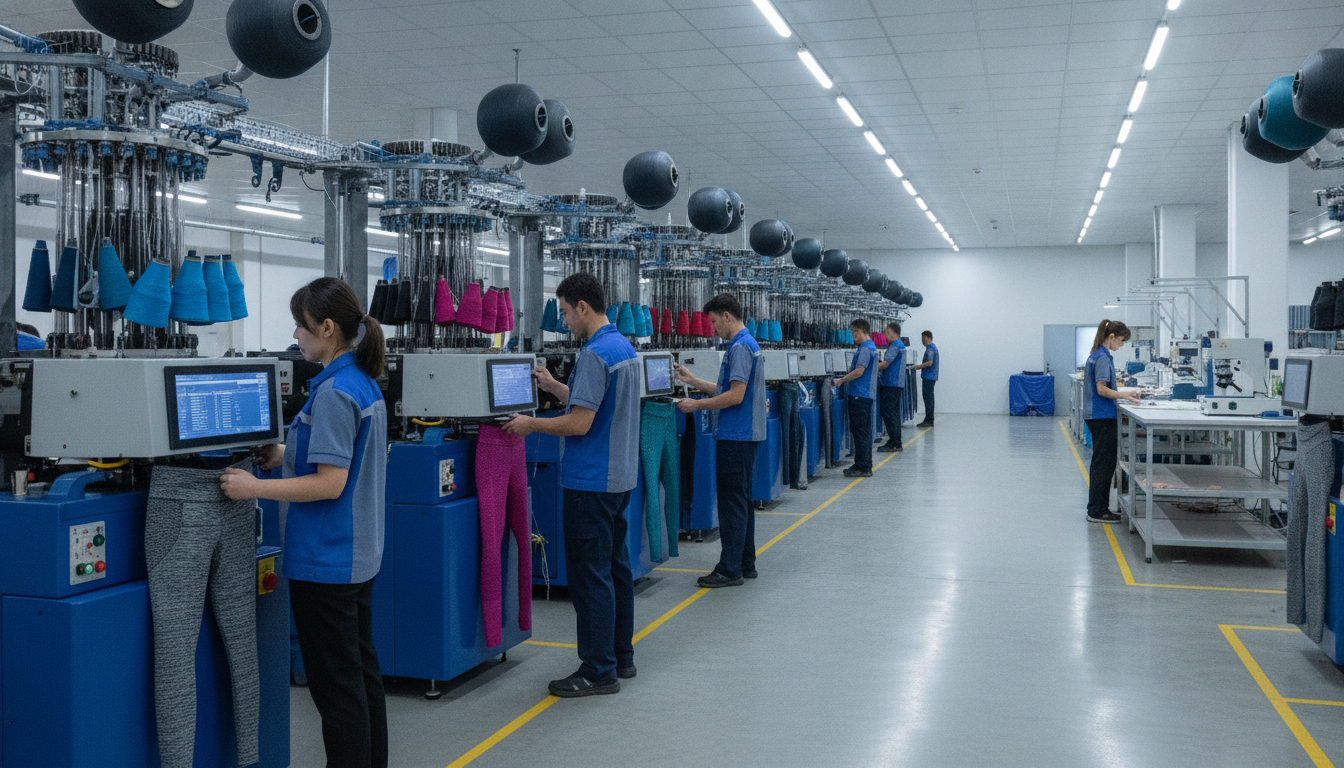
China remains the best country for manufacturing seamless activewear when your priority is machine capacity, fabric mill integration, and the ability to scale from sampling to bulk orders without switching suppliers. The concentration of circular seamless knitting equipment in Zhejiang and Guangdong provinces creates a supply chain where yarn suppliers, dye houses, and finishing specialists operate within 50 kilometers of cut-and-sew facilities.
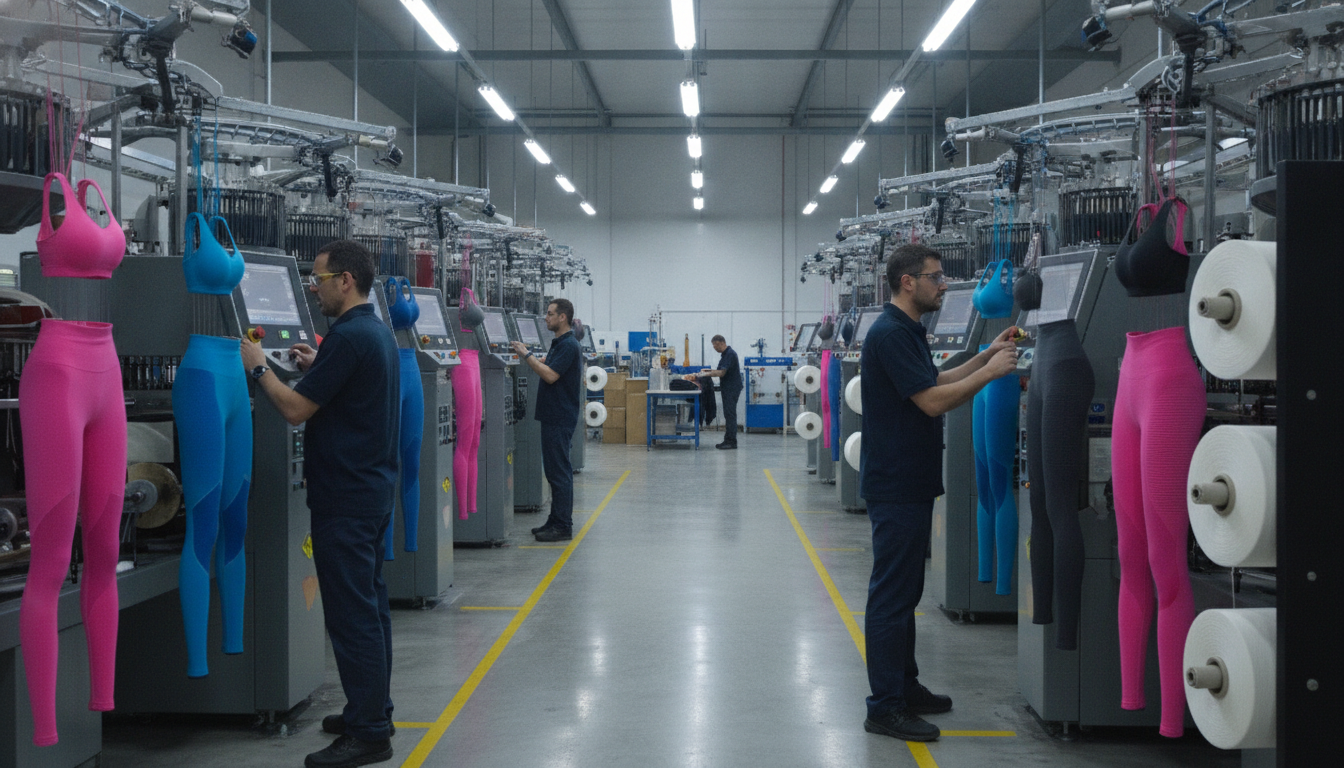
Yiwu, Ningbo, and Shaoxing form a seamless activewear manufacturing triangle where custom yoga apparel manufacturers operate vertically integrated facilities with in-house pattern studios, seamless knitting lines, and quality control labs. Walundi’s 18,000m² facility in Yiwu runs Santoni circular knitting machines for seamless leggings, sports bras, and yoga tops, with a 200+ workforce trained in compression-zone programming and stretch-recovery testing. Production capacity reaches 2.4 million pieces per year, and proximity to Ningbo port cuts freight lead time by 3-5 days compared to inland facilities.
Shenzhen and Dongguan host factories specializing in high-compression seamless activewear with silicone grip bands, mesh ventilation zones, and gradient compression mapping. These facilities typically serve performance-led activewear brands with higher MOQs (500-1,000 pieces per style) and longer sampling cycles (14-21 days). Fabric mills in Guangdong offer nylon-spandex blends with moisture-wicking finishes and anti-microbial treatments, but smaller brands report difficulty securing sampling slots during peak production months (March-May, August-October).
FOB pricing for seamless yoga leggings in China ranges from 6 USD for basic single-color styles to 9 USD for multi-zone compression designs with custom jacquard patterns. Standard bulk MOQ sits at 300-500 pieces per color per style, but low MOQ yoga manufacturers like Walundi support 30-piece minimums to help DTC founders validate designs before committing capital to large inventory runs. Sample costs average 25-40 USD per piece with a 7-10 day turnaround when the factory controls its own seamless knitting lines.
In practice: A UK yoga brand founder validated three seamless sports bra designs with 1-piece samples from Walundi, tested them with 50 studio members over 4 weeks, then placed a 30-unit-per-SKU first order to launch her DTC site without locking up 15,000 USD in untested inventory
Vietnam positions itself as a quality-first alternative for technical activewear, with factories in Ho Chi Minh City and Hanoi investing in Santoni and Lonati seamless equipment to serve European and North American performance brands. The country benefits from free-trade agreements with the EU (EVFTA) and preferential duty rates under USMCA for certain yarn-forward products, making it attractive for brands importing into the US or EU markets.
Vietnamese seamless activewear factories typically run 20-50 circular knitting machines per facility, compared to 80-150 machines in larger Chinese operations. This smaller scale creates flexibility for custom development and closer communication during sampling, but limits production capacity for brands scaling past 10,000 units per month. Factories in Vietnam often specialize in specific product categories (seamless leggings, seamless sports bras, or seamless tops) rather than offering full-range capabilities, which can complicate sourcing for brands building complete activewear collections.
Minimum order quantities in Vietnam start at 500-800 pieces per style for seamless products, with sample MOQs of 5-10 pieces and sampling costs of 35-50 USD per unit. Lead times run 50-70 days for bulk production and 10-14 days for sampling, slightly longer than China due to smaller factory scale and higher workload concentration during peak months. Brands report that Vietnamese factories excel at technical spec execution and communication clarity, but the higher MOQ threshold makes them less suitable for early-stage product validation.
FOB pricing for seamless activewear in Vietnam ranges from 8-11 USD per piece, 15-25% higher than comparable Chinese production. Freight costs from Ho Chi Minh City to US West Coast ports run 0.80-1.20 USD per kilogram by ocean, and EVFTA duty-free access to the EU can offset the FOB premium for brands selling primarily into European markets. Total landed cost (FOB + freight + duty + compliance) for a seamless legging typically sits 1.50-2.50 USD higher from Vietnam than from China when importing into the US.
Portugal serves European activewear brands prioritizing speed to market, lower minimums, and easier factory communication over absolute cost efficiency. Factories in Porto and Braga run Italian and German seamless knitting equipment with skilled operators trained in luxury sportswear construction, making Portugal the best country for manufacturing seamless activewear when your brand targets premium positioning and European retail distribution.
Portuguese seamless factories accept MOQs as low as 100-200 pieces per style, with sampling minimums of 2-5 pieces and 5-7 day sampling turnarounds. This flexibility supports boutique yoga studios building private label yoga clothing lines and DTC founders testing multiple colorways before committing to bulk orders. Production lead times run 30-45 days, roughly half the timeline from Asia, and proximity to major European markets enables truck delivery within 3-5 days of production completion.
Seamless activewear from Portugal typically features superior fabric hand-feel, tighter compression-zone tolerances, and more consistent sizing across production runs compared to mass-market Asian production. Factories invest in Santoni Mecmor and Merz seamless machines with advanced jacquard capabilities, enabling intricate pattern work and gradient compression designs. Labor costs in Portugal run 4-6 times higher than China, which translates directly into FOB pricing but also reduces defect rates and rework cycles.
FOB pricing for seamless leggings in Portugal ranges from 12-18 USD per piece for basic designs and 20-28 USD for technical styles with multi-zone compression and custom jacquard. Freight costs within Europe run 0.30-0.60 USD per kilogram by truck, significantly lower than ocean freight from Asia, and zero-duty intra-EU trade eliminates customs delays. Total landed cost for a Portuguese seamless legging into Germany or France typically runs 14-20 USD, compared to 9-13 USD from China including 12% EU duty on activewear imports.
Bangladesh focuses on high-volume basic activewear rather than specialized seamless construction. The country’s strength lies in cut-and-sew knit leggings and jersey-fabric sports bras, not circular seamless knitting, which requires different equipment and operator training than Bangladesh’s dominant woven and basic knit infrastructure.
Fewer than 15 factories in Bangladesh operate true circular seamless knitting machines, and most of these facilities serve large international brands with MOQs above 5,000 pieces per style. The seamless capacity that exists concentrates on basic single-color designs without compression zones or technical performance features. Brands seeking seamless activewear with moisture-wicking, anti-microbial treatments, or gradient compression typically find Bangladesh factories unable to execute these specifications consistently.
For traditional cut-and-sew activewear (leggings made from tubular knit fabric with side seams), Bangladesh offers FOB pricing 20-30% below China at 4-6 USD per piece. However, this cost advantage disappears for seamless products due to limited machine capacity and reliance on imported technical yarns. Lead times run 60-90 days for bulk orders and 14-21 days for sampling, longer than China or Vietnam, and freight costs from Chittagong port to US or EU destinations add 1.20-1.80 USD per kilogram.
Bangladesh works well for activewear brands focused on volume basics (10,000+ units per style), cost-led positioning, and traditional construction methods. The country’s duty-free access to EU markets under Everything But Arms (EBA) preferences and GSP benefits for US imports can create landed-cost advantages for simple designs, but these benefits do not extend to the specialized seamless segment where machine capacity and technical expertise drive sourcing decisions.
Selecting the best country for manufacturing seamless activewear requires matching your brand stage, order volume, and technical requirements to each country’s strengths. The framework below maps sourcing strategy to business reality rather than generic advice.
DTC founders validating product-market fit (0-500K USD revenue) need sample MOQs of 1-5 pieces and bulk minimums under 100 units per style to test designs without tying up 10,000-20,000 USD in untested inventory. China offers the widest range of low-MOQ options through vertically integrated facilities like Walundi (1-piece sample MOQ, 30-piece bulk MOQ), while Vietnam and Portugal require 5-10 piece sampling minimums and 100-500 piece bulk orders. Bangladesh’s 5,000+ piece minimums eliminate it from consideration at this stage.
Seamless activewear with multi-zone compression, gradient knit patterns, silicone grip bands, or mesh ventilation panels requires factories with advanced circular knitting machines and experienced pattern programmers. China’s Zhejiang and Guangdong provinces hold the deepest bench of seamless technical expertise, with operators trained to program Santoni machines for complex jacquard designs and compression mapping. Vietnam offers solid technical execution for standard seamless designs but less depth for custom development. Portugal excels at luxury-level finishing and intricate patterns but at 2-3 times the FOB cost of Asian production.
Brands launching seasonal collections or responding quickly to trend shifts benefit from shorter production cycles and faster sampling. Portugal delivers 30-45 day production and 5-7 day sampling, half the timeline from Asia, making it ideal for European brands prioritizing speed over cost. China offers 45-60 day production with 7-10 day sampling when working with vertically integrated facilities that control their own seamless lines. Vietnam’s 50-70 day production and 10-14 day sampling sits between China and Portugal, while Bangladesh’s 60-90 day timeline makes it unsuitable for fast-turn programs.
Brands building around sustainable yoga clothing need factories with current GRS, OEKO-TEX, and BSCI certifications issued to the manufacturing facility itself, not a parent company or trading office. Buyers report that some suppliers advertise sustainability loosely, but verification requires requesting certificate copies with the factory’s legal name and address matching the production location. Walundi holds GRS, OEKO-TEX Standard 100, and BSCI certifications issued to our Yiwu facility, with certificate numbers available for buyer verification before sampling begins.
Understanding total landed cost requires adding freight, duty, and compliance expenses to FOB pricing. The table below shows realistic unit economics for a seamless yoga legging imported into the US market, based on 500-piece order quantities and standard shipping methods.
These unit economics shift significantly based on order volume, shipping method, and destination country. European brands importing into the EU face 12% duty on activewear from China and Vietnam but zero duty from Portugal, which narrows the landed-cost gap. Air freight from Asia adds 3-5 USD per piece but cuts lead time to 10-14 days, useful for rush re-orders or seasonal launches.
Buyers consistently report needing to verify whether a factory actually owns seamless knitting machines and controls production, rather than relying on website claims or broker introductions. The checklist below addresses the most common verification gaps that lead to quality issues, rework, and missed delivery dates.
Request a factory video showing seamless knitting machines in operation with your contact’s company signage visible in the background. Legitimate seamless factories can provide this within 24-48 hours. Ask for machine brand names (Santoni, Lonati, Merz), model numbers, and total machine count. Cross-reference the machine count against the factory’s stated monthly capacity (one Santoni machine typically produces 800-1,200 seamless pieces per month depending on complexity). Trading companies and brokers cannot provide real-time production video because they do not own equipment.
Request PDF copies of GRS, OEKO-TEX, and BSCI certificates with the factory’s legal name and production address matching the facility you plan to visit or audit. Check that certificate expiration dates are current (GRS renews annually, OEKO-TEX every 12 months, BSCI every 2 years). Verify the certificate holder name matches the company issuing your proforma invoice. Some suppliers display certificates issued to a parent company or different facility, which does not transfer compliance to your production location.
Physical samples remain necessary because fabric feel, stretch recovery, and stitching quality cannot be judged from photos alone. Request samples in your target fabric weight (220-280 GSM for yoga leggings) and test for stretch recovery by pulling the waistband to 150% width, holding for 30 seconds, then releasing. The fabric should return to within 5% of original width within 60 seconds. Check that compression zones (waistband, thigh panels, calf areas) maintain consistent pressure across the garment and do not create visible lines or bulges when worn.
Send a detailed tech pack for one style (measurements, fabric specs, colorways, trim details) and evaluate response time, clarifying questions, and accuracy of the returned quote. Factories experienced in seamless activewear will ask about compression-zone placement, stretch-recovery requirements, and size-grading rules. Generic responses or failure to address technical specs signal limited seamless expertise. Time-zone differences between Asia and North America or Europe add communication lag, but experienced factories structure their teams to provide responses within 12-24 hours.
Ask how the factory handles in-process quality checks during seamless knitting, cutting, and assembly. Vertically integrated facilities like Walundi run in-house QC at three stages: post-knitting (fabric weight, stretch, color match), post-cutting (pattern accuracy, size grading), and pre-packing (final inspection for stitching defects, compression-zone alignment, labeling accuracy). Factories that outsource knitting or finishing have less control over quality and longer lead times due to coordination between multiple vendors.
In practice: A German activewear startup requested production video from three Chinese factories claiming seamless capability; only one could provide same-day footage of Santoni machines running, and that factory became their long-term partner after successful 30-piece test order
China remains the best country for manufacturing seamless activewear due to the deepest installed base of circular knitting machines, vertically integrated supply chains in Zhejiang and Guangdong provinces, and the widest range of MOQ options from 30-piece minimums to 10,000+ unit production runs. Vietnam offers quality-focused alternatives for established brands, while Portugal serves European brands prioritizing speed and small-batch flexibility.
China offers greater seamless knitting capacity, lower MOQs (30-500 pieces vs 500-800 pieces), faster sampling (7-10 days vs 10-14 days), and lower FOB pricing (6-9 USD vs 8-11 USD per piece) compared to Vietnam. Vietnam provides advantages in communication clarity, technical spec execution for standard designs, and preferential duty access to EU markets under EVFTA, making it suitable for established brands with higher order volumes.
China serves most private label activewear brands through low-MOQ manufacturers offering 30-piece minimums, 1-piece sample MOQs, and vertically integrated facilities that handle pattern development, seamless knitting, cut-and-sew, and labeling under one roof. Portugal works well for European private-label programs requiring 100-200 piece minimums and 30-45 day lead times, while Vietnam suits brands with 500+ piece orders and established design specs.
Standard seamless activewear MOQs range from 300-500 pieces per style in China, 500-800 pieces in Vietnam, and 100-200 pieces in Portugal. Vertically integrated Chinese manufacturers like Walundi offer 30-piece bulk MOQs and 1-piece sample MOQs to support DTC founders validating product-market fit. Bangladesh requires 5,000+ pieces for the limited seamless capacity available in that market.
Request production video showing seamless knitting machines operating with factory signage visible, verify that GRS and OEKO-TEX certificates list the exact factory entity and address, order physical samples to test stretch recovery and compression consistency, evaluate tech-pack responses for seamless-specific questions about compression zones and size grading, and confirm the factory runs in-house QC rather than outsourcing knitting or finishing to subcontractors.
Written by the Walundi Export Team.
Ready to validate your seamless activewear designs without locking up capital in untested inventory?
Request 1-piece samples from our Yiwu facility →
Sample 1 piece · bulk from 30 · OEKO-TEX & GRS certified · reply in 24h. No gatekeeping.
Low MOQ. Sustainable fabrics. OEM ready. Tell us your vision.
Click the button below to open WhatsApp. If you're not logged in to WhatsApp Web yet, scan the QR code first — then come back here and copy the message into the chat.