
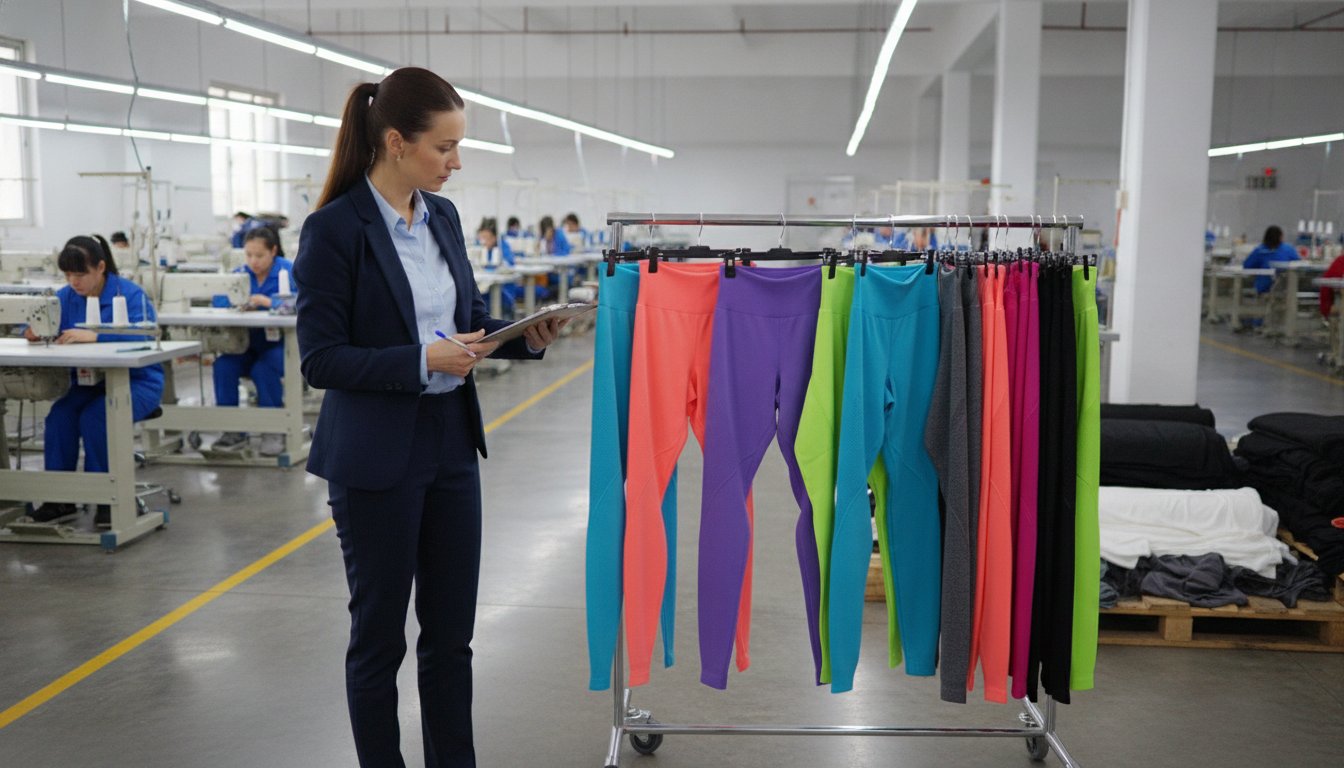
An activewear factory audit checklist before ordering should verify business legitimacy, quality-control systems, certifications, production capacity, MOQ terms, and sample consistency. Request business licenses, scope certificates for GRS and OEKO-TEX, in-process inspection records, and written MOQ and payment terms before placing a deposit. A thorough pre-order audit catches material substitutions, capacity mismatches, and documentation gaps that surface only after payment.
📋 Table of Contents
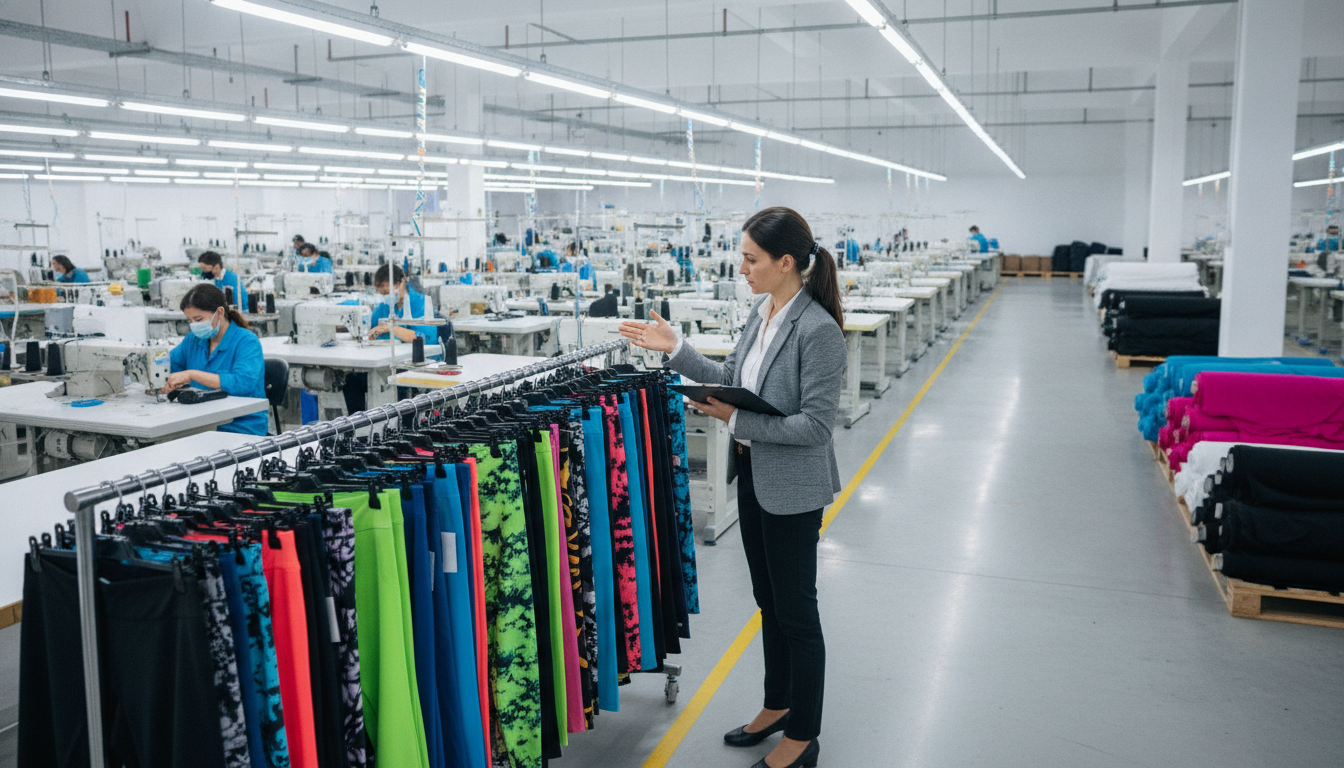
Verifying business legitimacy prevents orders from disappearing with your deposit or arriving with substandard goods from an unlicensed subcontractor. Request three core documents: a valid business license showing the factory’s legal registration, an export license confirming authority to ship internationally, and a customs registration number that proves the entity can clear goods through port. Cross-check the factory name, address, and legal representative across all three documents. Mismatches signal a middleman or shell company.
The business license should display the factory’s full legal name, registered address, scope of business (garment manufacturing), and an issue date within the past five years. In China, this document is called a 营业执照 (yíngyè zhízhào). Verify the registered address matches the production facility you plan to visit or audit remotely. Founders often discover the registered office is a serviced address in a different province, with actual production outsourced to an unlicensed workshop. Ask for a photo of the license displayed at the factory entrance and compare the legal name to the entity on your proforma invoice.
An export license confirms the factory has government approval to ship apparel internationally. In China, this is the 对外贸易经营者备案登记表 (duìwài màoyì jīngyíngzhě bèi’àn dēngjì biǎo). The customs registration number, issued by the General Administration of Customs, allows the factory to declare shipments and clear export formalities. Without it, your order ships through a third-party trading company, adding a margin and reducing your if quality issues arise. Request both documents as PDFs with visible stamps and issue dates. Verify the customs code on your proforma invoice matches the registered entity.
A live video tour confirms the factory exists and matches the scale claimed in sales materials. Request a walkthrough of the cutting floor, sewing lines, QC station, and fabric warehouse during working hours. Count the number of active sewing machines and compare it to the stated capacity. A factory claiming 200 machines should show at least 150 running during peak season. Ask the tour guide to show the business license displayed on-site and the fabric rolls labeled with your order code if sampling is already underway. Founders report discovering that polished sample photos came from a showroom, while actual production happened in a cramped subcontractor facility with no QC station.
In practice: A UK activewear founder requested a video tour after receiving impressive sample leggings, discovering the factory had only 30 machines and no fabric warehouse, signaling they were a middleman sourcing from uncertified workshops
Certifications prove a factory meets third-party standards for chemical safety, recycled content, and labor practices. The three most relevant for activewear are OEKO-TEX Standard 100 for fabric chemical safety, GRS (Global Recycled Standard) for recycled-content claims, and BSCI (Business Social Compliance Initiative) for labor and workplace safety. Each certificate has a scope, expiry date, and issuing body. Verify the scope covers the exact facility, fabric supplier, and product category you plan to order. A certificate issued to the parent company or a different factory location does not cover your order.
OEKO-TEX Standard 100 tests finished fabrics and trims against restricted substances including azo dyes, formaldehyde, heavy metals, and phthalates. The certificate lists the tested article (e.g., polyester-spandex knit fabric), the product class (Class II for skin-contact activewear), and the issuing institute. Request the certificate PDF and verify the fabric description matches your tech pack. The certificate expires after 12 months, so check the issue date. Factories sometimes display an expired certificate or a certificate covering only one fabric type while claiming it applies to all materials. OEKO-TEX maintains a public database at oeko-tex.com where you can verify the certificate number and scope.
GRS governs recycled-content claims and chain-of-custody traceability from raw material to finished garment. The certificate lists the facility address, the scope of certification (e.g., cut-and-sew of knitted garments), and the percentage of recycled content the factory is authorized to claim. A GRS certificate does not automatically mean your fabric contains recycled polyester. It means the factory has systems to track and document recycled content when the fabric supplier provides GRS-certified material. Request the fabric supplier’s GRS transaction certificate (TC) for the specific polyester or nylon you plan to use. Without a valid TC, the factory cannot legally label your product as recycled content, even if they hold a GRS facility certificate.
BSCI audits cover working hours, wages, health and safety, and freedom of association. The audit report includes a performance rating (Good, Acceptable, or To Be Improved) and a list of corrective actions. Request the most recent BSCI audit report and check the issue date. Reports older than 24 months suggest the factory has not maintained compliance. US and EU buyers face increasing due-diligence requirements under forced-labor regulations, so a current BSCI or equivalent audit (WRAP, SMETA, SA8000) is no longer optional for brands selling into those markets. Verify the audit covers the exact facility where your order will be sewn, not a sister factory or the parent company’s headquarters.
Quality systems determine whether your bulk order matches the approved sample. Founders often receive flawless samples, then discover the bulk order has inconsistent stitching, off-spec sizing, or fabric that pills after one wash. A factory with repeatable QC documents every inspection checkpoint, tracks defect rates, and maintains calibrated testing equipment. Request in-process inspection records, defect logs, and pre-shipment audit results from recent orders to confirm the factory runs structured QC, not ad-hoc spot checks.
In-process inspections catch defects during production, when corrections cost less than reworking finished garments. The factory should inspect fabric upon arrival (shade matching, width, weight), after cutting (piece count, pattern accuracy), during sewing (stitch density, seam alignment), and before packing (measurements, labeling, folding). Request inspection checklists from three recent orders and verify each checkpoint has recorded measurements, pass/fail criteria, and inspector initials. A factory that cannot produce these records either skips in-process QC or conducts it informally, leaving you exposed to batch-to-batch variation. Ask how the factory handles a failed inspection. The answer should describe a documented corrective-action process, not a verbal instruction to the line supervisor.
A mature QC system tracks defect rates by type (stitching, fabric flaw, sizing error) and by production line. Request a defect log from the past three months and calculate the defect rate per 100 pieces. Rates above 5 percent signal process-control problems. More important than the rate is whether the factory investigates root causes. Ask for an example of a recurring defect and how the factory resolved it. The response should reference a specific corrective action (e.g., retrained the overlock operator, adjusted the needle size, changed the fabric pre-treatment), not a generic statement about improving quality. Founders report that factories with no defect-tracking system blame fabric suppliers or shipping damage when bulk orders fail QC, rather than owning process gaps.
Activewear performance depends on measurable fabric properties: stretch recovery, pilling resistance, colorfastness, and moisture wicking. The factory should own or have access to testing equipment including a tensile tester for stretch, a Martindale abrasion tester for pilling, a launder-o-meter for wash fastness, and a moisture-management tester for wicking. Request calibration certificates for each instrument, issued within the past 12 months by an accredited lab. Uncalibrated equipment produces unreliable data, so a factory claiming to test fabrics in-house but unable to show calibration records is running subjective assessments, not quantitative QC. Ask whether the factory sends fabrics to a third-party lab for pre-production testing. The answer should name the lab (e.g., SGS, Intertek, Bureau Veritas) and specify which tests are standard for activewear orders.
Yoga leggings must remain opaque during deep squats and recover their shape after repeated stretching. The factory should test opacity by holding the fabric over a contrasting background under standardized lighting and measuring light transmission. Stretch recovery is tested by extending the fabric to 50 percent elongation, holding for one minute, then releasing and measuring residual deformation after five minutes. Recovery below 90 percent signals the fabric will bag out after a few wears. Request test results for the exact fabric weight and blend you plan to use. A factory that has never tested squat-proof opacity or stretch recovery for yoga apparel lacks category-specific QC expertise, increasing the risk that your first bulk order fails on-body performance even if it passes visual inspection.
In practice: A DTC yoga brand founder approved samples with excellent stretch, then discovered the bulk order used a different spandex percentage, causing the leggings to lose compression after three washes because the factory had no material-substitution approval gate
Production readiness confirms the factory has the capacity, lead time, and supply-chain control to deliver your order on schedule without quality compromises. Capacity mismatches cause delays when the factory overbooks lines or subcontracts your order to an uncertified workshop. Supply-chain control prevents undisclosed material substitutions when the approved fabric goes out of stock. Your activewear factory audit checklist before ordering should verify current capacity utilization, lead-time assumptions, fabric-sourcing practices, and subcontracting policies before you place a deposit.
Ask the factory to state their current capacity utilization as a percentage and show the production schedule for the next 60 days. A factory running above 90 percent capacity will struggle to accommodate rush orders or design revisions. Request a commitment that your order will be sewn on a dedicated line, not split across multiple lines or mixed with other brands’ orders. Mixed-line production increases the risk of style confusion, mislabeling, and cross-contamination of trims. Verify the factory has enough sewing machines of the correct type for your garment category. Seamless knit activewear requires circular knitting machines and linking machines, not flatlock machines used for cut-and-sew. A factory claiming to produce both seamless and cut-and-sew styles should show separate equipment for each category.
Request a lead-time breakdown showing days allocated to fabric procurement, cutting, sewing, QC, and packing. Total lead time for a first order typically ranges from 45 to 60 days after sample approval, depending on fabric availability and order quantity. Factories that quote 30-day lead times either hold fabric in stock (ask which colors and weights) or plan to rush production, increasing defect risk. Verify the lead time includes pre-shipment inspection and allows three days for rework if the inspection fails. Ask what happens if fabric delivery delays by two weeks. The answer should describe a communication protocol and a revised timeline, not a vague assurance that delays never happen.
Undisclosed fabric substitutions are a common complaint among activewear buyers. The factory receives your approved fabric swatch, sources a visually similar alternative at lower cost, and ships the bulk order without informing you. Prevent this by requesting the factory’s fabric supplier list and verifying each supplier holds relevant certifications (GRS for recycled content, OEKO-TEX for chemical safety). Establish a written approval gate: the factory must submit a fabric swatch, lab dip, and test report for your sign-off before cutting. Include a clause in your purchase order that any material change without written approval constitutes a breach, entitling you to reject the order or demand rework at the factory’s cost. Ask whether the factory stocks your chosen fabric or orders it per production run. Stocked fabric shortens lead time but limits color and weight options.
Some factories subcontract overflow orders to partner workshops, especially during peak season. Ask the factory to state their subcontracting policy in writing. If subcontracting is permitted, request the names and addresses of approved subcontractors, plus copies of their business licenses and audit reports. Your purchase order should include a no-subcontracting clause unless you have pre-approved the subcontractor and verified it holds the same certifications as the primary factory. Founders discover subcontracting when the bulk order arrives with different stitching, labeling, or packaging than the sample, because the subcontractor used different equipment or followed different work instructions.
Minimum order quantities, payment terms, and revision policies determine whether the factory fits your brand stage and cash-flow constraints. Early-stage founders need low MOQs to validate product-market fit without locking up capital in unsold inventory. Established brands prioritize stable pricing and flexible reorder terms. Your activewear factory audit checklist before ordering should document sample MOQ, bulk MOQ per SKU, deposit percentage, payment schedule, revision costs, and reorder lead time in writing before you commit to a supplier relationship.
Sample MOQ is the minimum number of pieces the factory will produce for fit and quality approval before bulk production. High sample MOQs (10+ pieces per style) force founders to commit significant capital before validating demand. At Walundi, sample MOQ is 1 piece, allowing founders to test multiple styles and colorways without inventory risk. Ask whether sample costs are deducted from the bulk order or treated as a separate fee. Factories that charge non-refundable sample fees (common at $50 to $150 per piece) add to your validation cost. Request a written quote showing sample cost per piece, sampling lead time (typically 7 to 10 days), and any setup charges for custom prints or embroidery. Verify whether the sample price includes shipping or whether you pay freight separately.
Bulk MOQ per SKU is the minimum quantity the factory requires for each style-color-size combination in a production run. Traditional activewear factories set MOQs at 300 to 500 pieces per SKU, forcing founders to order 1,500+ pieces for a five-color capsule. This locks up $8,000 to $15,000 in inventory before the first sale. Low-MOQ manufacturers like Walundi offer bulk MOQs starting at 30 pieces per SKU, enabling founders to launch with 150 to 300 total units and reorder based on actual demand. Ask whether the factory allows mixed SKUs in a single production run or requires separate runs per style. Mixed-SKU flexibility reduces your total order size and lets you test multiple styles in one shipment.
Standard payment terms for new buyers are 30 percent deposit upon order confirmation, 70 percent balance before shipment. Some factories require 50 percent upfront, increasing your cash exposure if the order fails QC. Ask whether the factory accepts payment by letter of credit (LC), which protects both parties by releasing funds only when shipping documents are presented. LC terms add bank fees (typically 1 to 2 percent of order value) but reduce payment risk for first orders. Request a written payment schedule showing deposit amount, balance due date, and accepted payment methods (wire transfer, PayPal, Alibaba Trade Assurance). Verify whether the deposit is refundable if the factory cannot meet the agreed lead time or if the pre-production sample fails approval. Non-refundable deposits are common, so negotiate a refund clause or escrow arrangement for your first order.
Design revisions during sampling are normal, but factories handle revision costs differently. Ask how many free revision rounds are included in the sample price. Some factories allow one free revision, then charge $30 to $80 per additional revision. Others charge per change (e.g., $15 to adjust a waistband height, $25 to change a strap width). Request a revision cost schedule in writing so you can budget for fit adjustments. For bulk orders, clarify who pays for rework if the order fails pre-shipment inspection due to factory error (stitching defects, wrong measurements, fabric flaws). The purchase order should state that factory-caused defects are reworked at no cost to you, while buyer-requested changes (e.g., switching to a different trim after cutting) are charged at an agreed hourly rate.
Ask the factory to state reorder lead time and whether pricing remains stable for repeat orders. Reorder lead time is typically 20 to 30 percent shorter than first-order lead time because the factory already has your patterns, work instructions, and approved trims on file. Verify whether the factory holds your patterns and trims in storage or whether you must re-submit them for each order. Pattern storage simplifies reorders but ties you to the factory, so negotiate a clause allowing you to retrieve your patterns if you switch suppliers. Pricing stability matters for brands planning seasonal collections. Ask whether the factory locks pricing for 90 or 180 days, or whether prices fluctuate with fabric costs. Some factories offer tiered pricing (e.g., 10 percent discount at 500 pieces, 15 percent at 1,000 pieces), so request a pricing matrix showing unit cost at multiple order quantities.
Sample MOQ: 1 piece. Bulk MOQ: 30 pieces per SKU. Sampling time: 7-10 days. These terms let founders validate styles without locking up cash in unsold inventory.
In practice: A boutique yoga studio founder validated three legging styles with 1-piece samples from Walundi, then placed a 30-unit-per-SKU first order (90 total pieces) without locking up cash in unsold inventory, reordering the best-selling colorway after six weeks
Request the certificate PDF and check the issue date, expiry date, facility address, and scope description. OEKO-TEX certificates expire after 12 months, so verify the issue date is recent. GRS certificates list the facility address and the scope of certification (e.g., cut-and-sew of knitted garments). Cross-check the facility address on the certificate against the address on the business license and your proforma invoice. A certificate issued to a parent company or a different factory location does not cover your order. OEKO-TEX maintains a public verification database at oeko-tex.com where you can enter the certificate number and confirm it is valid. For GRS, request the fabric supplier’s transaction certificate (TC) for the specific recycled polyester or nylon you plan to use, because the factory’s facility certificate alone does not authorize recycled-content claims without a valid TC from the material supplier.
A factory that cannot produce in-process inspection records either skips structured QC or conducts it informally, leaving you exposed to batch-to-batch variation. Request that the factory implement documented checkpoints for your order: fabric inspection upon arrival (shade matching, width, weight), cutting inspection (piece count, pattern accuracy), sewing inspection (stitch density, seam alignment), and pre-packing inspection (measurements, labeling, folding). Provide a simple inspection checklist template with pass/fail criteria for each checkpoint and require the factory to complete it during production, with inspector initials and timestamps. Make pre-shipment inspection by a third-party QC firm (SGS, Intertek, Bureau Veritas) a condition of final payment. The inspection report will reveal whether the factory followed the checkpoints or skipped them. If the factory resists documented QC, treat it as a red flag and consider sourcing from a manufacturer with established quality systems.
Remote audits are feasible using live video tours, document requests, and third-party inspection services. Request a live video walkthrough via Zoom or WhatsApp during working hours, showing the cutting floor, sewing lines, QC station, fabric warehouse, and business license displayed on-site. Ask the guide to show fabric rolls labeled with order codes and count the number of active sewing machines. Request PDFs of the business license, export license, customs registration, and current certification scopes (GRS, OEKO-TEX, BSCI). Cross-check the facility address across all documents. Hire a third-party inspection firm to conduct an on-site audit covering capacity, equipment, certifications, and recent QC records. Inspection firms charge $300 to $800 per audit day and provide a written report with photos. Remote audits miss some nuances (e.g., worker morale, cleanliness of restrooms), but they verify the core facts: the factory exists, holds stated certifications, and operates at the claimed scale.
Ready to audit your next activewear factory with confidence?
Request 1-piece samples and verify our certifications →
Last updated: August 2026
Written by the Walundi Export Team.
Sample 1 piece · bulk from 30 · OEKO-TEX & GRS certified · reply in 24h. No gatekeeping.
Low MOQ. Sustainable fabrics. OEM ready. Tell us your vision.
Click the button below to open WhatsApp. If you're not logged in to WhatsApp Web yet, scan the QR code first — then come back here and copy the message into the chat.