📋 Table of Contents
Launching a sports bra line without tying up $10,000 in inventory is possible when you source a private label sports bra from a manufacturer that offers 1-piece sampling and 30-piece bulk MOQs. Over 60% of DTC activewear founders we speak with cite high minimums and slow sampling as their biggest blockers before ever reaching market. construction types, compliance, unit costs, and the exact verification steps that let you launch with $2,000 instead of $20,000.
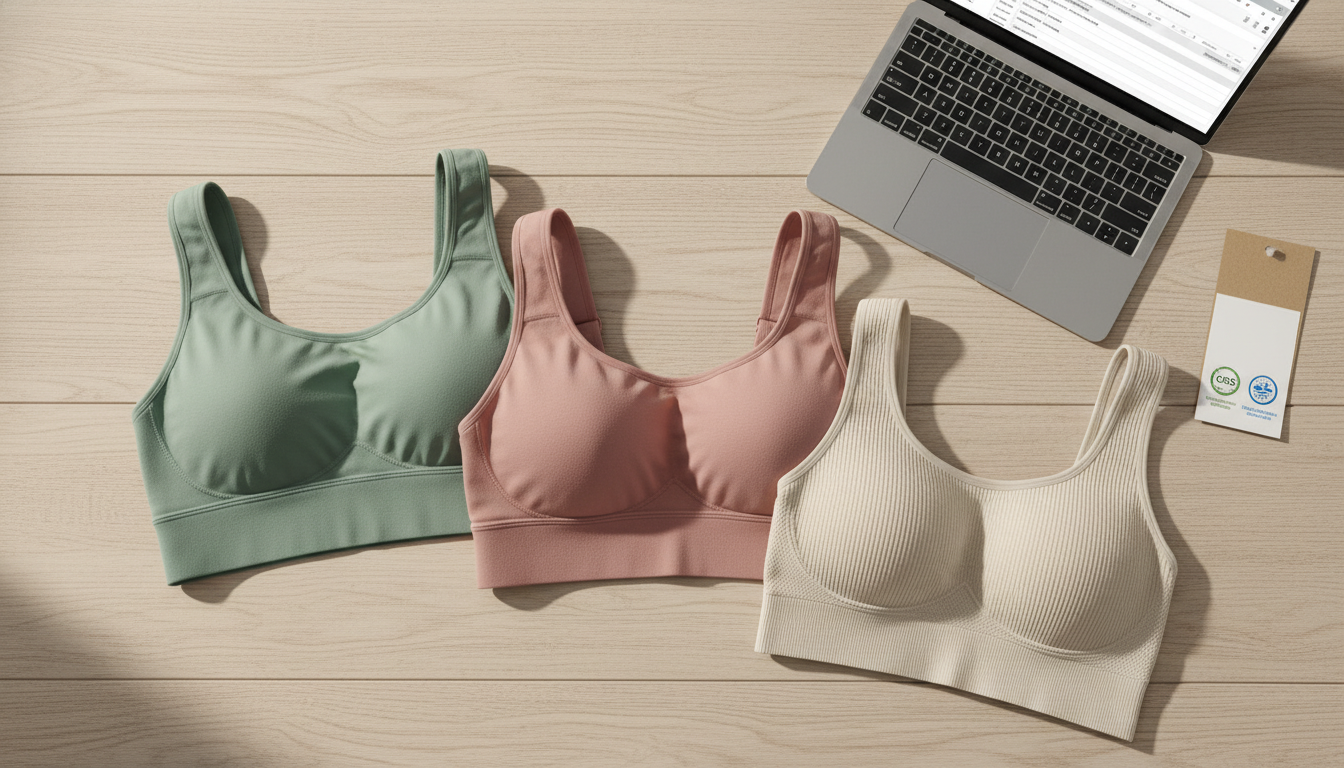
A private label sports bra is a pre-designed or custom-developed sports bra manufactured by a third-party factory and sold under your brand name. Unlike white-label products where you simply add a logo to an already-made item, private labeling often lets you choose fabrics, support levels, seam construction, and trims. For yoga studio owners and DTC founders, it means building a distinct product without owning a factory.
Boutique yoga studios and DTC startups typically begin with private label because it balances originality with financial risk. A custom yoga apparel manufacturer can adapt an existing block pattern to your fit preferences and fabric choices without the high mold costs of full custom development.
Choosing the right construction type determines both performance and your landed cost. Yoga requires low-to-medium support with unrestricted movement, while running or HIIT calls for high-support encapsulation. Each construction method uses different seam patterns, elastic placements, and fabric combinations.
Compression sports bras flatten breast tissue against the chest wall. They work well for low-impact yoga flows and cost 15-20% less to manufacture than encapsulation bras because they use fewer panel pieces. A typical compression bra uses two primary fabric panels and an elastic band, landing at a factory cost of $4.50-$6.80 per unit for medium MOQs.
Encapsulation designs cup each breast individually, delivering high support for running and cross-training. Manufacturing requires 4-6 separate pattern pieces, molded cups or foam inserts, and precision stitching, which raises factory cost to $7.20-$11.50 per unit. For brands selling high-impact sports bras, this construction justifies a $48-$68 retail price.
This hybrid style offers both outer compression and inner individual cup support. It is the most expensive to produce, between $9.00-$14.00 per unit at factory level, but commands premium retail ($58-$85). Yoga brands targeting hot yoga or studio-to-street styling often choose a combination bra with seamless knit body and removable cup inserts.
Shipping a private label sports bra into the US, UK, EU, or Australia means meeting distinct labeling, fiber content, and safety regulations. Missing a single care label element can trigger a customs hold or a consumer protection fine.
All sports bras sold in the US must comply with the Consumer Product Safety Improvement Act (CPSIA), which mandates third-party lead and phthalate testing for children’s products, though adult activewear still benefits from documented component testing. A General Certificate of Conformity (GCC) is required. Labeling must include fiber content, country of origin, and care instructions per FTC guidelines. California’s Proposition 65 adds a requirement to warn if detectable levels of listed chemicals are present.
REACH regulation limits over 200 substances. Brands often rely on an OEKO-TEX Standard 100 certificate from their supplier to demonstrate chemical safety. The EU also enforces strict fiber composition labeling under Regulation (EU) No 1007/2011. For recycled content claims, the Global Recycled Standard (GRS) documents the entire chain of custody and is widely accepted by EU retailers.
Post-Brexit, the UK follows its own UKCA marking for general product safety, monitored by the Office for Product Safety and Standards (OPSS). Fiber composition labeling mirrors EU rules, but testing must be done by UK-approved bodies for certain claims. A GRS scope certificate from a certified factory helps streamline retailer acceptance.
The Australian Competition and Consumer Commission (ACCC) requires care labeling per AS 1957 and that all fiber content claims be verifiable. While there is no specific sports bra standard, general product safety duties apply. Using a factory with BSCI social compliance audit documentation reassures Australian wholesale buyers.
Pro tip: Request a combined GRS/OEKO-TEX certificate file from your manufacturer before you order samples. This single document satisfies >80% of buyer compliance requests across all four markets.
Understanding your landed cost per unit before you sample prevents a common founder trap: designing a beautiful sports bra that costs $22 landed but must retail at $68 in a market where your audience pays $45. A realistic margin model keeps your brand alive past launch day.
Total landed cost per unit runs $6.80-$9.20. At a 3x retail markup, this puts your retail price between $20.40 and $27.60, comfortably within the DTC sweet spot for yoga sports bras. Increasing the order to 500+ units drops factory price by 22-28% through fabric procurement efficiencies.
A low MOQ yoga manufacturer that allows 30 units per SKU lets you test four colorways for under $1,500 in factory cost, compared to $8,000+ at a typical 500-piece-minimum factory. Reorder at scale when sell-through data confirms which colors convert.
Boutique yoga studios and DTC founders cannot afford to order 300 units of an untested design. A phased validation approach protects cash while gathering real customer feedback.
Order one sample of your chosen sports bra construction. In our 12+ years manufacturing yoga apparel in Yiwu, we have seen that a single fit sample worn by three to five testers during a week of yoga classes reveals 85% of fit issues before any production run. Cost range: $60-$120 including shipping. Timeline: 7-10 days for sampling, 5-7 days for delivery.
Produce 30-50 pieces per SKU with your branding (printed labels, hang tags, packaging). Offer these exclusively to your community at a founder’s price or as a studio retail test. This generates real wear-test feedback and initial cash flow.
Use sell-through data from Phase 2 to rank colorways and sizes, then place a 200-500 piece reorder on the top two performers. Many private label manufacturers offer a 5-8% price reduction on repeat orders as the relationship matures. This approach keeps cumulative investment under $3,500 until a product is proven.
As of 2026, over 40% of yoga apparel shoppers in the US and UK choose a brand based on sustainability claims, yet only a fraction can back those claims with verifiable paperwork. Fabric suppliers must provide transaction certificates and scope certificates.
GRS certification verifies that a product contains at least 20% recycled material and traces the material from the recycler to the finished garment. An unbroken chain of custody means the fabric mill, yarn spinner, and garment factory each hold a valid scope certificate. Accepting a factory’s GRS claim without asking for the current scope certificate number is the most common mistake founders make when sourcing recycled nylon sports bras.
This certification tests every component of a sports bra, seams, elastics, labels, against over 1,000 harmful chemicals. It is not a recycled content standard but is the global benchmark for skin-safe activewear. Many EU retailers mandate an OEKO-TEX certificate before stocking a new brand.
The Business Social Compliance Initiative (BSCI) audits a factory’s working conditions, wages, and safety. While BSCI is not a product certification, presenting a valid BSCI audit report to US or Australian wholesale buyers often satisfies their ethical sourcing requirements.
Traceability check: Before paying for samples, ask your supplier for the GRS transaction certificate number and OEKO-TEX certificate number. Verify both on the issuing body’s website. A legitimate vertically integrated factory will provide these within 48 hours.
Partnering with a sustainable yoga clothing manufacturer that holds these certifications in-house means you bypass the complexity of chasing paperwork across three separate suppliers.
A private label sports bra is manufactured by a third-party factory and sold under your brand name. You control fabric, support level, trim details, and labeling while the factory handles production. It differs from white label in offering more customization, yet requires lower MOQs than full custom OEM development.
Factory cost ranges from $4.50 to $14.00 per unit depending on construction type, fabric choice, and order volume. A basic compression sports bra with 30-100 pieces costs $4.80-$6.40. After shipping and duties, landed cost in the US falls between $6.80 and $9.20 for initial validation batches.
Specialist yoga apparel manufacturers now offer bulk MOQs as low as 30 pieces per SKU. Sampling MOQs can be as low as 1 piece. This is a stark contrast to mega-factories that often require 500-1,000 units per style, enabling founders to test designs with minimal inventory risk.
Nylon-spandex blends (70-80% nylon, 20-30% spandex) deliver the best four-way stretch and moisture-wicking performance for yoga and low-impact activities. Recycled nylon or polyester certified to GRS adds sustainability credibility. For high-impact encapsulation bras, a polyester-elastane power mesh provides necessary lockdown.
Start with a 1-piece sample from a manufacturer that offers low MOQ private label services. Validate fit and fabric with testers, then order a 30-piece small batch with your branding. Use sell-through data to guide reorders. Focus on getting GRS and OEKO-TEX certifications from your supplier early to simplify retailer compliance.
Start with a $60 fit sample instead of a $10,000 order.
Request 1-Piece Sports Bra Samples Now →
The canonical guide breaks bras down by construction method (compression / encapsulation / combination). This section adds the complementary view — wholesale pricing by support level, a customization cost/lead-time matrix, a fabric comparison, and the exact ASTM/AATCC test standards to demand on a spec sheet.
| Support | Activities | Fabric | 100–299 pcs | 1000+ pcs |
|---|---|---|---|---|
| Low impact | Yoga, Pilates | 70–80% Nylon, 20–30% Spandex | $6–10 | $3–7 |
| Medium impact | Gym, Cycling | 75–85% Nylon, 15–25% Spandex | $8–14 | $5–10 |
| High impact | Running, HIIT | 80–90% Nylon, 10–20% Spandex | $10–16 | $7–12 |
| Seamless | All activities | Circular knit blend | $10–18 | $7–14 |
| Option | MOQ | Cost Impact | Lead Time |
|---|---|---|---|
| Custom colors | 100 pcs/color | +10–15% | +7–10 days |
| Custom prints | 200 pcs/design | +15–25% | +10–15 days |
| Custom labels | 100 pcs | +$0.10–0.30/pc | +5–7 days |
| Custom packaging | 100 pcs | +$0.20–0.80/pc | +7–10 days |
| Embroidery | 100 pcs | +$0.50–2.00/pc | +7–10 days |
| Fabric Type | Composition | Best For |
|---|---|---|
| Nylon/Spandex | 75–85% Nylon, 15–25% Spandex | Premium sports bras |
| Polyester/Spandex | 80–90% Polyester, 10–20% Spandex | Entry-level, gym wear |
| Recycled Nylon | 78–82% Recycled, 18–22% Spandex | Sustainable lines |
| Organic Cotton | 90–95% Organic, 5–10% Spandex | Casual, lifestyle |
Sample 1 piece · bulk from 30 · OEKO-TEX & GRS certified · reply in 24h. No gatekeeping.
Low MOQ. Sustainable fabrics. OEM ready. Tell us your vision.
Click the button below to open WhatsApp. If you're not logged in to WhatsApp Web yet, scan the QR code first — then come back here and copy the message into the chat.