
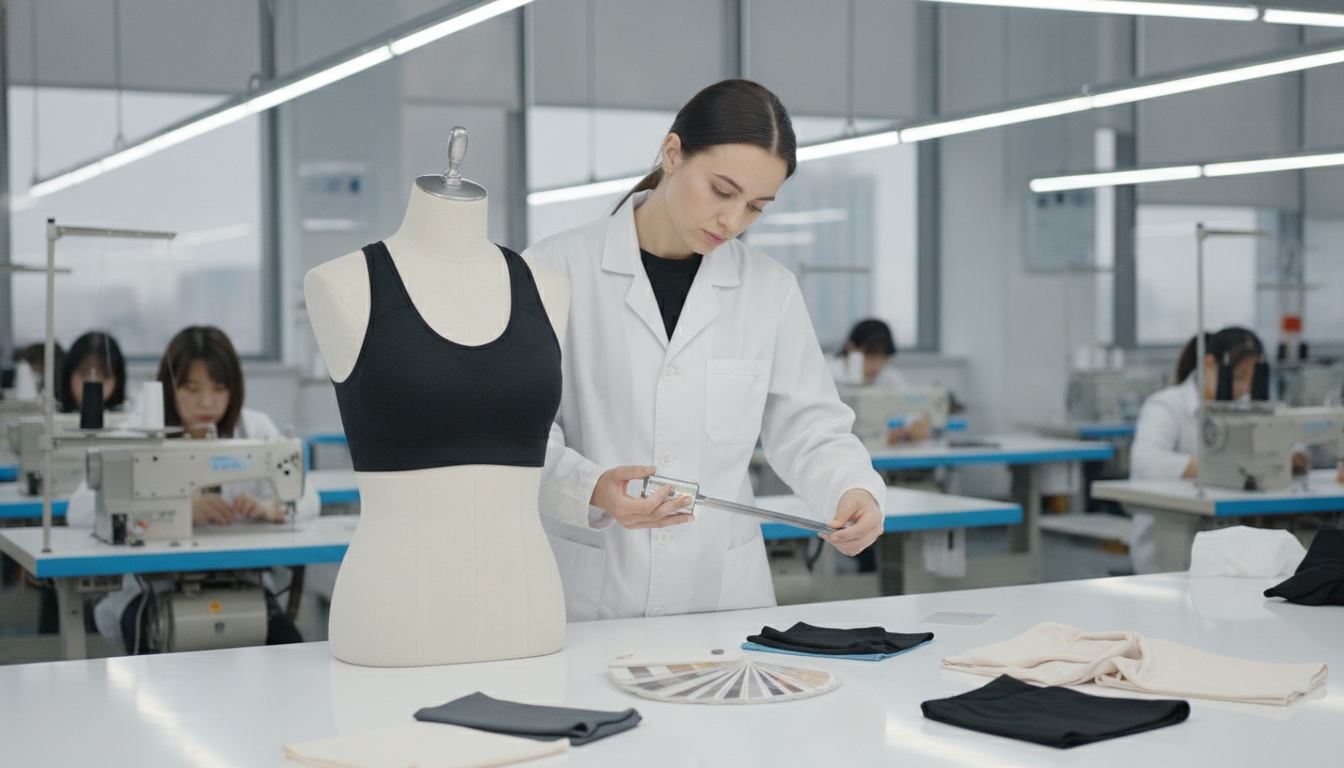
The questions to ask sports bra manufacturer before first order fall into five critical categories: support construction verification, MOQ and pricing transparency, sample approval workflow, quality control tolerances, and material traceability. Start with support-level construction (cup stability, underbust band behavior, bounce reduction) because generic apparel factories often lack the technical expertise to engineer performance bras. Follow with itemized pricing to avoid surprise charges for trims, labeling, or packaging, then lock in sample approval steps and tolerance rules before committing to bulk production.
📋 Table of Contents
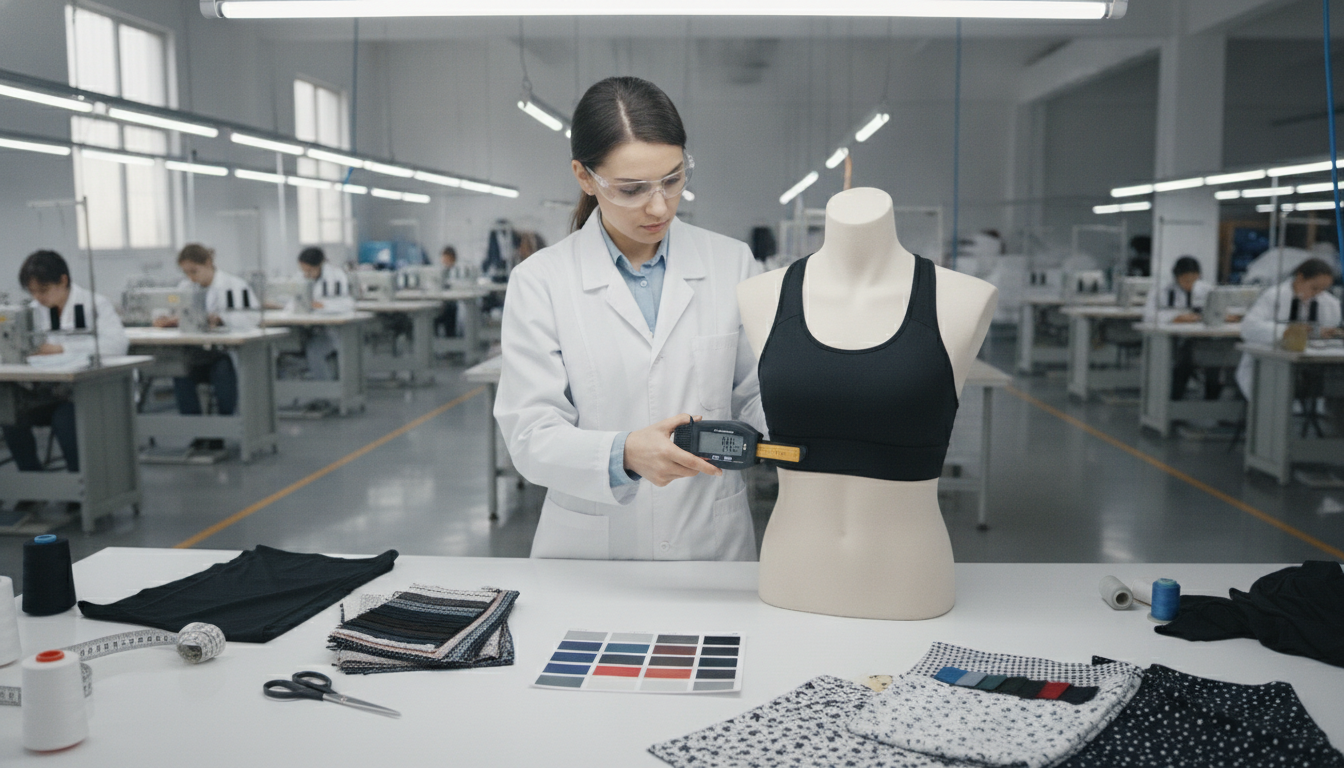
Support construction separates performance sports bras from generic activewear tops. Many apparel factories claim activewear capability but lack the pattern-making expertise to engineer cup stability, underbust band compression, and bounce reduction across different impact levels. Ask the factory to describe their support-level construction methods before you send a tech pack.
Ask whether the factory builds encapsulation bras (individual cups that separate and support each breast) or compression bras (a single layer that presses the chest against the body). Encapsulation requires molded cups or sewn cup panels with internal seams that maintain shape under movement. Compression designs work for low-impact yoga but fail for high-impact activities like running or HIIT.
Request photos of similar bras the factory has produced, focusing on internal cup construction. Look for clean cup seams, reinforced underbust bands, and multi-panel designs that distribute tension. Factories experienced in custom yoga apparel manufacturer work will show you pattern variations for light, medium, and high support levels.
The underbust band carries 80% of a sports bra’s support load. Ask the factory how they calculate band width, elastic modulus, and stitching reinforcement for different support levels. A high-support bra needs a wider band (3-5 cm) with higher-modulus elastic and double-needle stitching to prevent roll-up during wear.
Request elastic specifications: fiber content (nylon/spandex blend ratio), recovery rate after stretch, and whether the elastic is knitted in-house or sourced. Factories that source generic elastic often cannot match the recovery performance of specialized sports bra elastic, leading to band sag after repeated washing.
Ask whether the factory conducts wear testing or bounce reduction testing on samples before bulk production. Performance bra manufacturers test samples on live models during movement (jumping, running, yoga flows) to verify that the design actually reduces bounce and maintains support.
Factories without wear-testing protocols rely on static fit checks, which miss dynamic performance issues. In our 12+ years manufacturing yoga apparel in Yiwu, we’ve seen first-time buyers approve samples that look good on a mannequin but fail during actual wear because the factory skipped movement testing.
MOQ and hidden charges are the most common pain points buyers raise when screening sports bra manufacturers. Factories quote attractive per-piece prices, then add charges for sampling, custom trims, logo work, labeling, and packaging after the buyer has invested time in sample development. Ask for itemized pricing upfront to avoid these surprises.
Separate sample MOQ from bulk MOQ in your initial inquiry. Sample MOQ determines how many pieces you must order to validate fit, fabric, and construction before committing to bulk production. Bulk MOQ sets the minimum per-SKU quantity for your first production order.
Sample MOQ: 1 piece. Bulk MOQ: 30 pieces per SKU. Sampling time: 7-10 days.
High sample MOQs (50-100 pieces) force you to lock up cash before validating product-market fit. Low MOQ yoga manufacturer terms let you test multiple styles, fabrics, and support levels without overcommitting inventory.
Request a line-item breakdown that covers fabric, trims, labor, packaging, labeling, and any customization charges. Ask specifically whether the quoted price includes woven labels, hang tags, polybags, and carton packaging, or whether these are billed separately.
Factories that bundle all costs into a single per-piece price make it easier to compare quotes, but you lose visibility into where your money goes. Itemized quotes let you negotiate specific components or substitute materials to hit your target price.
Ask what deposit the factory requires before starting sample development and before starting bulk production. Standard terms are 30% deposit on order confirmation, 70% balance before shipment, but some factories charge separate sample fees or require full payment upfront for first-time buyers.
Clarify whether sample fees are deducted from the bulk order if you proceed to production. Factories confident in their work often waive sample charges or apply them as a credit toward your first bulk order.
Sample approval workflow determines whether the bulk production matches your approved sample. Buyers commonly approve a sample that looks good, only to receive a bulk shipment with different fabric hand-feel, inconsistent sizing, or weaker seam construction. Ask the factory to map out every approval gate before bulk production starts.
The pre-production sample is the final prototype made with actual bulk fabrics, trims, and construction methods. This sample must match your approved design in every detail: fabric weight, color, stretch recovery, seam strength, cup shape, and underbust band tension.
Request written confirmation that the factory will not start bulk cutting until you sign off on the PPS in writing. Factories that skip this step or accept verbal approval create ambiguity when the bulk run drifts from the sample.
Ask the factory to send fabric swatches and color lab dips before cutting the pre-production sample. Fabric swatches let you verify weight, hand-feel, stretch, and recovery. Color lab dips confirm that the dye lot matches your Pantone reference or approved color standard.
Factories that skip swatch approval often substitute a similar fabric or accept a close-enough color, assuming the buyer will not notice. This substitution shows up when the bulk order arrives and the fabric feels different from the original sample.
Sports bras require precise grading across size ranges because cup volume, underbust circumference, and strap length all scale differently. Ask the factory to produce fit samples in at least three sizes (small, medium, large) so you can verify that the grading maintains support and fit proportions across the range.
Poorly graded bras fit well in one size but fail in others. The underbust band may ride up in larger sizes, or the cups may gap in smaller sizes. Fit samples catch these grading errors before you commit to bulk production.
Ask how many revision rounds are included in the sample price and how long each revision takes. Factories experienced in yoga clothing manufacturer for startups work typically allow 2-3 revision rounds within the quoted sample fee and turn around revisions in 7-10 days.
Factories that charge for every revision or take 3-4 weeks per round slow down your product development and increase your upfront costs. Clarify revision terms before you send your tech pack.
In practice: A US DTC activewear founder ordered 1-piece samples in three support levels (low, medium, high) to validate construction before committing to a 30-piece-per-SKU bulk order, avoiding the cash-flow risk of a 500-piece MOQ with an untested factory
Quality control tolerances define acceptable variation in measurements, fabric weight, color, and construction. Without written tolerances, the factory decides what counts as acceptable, and you have no recourse when the bulk order arrives with inconsistent sizing or fabric quality.
Ask the factory to state their measurement tolerances in writing. Standard apparel tolerances allow ±1 cm variation in body measurements, but sports bras need tighter tolerances (±0.5 cm) because fit directly affects support performance.
Factories that quote loose tolerances (±2 cm) produce inconsistent sizing. Buyers receive bras where size M in one production lot fits like size S in the next lot.
Ask the factory to specify fabric weight tolerance (±5% is standard) and stretch recovery tolerance. Sports bra fabrics need consistent stretch and recovery to maintain support over repeated wear and washing.
Request fabric testing reports that document weight (grams per square meter), stretch percentage (both lengthwise and crosswise), and recovery percentage after stretch. Factories that skip fabric testing accept whatever the mill ships, leading to batch-to-batch variation.
Ask which seams the factory inspects and what strength standard they use. Critical seams (underbust band attachment, cup seams, strap attachment points) should be tested for tensile strength and stitch density.
Factories experienced in performance activewear test seam strength using a tensile tester, pulling seams until failure to verify they exceed the minimum strength requirement. Generic apparel factories rely on visual inspection, which misses weak stitching that fails after a few wears.
Ask the factory to state their acceptable defect rate and what counts as a defect. Industry-standard Acceptable Quality Limit (AQL) for apparel is AQL 2.5, meaning 2.5% of pieces may have minor defects and still pass inspection.
Clarify what happens if the defect rate exceeds the AQL. Does the factory rework defective pieces at their cost, or do they expect you to accept a higher defect rate? Written defect-handling terms protect you from receiving a shipment where 10% of bras have crooked seams or misaligned cups.
Material traceability and certification verify that the fabrics, elastics, and trims used in your sports bras meet safety and sustainability standards. Buyers increasingly need documentation to back up claims about recycled content, organic fibers, or chemical safety.
Ask whether the factory’s OEKO-TEX Standard 100 certification covers all components used in sports bras: main fabric, elastic, padding, hook-and-eye closures, and any printed or dyed elements. OEKO-TEX screens textiles against more than 1,000 harmful substances, including formaldehyde, heavy metals, and restricted dyes.
Factories that hold OEKO-TEX certification for fabrics but not trims leave gaps in your chemical-safety documentation. Our 18,000m² Yiwu facility maintains OEKO-TEX certification across fabrics, elastics, and trims, so every component in the finished bra is covered.
If you plan to market sports bras with recycled content, ask the factory for Global Recycled Standard (GRS) chain-of-custody documentation. GRS requires a minimum of 20% recycled content and tracks material flow from recycler to finished product.
Factories that source GRS-certified fabrics but lack their own GRS certification cannot issue GRS transaction certificates, leaving you without the documentation needed to make recycled-content claims. Verify that the factory holds current GRS certification and can provide transaction certificates for your order.
Ask the factory to provide fabric mill certifications and test reports for the materials they plan to use. Test reports should document fabric weight, stretch, recovery, pilling resistance, colorfastness, and shrinkage after washing.
Factories that cannot provide mill certifications or test reports are sourcing from uncertified suppliers, which increases the risk of fabric quality variation and chemical-safety issues. Sustainable yoga clothing manufacturer operations maintain relationships with certified mills and can produce documentation for every fabric they source.
Ask the factory to confirm fiber content and verify that it matches the care label and any marketing claims you plan to make. US Federal Trade Commission (FTC) rules require fiber content to be listed in descending order by weight, and the label must match the actual fiber composition within a tolerance of ±3%.
Factories that guess at fiber content or copy labels from similar products expose you to compliance risk. Request fiber content test reports from an accredited lab before finalizing your care labels.
Commercial risk protection covers what happens when the bulk order does not match the approved sample, when delivery is delayed, or when quality defects exceed the agreed AQL. Buyers who skip these questions to ask sports bra manufacturer before first order often have no recourse when problems surface.
Ask the factory to state in writing what happens if the bulk production drifts from the approved pre-production sample. Will they rework defective pieces at their cost, or do they expect you to accept the deviation?
Factories confident in their quality control will commit to rework at their cost. Factories that refuse to put remedy terms in writing are signaling that you will bear the cost of fixing their mistakes.
Ask the factory to commit to a production timeline with specific milestones: sample delivery, pre-production sample approval, bulk cutting start, sewing completion, final inspection, and shipment. Clarify what happens if the factory misses the agreed delivery date.
Standard contracts include delay penalties (often 0.5-1% of order value per week of delay, capped at 5-10% total) to compensate buyers for lost sales or expedited shipping costs. Factories that resist delay penalties are signaling that on-time delivery is not a priority.
Ask whether you have the right to inspect production in progress or hire a third-party QC inspector to check the bulk order before shipment. Factories that allow in-process inspection give you visibility into production and let you catch quality issues before the entire order is sewn.
Third-party QC inspectors (such as SGS, Bureau Veritas, or Intertek) conduct pre-shipment inspections based on your AQL standard and provide detailed reports on defect rates, measurements, and construction quality. Factories experienced in export production expect third-party inspections and build them into the timeline.
Ask the factory to sign a non-disclosure agreement (NDA) covering your designs, tech packs, and any proprietary construction methods. Clarify that the factory will not produce your designs for other buyers or use your patterns as samples for new clients.
Factories that refuse to sign NDAs or claim they cannot control what happens after production are signaling that design protection is not enforceable. Our vertically integrated facility in Yiwu maintains strict IP controls, with separate pattern storage and restricted access to client tech packs.
In practice: A UK activewear startup negotiated written rework terms before placing a 90-piece first order across three styles, giving them recourse when the factory initially shipped bras with underbust bands 1.5 cm outside the agreed tolerance
Minimum order quantities for sports bras vary by factory. Large-scale manufacturers typically require 500-1,000 pieces per style to justify setup costs, while factories serving DTC startups offer lower MOQs. Walundi’s bulk MOQ is 30 pieces per SKU, allowing founders to test multiple styles and support levels without locking up cash in large production runs. Sample MOQ is 1 piece, so you can validate fit, fabric, and construction before committing to bulk production.
Check a clothing manufacturer by requesting photos of similar products they have produced, verifying their certifications (OEKO-TEX, GRS, BSCI), asking for client references, and ordering samples before committing to bulk production. For sports bras specifically, verify that the factory has experience with encapsulation or compression construction, cup grading across size ranges, and performance fabric sourcing. Request detailed quotations that itemize fabric, trims, labor, and packaging costs to avoid hidden charges. Factories with vertically integrated operations can show you their pattern studio, cut-and-sew lines, and in-house QC processes.
Good-quality sports bras maintain support during movement, recover their shape after washing, and show consistent sizing across the size range. Check seam strength by pulling the underbust band and cup seams to verify they do not gap or pucker. Inspect elastic recovery by stretching the band and straps, then releasing to see if they snap back to original length. Verify cup grading by comparing fit samples in multiple sizes to ensure support level and coverage remain consistent. Request fabric test reports documenting weight, stretch, recovery, and colorfastness. Factories that conduct wear testing on live models during movement catch performance issues that static fit checks miss.
Ready to place your first sports bra order with a factory that answers every question upfront?
Request 1-Piece Samples →
Written by the Walundi Export Team.
Sample 1 piece · bulk from 30 · OEKO-TEX & GRS certified · reply in 24h. No gatekeeping.
Low MOQ. Sustainable fabrics. OEM ready. Tell us your vision.
Click the button below to open WhatsApp. If you're not logged in to WhatsApp Web yet, scan the QR code first — then come back here and copy the message into the chat.