
📋 Table of Contents
Founders launching yoga leggings or sports bras discover that fabric choice defines product-market fit. A 4 way stretch fabric activewear manufacturer delivers the elasticity, recovery, and hand feel that keep customers coming back, but inconsistent stretch or slow sampling can stall your brand before it launches.
Four-way stretch fabric extends and recovers in both warp (lengthwise) and weft (crosswise) directions. This bi-directional elasticity supports full range of motion during yoga flows, HIIT workouts, and dance without fabric memory or bagging.
Spandex (also called elastane or Lycra) provides the elastic recovery. When blended with nylon or polyester base yarns, the fabric gains structure and abrasion resistance while the spandex delivers stretch. A typical activewear blend uses 15-20% spandex; higher percentages increase compression but can reduce breathability.
Two-way stretch fabrics extend in only one direction, usually the weft. Denim with a small amount of spandex is often 2-way. Four-way stretch moves in both directions, critical for leggings that must accommodate deep squats, lunges, and inverted poses without restricting movement or losing shape.
Activewear brands compete on fit and performance. Fabric that restricts movement or bags out after a single wash erodes customer trust faster than any marketing can rebuild it.
Yoga poses like Warrior II, Pigeon, and Downward Dog demand fabrics that extend without resistance and snap back to original shape. Four-way stretch prevents the knee-bagging and seat-sagging that plague lower-quality leggings after a few wears. Buyers report that inconsistent recovery between sample and bulk orders is one of the most common quality complaints.
Sports bras and high-waisted leggings rely on controlled compression to support muscles during high-impact activity. A custom yoga apparel manufacturer balances spandex percentage and fabric weight (GSM) to deliver compression without cutting circulation or rolling down at the waistband.
Stretch alone does not guarantee opacity. Founders discover this during wear testing when fabric thins visibly during deep squats. A 4 way stretch fabric activewear manufacturer must specify GSM (grams per square meter) above 240 for leggings to remain opaque under tension. Walundi’s in-house QC includes squat-proof testing on every production lot before shipment.
Sampling without clear fabric specifications wastes time and capital. Buyers struggle when manufacturers provide vague answers on composition, weight, or stretch recovery.
Fabric weight determines hand feel, opacity, and seasonal suitability. Lightweight fabrics (180-220 GSM) suit hot yoga and summer outdoor runs. Medium-weight fabrics (240-280 GSM) are the activewear standard for year-round leggings and sports bras. Heavy fabrics (300+ GSM) provide extra compression and cold-weather insulation but can feel restrictive in high-heat environments.
Four-way stretch fabrics should extend at least 40-60% in both directions and recover to within 5% of original dimensions after repeated stretching. A simple test: stretch a fabric swatch to its limit, hold for 10 seconds, release, and measure the residual elongation. Fabrics that stay elongated more than 5% will bag out quickly in finished garments.
Most activewear knits come in 150-160cm width. Wider fabrics reduce waste during pattern cutting, improving your per-unit cost. A low MOQ yoga manufacturer with in-house pattern studios can optimize marker layouts to maximize yield, especially critical when working with premium recycled or organic blends.
Polyester-spandex blends wick moisture faster than nylon-spandex but can retain odor after repeated wears. Nylon-spandex offers superior hand feel and odor resistance. Buyers launching premium lines often choose nylon; budget-conscious brands favor polyester for its lower cost and faster drying time.
In practice: A California yoga brand founder tested three nylon-spandex blends at 240, 260, and 280 GSM, then ordered 30-piece sample runs of each weight to validate customer preference before committing to bulk inventory
Selecting a manufacturing partner determines your product quality, lead times, and ability to scale. Founders report that slow communication and unclear fabric specs are the top frustrations when vetting overseas suppliers.
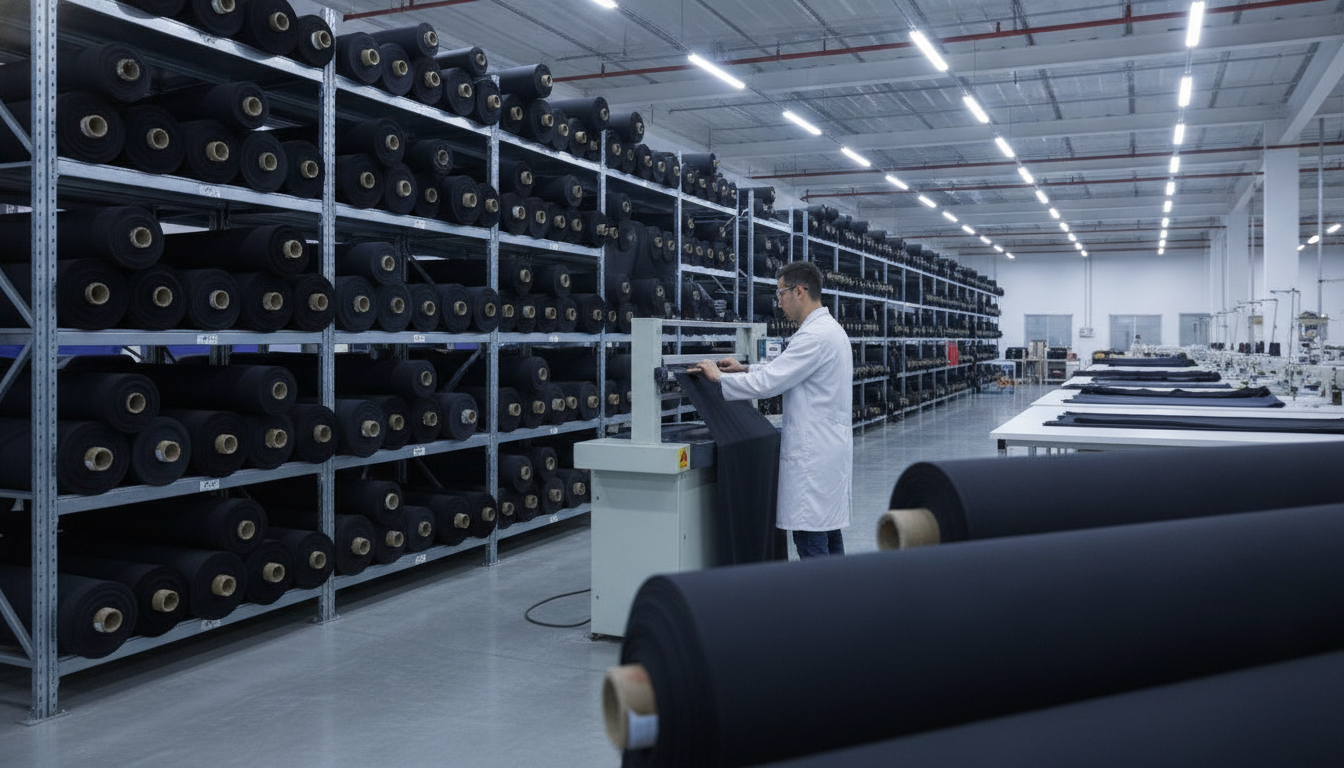
A vertically integrated facility controls fabric sourcing, pattern development, cut-and-sew, and quality control under one roof. This reduces lead times and eliminates the finger-pointing that happens when fabric mills, pattern makers, and sewing contractors operate independently. Walundi’s 18,000m² Yiwu facility includes an in-house pattern studio, multiple cut-and-sew lines, and QC inspection before shipment, cutting typical sampling time from 3-4 weeks to 7-10 days.
Certifications verify claims and protect your brand from greenwashing accusations. The Global Recycled Standard (GRS) requires at least 20% recycled content and traces the supply chain from post-consumer waste to finished garment. OEKO-TEX Standard 100 screens textiles against more than 1,000 harmful substances, critical for activewear that contacts skin during sweat-heavy workouts. BSCI certification audits labor practices and factory working conditions.
Founders launching their first collection often lack detailed tech packs. A yoga clothing manufacturer for startups should offer pattern development support, grading assistance, and clear answers on fabric composition, GSM, and stretch recovery before you commit to sampling. Slow or vague responses during the inquiry phase predict production headaches later.
A 200-worker facility can handle small initial orders and scale with your brand. Founders who start with a 30-piece test run need confidence that the same factory can produce 500 or 5,000 units per SKU as demand grows. Walundi’s 2.4 million pieces per year capacity supports brands from initial launch through multi-market expansion.
High minimum order quantities trap capital before you validate product-market fit. Small brands report that rigid MOQs force them to order excess inventory that never sells.
Most manufacturers require 50-100 pieces per design for sampling. Walundi offers 1-piece sample MOQ, letting you test multiple colorways, sizes, and fabric weights without committing thousands of dollars. A single sample costs more per unit than bulk production, but it prevents the costly mistake of ordering 500 units of a style that does not fit your customer.
Standard bulk minimums range from 300-500 pieces per SKU. A 4 way stretch fabric activewear manufacturer with 30-piece bulk MOQ per SKU lets you launch with three sizes in two colors (180 total units) instead of locking up capital in 1,500 pieces before you know which styles sell.
Sample MOQ: 1 piece. Bulk MOQ: 30 pieces per SKU. Sampling time: 7-10 days.
Vertically integrated manufacturers complete samples faster because they control every step. Expect 7-10 days for a pre-production sample when the factory has in-house pattern development and cut-and-sew. Factories that outsource pattern work or fabric sourcing often require 3-4 weeks.
After sample approval, bulk production for a 30-500 unit order typically takes 25-35 days, including fabric procurement, cutting, sewing, QC, and packing. Add 15-25 days for ocean freight from Ningbo port to Los Angeles or 30-40 days to European ports. Air freight cuts transit to 5-7 days but costs 4-6 times more per kilogram.
Founders report that fabric hand feel, stretch recovery, and compression can shift between sample and bulk orders. This inconsistency damages brand reputation and triggers returns.
Fabric mills produce in large dye lots. A manufacturer that sources from multiple mills or switches suppliers between orders introduces variation in color, GSM, and stretch. Walundi maintains long-term relationships with GRS-certified and OEKO-TEX-approved mills, ensuring that your reorder three months later uses the same base fabric as your initial production.
Quality control must happen at multiple checkpoints: incoming fabric inspection for GSM and stretch recovery, mid-production inspection for seam strength and pattern accuracy, and final inspection before packing. A sustainable yoga clothing manufacturer with in-house QC catches defects before they reach your warehouse, reducing the return rate and protecting your margin.
Every production lot should undergo physical testing. Stretch a fabric swatch to 150% of its resting length, hold for 30 seconds, release, and measure residual elongation after 5 minutes. Fabrics that exceed 5% residual elongation will bag out at the knees and seat after a few wears. Pilling resistance is tested by rubbing fabric samples against a standard abrasive surface for a set number of cycles, then grading the surface fuzziness.
Dye lot variation is inevitable, but a skilled manufacturer minimizes it by maintaining detailed records of dye formulas and using spectrophotometer readings to match new lots against approved samples. Request a lab dip (small fabric swatch dyed to your specified color) before bulk dyeing to confirm the match.
In practice: A UK activewear brand reordered black leggings six months after their initial run and discovered the new batch had noticeably less compression; the factory had switched to a lower-cost polyester-spandex blend without informing the buyer
Four-way stretch fabric extends and recovers in both lengthwise (warp) and crosswise (weft) directions, providing bi-directional elasticity. This allows full range of motion during yoga, HIIT, and dance without fabric memory or bagging. Most activewear blends use 15-25% spandex with nylon or polyester for optimal stretch and recovery.
Two-way stretch fabrics extend in only one direction, typically the weft (crosswise). Denim with a small amount of spandex is often 2-way. Four-way stretch moves in both warp and weft directions, essential for leggings that must accommodate deep squats, lunges, and inverted poses without restricting movement or losing shape.
Nylon-spandex blends (80/20 or 85/15) offer superior hand feel, odor resistance, and compression for yoga leggings and sports bras. Polyester-spandex blends (75/25 or 82/18) wick moisture faster and cost less, making them popular for running shorts and moisture-wicking tops. Premium brands often choose nylon; budget-conscious brands favor polyester.
Evaluate vertical integration (in-house pattern studio, cut-and-sew, QC), certifications (GRS, OEKO-TEX, BSCI), communication speed on tech pack questions, and MOQ flexibility. Request fabric swatches with clear GSM, composition, and stretch recovery specs before sampling. A vertically integrated facility completes samples in 7-10 days versus 3-4 weeks for factories that outsource.
Standard bulk minimums range from 300-500 pieces per SKU at most factories. Walundi offers 1-piece sample MOQ and 30-piece bulk MOQ per SKU, letting DTC founders test multiple colorways and sizes without locking up capital in excess inventory. This allows you to launch with three sizes in two colors (180 total units) instead of 1,500 pieces.
Ready to validate your activewear designs without locking up capital in high-MOQ orders?
Request 1-Piece Samples →
Written by the Walundi Export Team.
Sample 1 piece · bulk from 30 · OEKO-TEX & GRS certified · reply in 24h. No gatekeeping.
Low MOQ. Sustainable fabrics. OEM ready. Tell us your vision.
Click the button below to open WhatsApp. If you're not logged in to WhatsApp Web yet, scan the QR code first — then come back here and copy the message into the chat.