
📋 Table of Contents
Finding the right yoga clothing suppliers is the single most critical decision for DTC founders and boutique studios building branded apparel lines. Most new brands stall because their supplier locks them into high minimums, delivers inconsistent quality between samples and bulk orders, or goes silent across time zones when production questions arise.
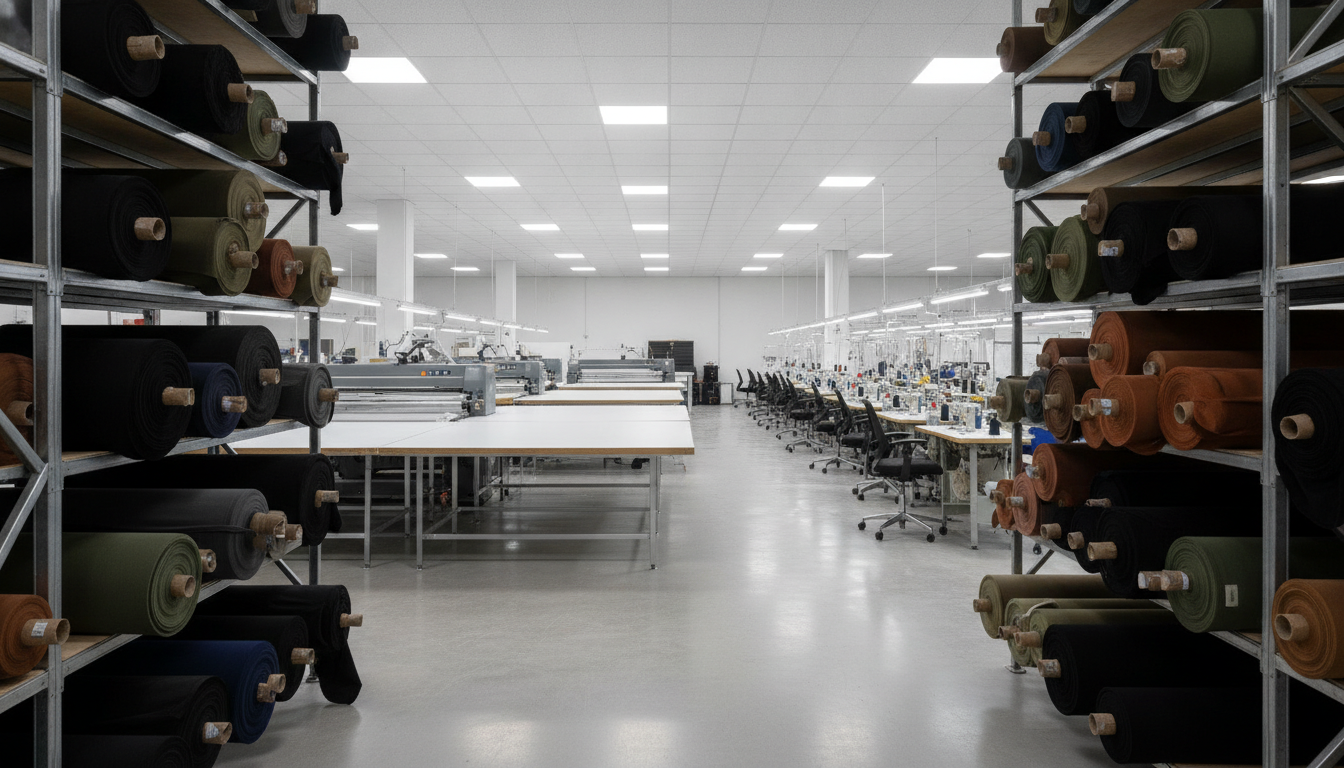
Reliable yoga clothing suppliers demonstrate three core attributes: verifiable production capacity, transparent communication systems, and documented quality control processes. The challenge is separating vertically integrated manufacturers from trading companies that subcontract production.
Ask for facility size, workforce count, and annual output in pieces. A legitimate custom yoga apparel manufacturer will provide specifics: 18,000m² facility, 200+ skilled workers, 2.4M pieces per year capacity. Trading companies deflect with vague answers or refuse factory video calls.
Legitimate suppliers provide scanned copies of GRS, OEKO-TEX, and BSCI certificates with valid dates and scope. Shell operations either lack certifications entirely or show expired documents. Cross-reference certificate numbers directly with issuing bodies (Control Union for GRS, OEKO-TEX Association for Standard 100).
Send a detailed technical question about fabric composition or grading. Measure response time and specificity. Factories with dedicated account managers reply within 24 hours with fabric specs, GSM ratings, and stretch percentages. Slow or generic responses signal either a trading middleman or overloaded production teams.
Sample MOQ reveals whether a supplier understands DTC founder constraints. Traditional factories demand 50-100 piece sample orders. Low MOQ yoga manufacturers offer 1-piece sampling, letting you validate three colorways and two size runs for under $300 before committing to bulk.
Minimum order quantities determine whether you can test product-market fit or must bet your entire launch budget on untested inventory. The gap between 1,000-piece traditional minimums and 30-piece DTC-friendly terms is the difference between $18,000 locked capital and $540 test orders.
Order single pieces in your top three colorways (black, navy, terracotta) and two size runs (S/M or M/L). Wear-test each sample for 5-7 days across yoga, HIIT, and casual wear. Document pilling, seam integrity, waistband roll-down, and opacity during squats. This costs $180-$240 and prevents the common complaint: samples looked perfect but bulk quality differed.
After sample approval, request a pre-production sample from the actual bulk fabric lot. This catches dye-lot variance and confirms the factory sources the approved fabric grade. Pre-production samples take 10-14 days and cost $40-$60 per piece. Skip this step and you risk receiving 300 units in a lighter shade or thinner hand-feel than your original sample.
Place your first bulk order at 30 pieces per SKU across 3-4 SKUs (90-120 total pieces). This generates $1,800-$2,400 in inventory at $20-$22 per unit landed cost, enough to validate sales velocity without warehouse risk. A common sourcing complaint is that 87% of clothing brands stay stuck because their manufacturer will not negotiate MOQ. Factories offering 30-piece minimums solve this lock-up.
In practice: A California yoga studio owner validated three legging styles with 1-piece samples in black, sage, and rust, then placed a 30-unit-per-SKU pilot order totaling 90 pieces without locking up studio operating capital
The most frequent complaint in Reddit sourcing threads and Alibaba reviews is that samples arrive perfect but bulk orders ship with thinner fabric, loose stitching, or different stretch recovery. This happens when factories use premium materials for samples and substitute cheaper inputs for production.
Request the fabric mill name and lot number used in your approved sample. Specify in your purchase order that bulk production must use the same mill and GSM rating. Vertically integrated manufacturers maintain fabric inventory and can pull from the same lot. Trading companies source spot fabric and cannot guarantee consistency.
Schedule a third-party inspection when production reaches 30-50% completion. Inspectors measure GSM with fabric scales, check stitch density (12-14 stitches per inch for activewear seams), and test stretch recovery (fabric should return to within 5% of original dimension after 50 stretch cycles). This catches substitutions before the full order ships.
Before authorizing final payment and shipment, request the factory send 2-3 finished units via express courier. Compare these against your approved sample under identical lighting and stretch tests. A common activewear factory complaint is that thinner stretch fabric causes see-through issues and going thicker kills the stretch. Factories with squat-proof testing protocols use 250-280 GSM four-way stretch with opacity ratings above 90%.
Inconsistent sizing from sample to sample and style to style is a recurring complaint in activewear reviews. Request the factory’s grading chart showing measurements for each size across chest, waist, hip, inseam, and rise. Verify the chart matches your approved sample measurements within 0.5cm tolerance. Private label yoga clothing programs should provide fit blocks (master patterns) that maintain proportional grading across your entire size run.
Vague answers about certifications or fabric composition signal either a trading company or a factory cutting corners. Professional yoga clothing suppliers provide certificate scans, test reports, and material composition breakdowns within 24 hours of request.
GRS certification verifies recycled content and tracks chain of custody from raw material to finished product. The standard requires at least 20% recycled material content. Factories claiming recycled polyester or nylon must provide a valid GRS certificate with scope covering textile manufacturing. The certificate lists the Control Union transaction certificate number, which you can verify directly on the GRS public database.
This certification screens textiles against more than 1,000 harmful substances including formaldehyde, heavy metals, pesticides, and chlorinated phenols. OEKO-TEX certificates specify product class (Class I for baby products, Class II for skin-contact apparel like leggings and sports bras). Request the certificate and cross-reference the certificate number at oeko-tex.com. Certificates expire annually and must be renewed.
BSCI audits cover working conditions, wages, working hours, and health and safety. A valid BSCI audit report includes the audit date, score (A, B, C rating), and corrective action plans for any non-conformances. Factories manufacturing for US and EU brands typically maintain B-rating or higher. The audit must be less than two years old to remain valid.
Request fabric mill test reports showing fiber content percentages, GSM, stretch recovery, colorfastness (Grade 4+ for activewear), and pilling resistance (Grade 3+ after 5,000 cycles). These reports confirm the fabric meets performance standards and matches the composition declared on your care labels. Factories vague about fabric specs either lack mill relationships or source inconsistent spot fabric.
Slow and unclear communication across time zones is a recurring frustration in supplier reviews. The gap between a factory’s quoted lead time and actual delivery often derails launch plans and preorder commitments.
Professional suppliers assign a dedicated account manager who handles sampling, production updates, and logistics coordination. Your contact should respond to technical questions within 24 hours and provide weekly production updates once your order enters the cut-and-sew phase. Factories that route every question through a generic sales inbox lack the structure to support DTC brands.
Sampling requires 7-10 days from pattern approval to finished sample in hand. Pre-production samples take 10-14 days after bulk fabric arrives at the factory. Bulk production spans 30-45 days: fabric procurement (10-14 days), cutting and sewing (12-18 days), quality control and packing (3-5 days), and port delivery (3-5 days). Ocean freight from Ningbo to Los Angeles adds 18-22 days. Total timeline from purchase order to US warehouse: 60-75 days.
Shipping delays are a repeated complaint in marketplace feedback. Build 2-3 week buffers into your launch timeline. If you promise preorder customers delivery by October 15, set your factory shipment deadline for September 10. This absorbs port congestion, customs clearance delays, and last-mile carrier slowdowns. Sustainable yoga clothing manufacturers shipping GRS-certified goods may face additional customs documentation review, adding 3-5 days to clearance.
Request photo updates at four production milestones: fabric arrival and inspection, cutting complete, 50% sewing complete, and final QC packing. These photos confirm production is on schedule and match your approved samples. Factories that resist milestone updates either run disorganized production floors or subcontract to workshops they cannot monitor.
Sample MOQ: 1 piece. Bulk MOQ: 30 pieces per SKU. Sampling time: 7-10 days. Pre-production: 10-14 days. Bulk production: 30-45 days.
In practice: A Netherlands-based activewear startup requested milestone photos at fabric arrival, cutting, and 50% sewing stages, catching a dye-lot variance at the cutting phase before the full 120-piece order was sewn
Start by verifying production capacity (facility size, workforce count, annual output), requesting certification documentation (GRS, OEKO-TEX, BSCI with valid dates), and testing communication responsiveness with detailed technical questions. Legitimate suppliers provide factory video calls, scanned certificates, and respond within 24 hours. Evaluate sampling terms: 1-piece sample MOQ signals DTC-friendly operations, while 50-100 piece minimums indicate traditional wholesale focus.
Traditional factories require 500-1,000 pieces per style, locking up $10,000-$18,000 in untested inventory. DTC-focused manufacturers offer 30 pieces per SKU bulk minimums, letting founders test market demand with $1,800-$2,400 pilot orders. Sample MOQ varies from 1 piece (vertically integrated factories) to 50-100 pieces (trading companies). Always request pre-production samples from the actual bulk fabric lot to confirm consistency.
Request facility size, workforce count, and annual capacity (legitimate manufacturers provide specifics like 18,000m² facility, 200+ workers, 2.4M pieces/year). Ask for scanned certification documents (GRS, OEKO-TEX, BSCI) and cross-reference certificate numbers with issuing bodies. Schedule a factory video call to verify cut-and-sew lines, pattern studio, and QC stations. Order 1-piece samples and wear-test for 5-7 days across yoga, HIIT, and casual wear to check pilling, seam integrity, and opacity during squats.
Yes, if you find a supplier offering 1-piece sample MOQ and 30-piece bulk minimums. Budget $180-$240 for initial samples (3 colorways, 2 sizes), $1,800-$2,400 for a 90-120 piece pilot order, and $800-$1,200 for ocean freight and customs clearance. Total launch budget: $3,000-$4,000. Avoid factories demanding 500-1,000 piece minimums, which require $12,000-$18,000 upfront and prevent product-market fit validation.
GRS (Global Recycled Standard) for recycled-content claims (requires ≥20% recycled material), OEKO-TEX Standard 100 for chemical safety (screens against 1,000+ harmful substances), and BSCI for ethical working conditions. Request scanned certificates with valid dates and verify certificate numbers directly with issuing bodies. GRS certificates list Control Union transaction numbers; OEKO-TEX certificates can be verified at oeko-tex.com. BSCI audit reports should show B-rating or higher and be less than two years old.
Written by the Walundi Export Team.
Ready to validate your yoga apparel line without locking up capital in untested inventory?
Request 1-Piece Samples →
Sample 1 piece · bulk from 30 · OEKO-TEX & GRS certified · reply in 24h. No gatekeeping.
Low MOQ. Sustainable fabrics. OEM ready. Tell us your vision.
Click the button below to open WhatsApp. If you're not logged in to WhatsApp Web yet, scan the QR code first — then come back here and copy the message into the chat.