📋 Table of Contents
Launching a yoga apparel brand feels like a cash-flow puzzle. You need production flexibility, but most factories want minimum orders of 500 pieces per style, locking up $15,000 before you’ve even tested whether your designs resonate. You need a partner that understands this, a custom yoga apparel manufacturer who offers 1-piece samples and 30-piece bulk MOQs. Private label yoga apparel solves that puzzle if you choose the right manufacturing partner. In this guide, we break down exactly what DTC founders and boutique studios need to know before placing their first order.
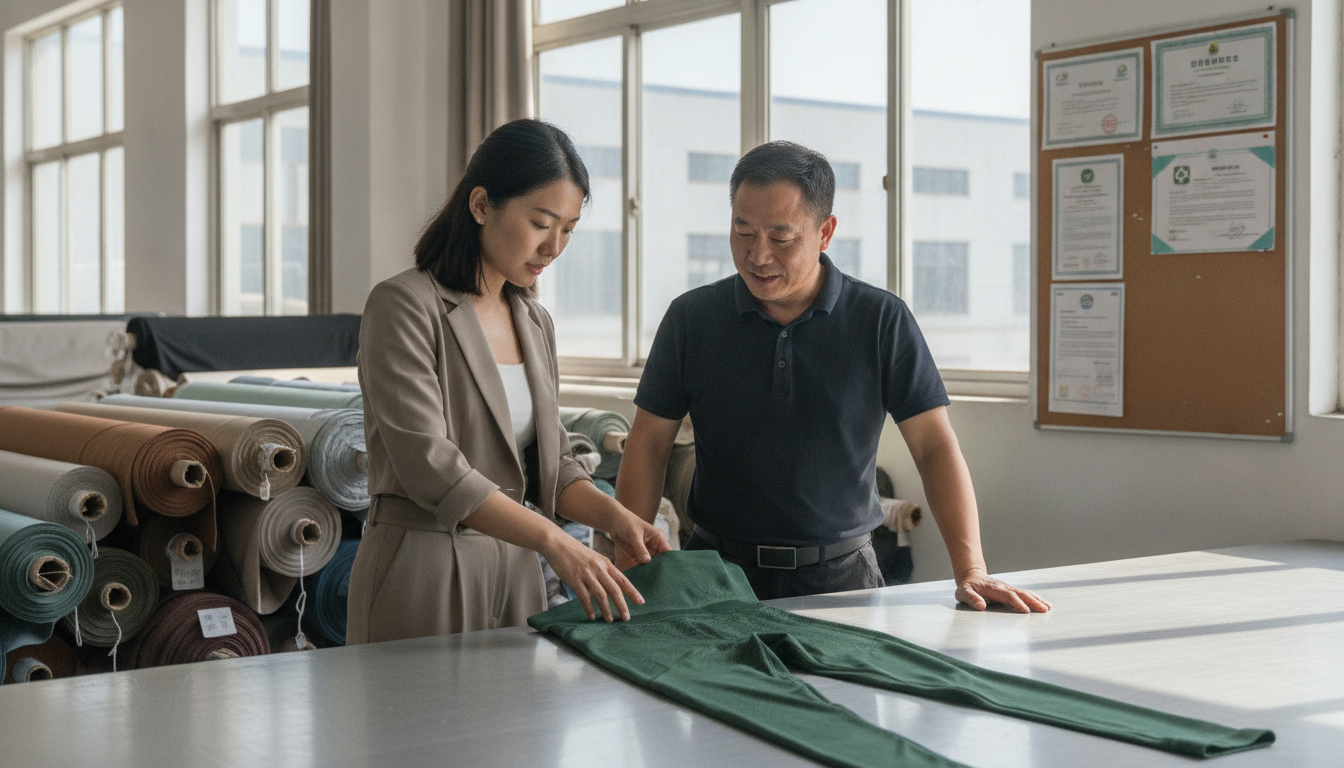
With private label yoga apparel, you create a unique brand while the manufacturer produces to your specifications, often with custom labels, hangtags, and packaging. Wholesale means you buy generic stock that other retailers also sell, limiting your brand identity and margins. The difference is control over every customer touchpoint. A vertically integrated private label partner can handle design, fabric sourcing, and even global logistics under one roof, cutting coordination effort.
For founders validating market fit, every dollar counts. A single 30-unit trial run costs far less than traditional bulk orders and lets you test 2-3 styles without warehouse risk. The pricing model you choose, direct-to-consumer or wholesale to retailers, determines your cost tolerance, required MOQs, and packaging needs.
Sample MOQ: 1 piece. Bulk MOQ: 30 pieces per SKU. Sampling time: 7-10 days.
Get a Tiered QuoteBuilding a yoga brand? Sample 1 piece, bulk from 30.OEM / ODM / private label · OEKO-TEX & GRS certified · 24h quote
A single pre-production sample typically costs $50, $80, including shipping. This is your lowest-risk way to assess fabric hand feel, stitching quality, and color accuracy before committing to bulk. Requesting a sample with your brand’s label sewn in gives you a tangible selling tool for early customer feedback.
For orders of 30-100 pieces per style, expect landed costs around $8, $12 for a standard high-waist yoga legging in nylon-spandex. Eco fabrics like recycled polyester or organic cotton blends add $2, $4 per unit. For founders testing market fit with under 50 units, a low MOQ yoga manufacturer turns capital risk from $15,000 into under $2,000.
When you scale to 200+ pieces per SKU, unit prices drop to $5, $9. At this volume, negotiating quarterly open orders with a single factory reduces per-unit costs further. Sustainable certifications like GRS often add $0.50, $1.00 per unit for the audit trail, but the marketing ROI for eco-conscious DTC brands usually justifies it.
Selecting a manufacturer for private label yoga clothing involves more than comparing price sheets. A low advertised unit price often hides minimums you cannot meet or fabric substitutions after the order. These three steps protect your cash and your brand.
Verify GRS, OEKO-TEX, or BSCI certificates directly on the certifier’s website using the factory’s license number. A valid certificate proves the factory operates under social compliance and material traceability rules, not just a PDF on a sales deck. Without these, your sustainability claims are unbacked.
A pre-production sample made with your actual chosen fabric and trims reveals color accuracy, seam stretch, and size consistency. Order 2-3 samples in different colorways simultaneously to compare dye lots. If a factory refuses a sample order under 5 pieces, treat that as a red flag.
Ask for photos of the actual cut-and-sew floor, not a showroom. Confirm the number of stitching lines and whether the factory owns its pattern room or outsources it. A factory that controls pattern making in-house reduces miscommunication and lead-time delays by up to 30% compared with outsourced pattern services.
DTC shoppers increasingly filter by sustainability markers. A sustainable yoga clothing manufacturer can supply GRS-certified recycled polyester or OEKO-TEX-tested organic cotton, but you must understand what each certificate actually verifies. The table below clarifies the top three certifications relevant to yoga wear.
A realistic timeline prevents missed launch dates. Most delays happen not in sewing but in pattern approval and freight consolidation. Below is a phase-by-phase breakdown for a 30-100 piece order manufactured in a vertically integrated facility and shipped to a US East Coast port.
After you send a tech pack or reference sample, the factory digitizes the pattern and grades it for your size range. A first prototype sample is sewn and shipped. Expect 1-2 fit revisions in this window.
The PP sample uses your exact fabric and trims. Once you sign off, bulk fabric cutting begins. Changing trims after this step adds 5 days and cost overruns.
Cutting is done by computerized plotter; sewing follows your approved stitch specification. A 30-piece order typically completes in one 10-person line shift.
Inline QC checks every 10th piece; final AQL 2.5 inspection catches seam slippage, size variances, and label errors. UPC or QR code tagging for DTC fulfillment is applied here.
Ocean freight LCL (less-than-container-load) from Ningbo to Los Angeles takes 14-18 days sailing plus 2-3 days customs clearance. Air freight cuts transit to 5-7 days but raises cost 3x.
Total lead time for 30-100 units: 6-8 weeks, including sampling and freight to US West Coast.
Your initial sample order is a low-cost proof of partnership. Evaluate these five criteria before you pay for a pre-production piece. A manufacturer that fails even one may cost you months of rework.
For DTC founders in the validation stage, a yoga clothing manufacturer for startups that offers 1-piece samples and a 30-piece bulk MOQ removes the single biggest barrier to entry: cash lockup. Starting a private label yoga apparel brand begins with a single, low-risk sample order.
Request 1-piece samples with your label sewn in, and see the quality firsthand.
Book Your Sample Consultation →
The best manufacturer depends on your order size. Many US-based cut-and-sew shops have high MOQs (300+). Overseas vertically integrated factories often support 30-piece minimums with 1-piece sampling. Look for GRS and OEKO-TEX certifications, and verify they have in-house pattern and QC teams.
A lean validation can cost under $5,000. Budget $150 for 3 sample pieces, $2,500 for a 30-unit test order of one legging style, and $1,000 for packaging, photography, and a basic Shopify site. Total investment before first customer: $4,000, $7,000.
Standard bulk MOQs range from 30 to 500 pieces per SKU. Low-MOQ specialists offer sample MOQs of 1 piece and bulk MOQs of 30 pieces per style. Always confirm whether MOQ is per style or per colorway, as that impacts initial funding needs.
Vertically integrated manufacturers in China’s Zhejiang province often stock GRS-certified recycled polyester and OEKO-TEX certified organic cotton blends. Ask for current certificate URLs and verify them on the certifier’s public registry before ordering.
Search for manufacturers advertising “small batch yoga apparel” or “30-piece MOQ.” Request a paid sample of your chosen design with your logo sewn in to evaluate quality. Platforms like Maker’s Row or direct factory websites with transparent MOQ policies reduce risk.
Sample 1 piece · bulk from 30 · OEKO-TEX & GRS certified · reply in 24h. No gatekeeping.
Fill in your details and we'll connect on WhatsApp instantly.
Click the button below to open WhatsApp. If you're not logged in to WhatsApp Web yet, scan the QR code first — then come back here and copy the message into the chat.