
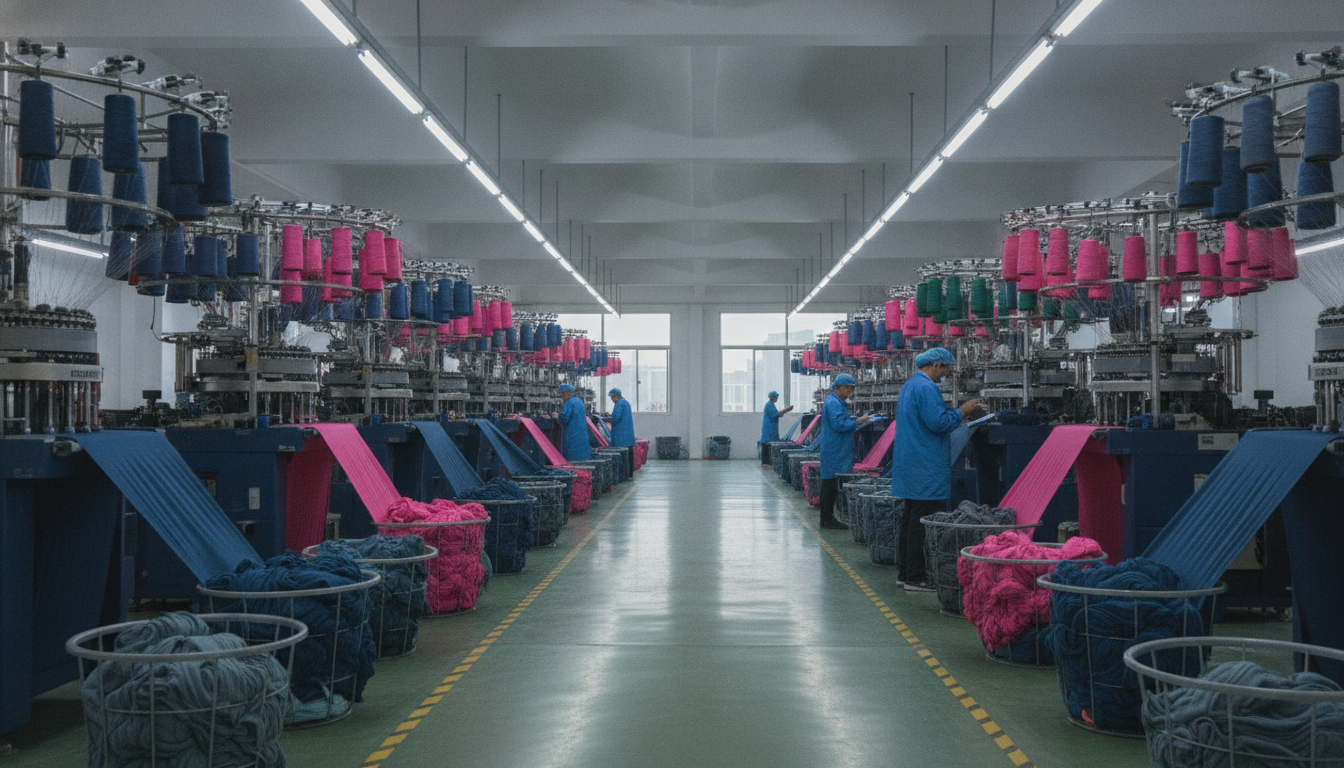
To find a reliable seamless leggings manufacturer, verify on-site circular knitting capability through factory video tours or third-party audits, request 1-piece samples to validate construction before committing to bulk minimums, and lock down fabric specs, tolerances, and a golden sample in writing before production. Sample MOQ is 1 piece at vertically integrated facilities; bulk MOQ typically starts at 30 pieces per SKU.
📋 Table of Contents
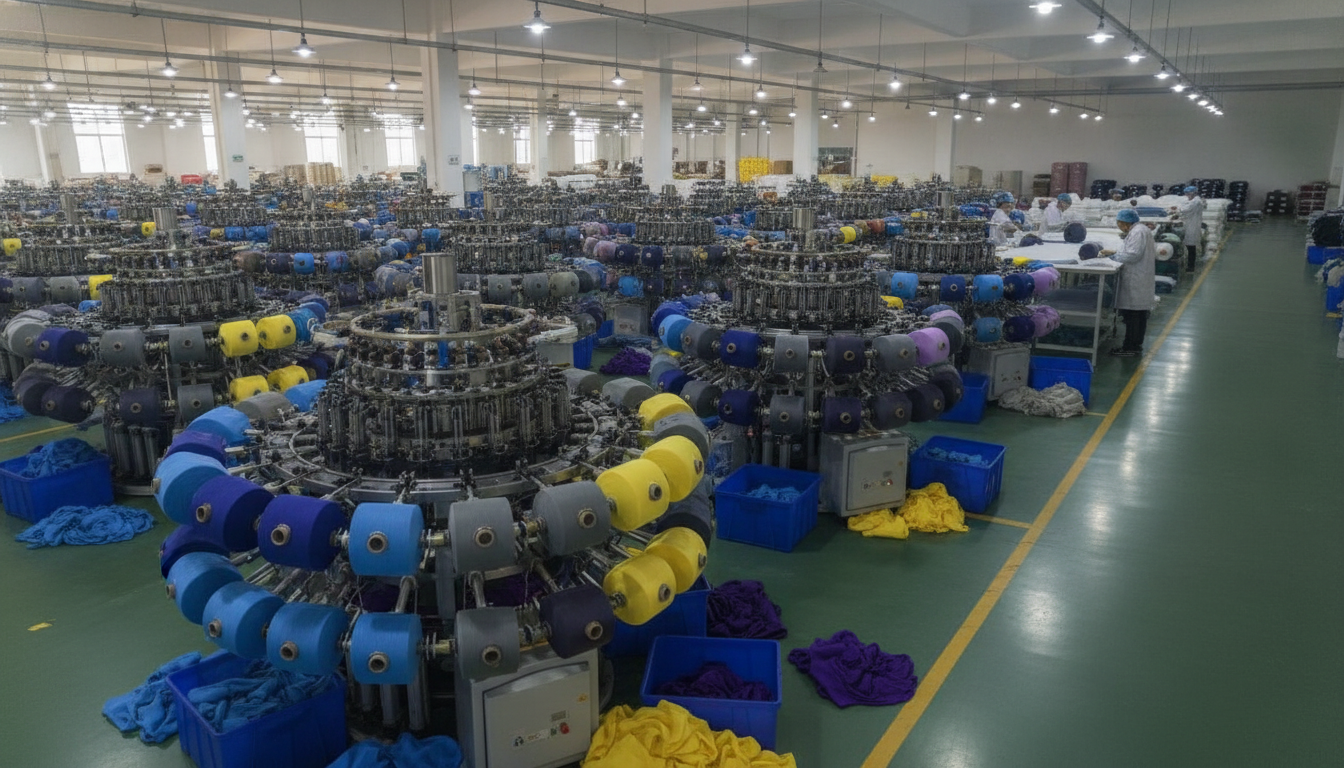
Manufacturers often label flatlock or cut-and-sew leggings as seamless when the construction is actually bonded panels. True seamless leggings are knit in one continuous tubular pass on circular knitting machines, eliminating side seams entirely. Founders discover this gap when samples arrive with visible flatlock stitching or bonded edges that fail squat tests. To confirm genuine seamless capability, ask for a factory video tour showing the circular knitting floor in operation, or request photos of the knitting machines with visible brand plates (Santoni, Lonati, and Pai Lung are common circular-knit equipment manufacturers).
A polished website does not prove the factory owns the equipment or can deliver consistent seamless construction. Request timestamped photos of the knitting machines, yarn feeders, and finished tubular fabric on the machine bed. Cross-reference machine serial numbers or brand plates against the factory’s stated capacity. If the supplier hesitates or sends generic stock photos, move to the next candidate.
Sampling from at least two manufacturers lets you compare construction quality, fabric hand-feel, and compression performance side by side. At Walundi, sample MOQ is 1 piece, so founders can validate seamless construction, waistband elasticity, and squat-proof opacity without committing to bulk minimums. Send identical tech packs to both factories and compare turnaround time, communication speed, and willingness to iterate on fit feedback.
Vertically integrated facilities control knitting, dyeing, finishing, and quality control under one roof, reducing lead time and quality variation. Ask whether the factory knits in-house or outsources to a subcontractor. Outsourced knitting adds 7-14 days to sampling and introduces a second quality-control handoff. Our 18,000m² Yiwu facility runs in-house circular knitting, cut-and-sew lines, and QC, so every sample and bulk order follows the same process path.
High MOQs lock up cash before a founder validates product-market fit or confirms the legging style sells. Sample MOQ is 1 piece at vertically integrated manufacturers; bulk MOQ typically starts at 30 pieces per SKU. This structure lets a DTC brand test three colorways with 90 total units (30 per color), gather customer feedback, and adjust sizing or fabric weight before scaling to 300-500 pieces per reorder.
Sample turnaround typically runs 7-10 days for seamless leggings once the tech pack and fabric selection are confirmed. Some factories charge $50-150 per sample piece, refundable against bulk orders; others absorb sample cost if the buyer commits to a pilot order within 60 days. Clarify sample cost, payment terms, and refund policy in the initial RFQ to avoid surprises.
If your line includes XS through XL, confirm whether the 30-piece MOQ applies per size or per colorway. Some manufacturers require 30 pieces per size per color, pushing total commitment to 150-180 pieces for a single style. Others allow size assortments within the 30-piece minimum (for example, 6 XS, 8 S, 10 M, 4 L, 2 XL). Lock this down in writing before sampling.
Quality varies unless the buyer locks down specs, tolerances, and a golden sample before production. A written spec sheet should include fabric weight (grams per square meter), compression grade (light / medium / firm), squat-test opacity (measured with a colorimeter or visual pass/fail), and wash-shrinkage tolerance (typically ±3% after five home washes). Without these anchors, the factory optimizes for cost and speed, not the performance your customers expect.
Your spec sheet should cover fabric composition (for example, 75% nylon, 25% spandex), weight (240-280 gsm for squat-proof leggings), compression level, waistband width and elasticity, inseam length by size, and acceptable color-match tolerance (Delta E ≤ 1.5 against Pantone reference). Attach this sheet to every RFQ and reference it in the purchase order. Founders who skip this step receive leggings that pill after two washes or turn sheer during downward dog.
Once the first sample meets your fit and quality standards, designate it as the golden sample and store it at the factory and in your own archive. Every bulk production run is measured against this reference for color, compression, waistband tension, and seam finish. Label the golden sample with style number, fabric lot, and approval date. If quality drifts in later orders, the golden sample is your proof of the agreed standard.
Squat-test opacity is the most common legging failure mode. Define a pass/fail protocol: the fabric must remain opaque (no visible skin tone or undergarment outline) when stretched to 150% of resting width in a 90-degree squat position. Wash-shrinkage tolerance should be ±3% in length and width after five machine washes at 30°C, tumble-dried on low. Document these criteria in the spec sheet and request pre-production test reports before approving bulk.
A polished website does not prove the factory actually owns the equipment or can deliver consistent seamless construction. Founders lose deposits to shell companies that subcontract production to unknown workshops, ship late, or vanish after the first payment. Factory verification steps include business license checks, video tours, third-party audits, and buyer references.
Ask for a copy of the factory’s business license (in China, this is the 营业执照 or yingyezhizhao), export license, and any third-party certifications (GRS, OEKO-TEX Standard 100, BSCI, WRAP). Cross-check the legal entity name on the license against the name on the quotation and invoice. Walundi holds GRS certification for recycled-content claims, OEKO-TEX Standard 100 for textile safety, and BSCI for social compliance; we share scope certificates on request.
Request a live video call walking through the knitting floor, cut-and-sew lines, and QC area. Watch for equipment in operation, not idle machines in an empty room. Ask the tour guide to show the yarn storage area, fabric inspection tables, and finished-goods warehouse. A factory that hesitates or offers only pre-recorded video may be a trading company, not a manufacturer.
Request contact details for two current customers in your target market (for example, US or UK DTC brands) who have completed at least two production runs. Email or call those references and ask about communication speed, sampling turnaround, quality consistency across orders, and whether the factory met quoted lead times. A manufacturer confident in its track record will provide references without hesitation.
Third-party audits (BSCI, WRAP, Sedex) verify labor practices, safety conditions, and environmental controls. Request the most recent audit report and check the issue date (reports older than 18 months may not reflect current conditions). Look for critical non-conformances (child labor, unsafe electrical systems, blocked fire exits) and confirm the factory has closed out corrective actions. BSCI audits are common in China and cover working hours, wages, health and safety, and environmental management.
Domestic manufacturers in the US, UK, or EU offer faster sampling (3-5 days), tighter quality control, and no import duties or long freight windows. Overseas facilities in China, Vietnam, or Bangladesh deliver lower per-piece costs and access to GRS-certified recycled yarns at scale. The right choice depends on your brand’s stage, cash position, and control priorities.
Choose a domestic manufacturer if you need rapid iteration on fit and design, plan frequent small reorders (under 200 pieces), or sell primarily through pop-ups and local studios where lead time matters more than per-piece margin. Domestic production also simplifies compliance (no customs paperwork) and reduces freight-damage risk.
Overseas manufacturing works for brands that have validated product-market fit, can forecast demand 8-12 weeks ahead, and prioritize landed-cost margin over speed. Access to GRS-certified recycled fabrics is significantly broader in China and Vietnam, where yarn mills invest in post-consumer PET and nylon recycling at scale. If your brand messaging centers on sustainability, overseas sourcing may be the only path to certified recycled content at accessible MOQs.
Some founders start with a domestic manufacturer for the first 2-3 production runs to dial in fit and quality, then transition to an overseas facility once the style is locked and demand is predictable. This hybrid approach balances control during the validation phase with margin expansion as the brand scales.
Request a factory video tour showing circular knitting machines in operation, or ask for timestamped photos of the knitting floor with visible equipment brand plates (Santoni, Lonati, Pai Lung). True seamless leggings are knit in one continuous tubular pass, eliminating side seams entirely. If the supplier hesitates or sends generic stock photos, they may be a trading company outsourcing to a subcontractor. Order 1-piece samples from at least two manufacturers to compare construction quality and confirm the fabric is genuinely tubular, not cut-and-sew panels with flatlock finishing.
A seamless legging tech pack should include fabric composition (for example, 75% nylon, 25% spandex), weight (240-280 gsm for squat-proof opacity), compression level (light, medium, or firm), waistband width and elasticity spec, inseam length by size, and color-match tolerance (Delta E ≤ 1.5 against Pantone reference). Add squat-test pass/fail criteria (fabric must remain opaque when stretched to 150% of resting width) and wash-shrinkage tolerance (±3% after five home washes at 30°C). Attach flat sketches, a size chart with measurements in centimeters, and any branding or label placement details. Reference the tech pack in your RFQ and purchase order so the factory has a single source of truth.
Choose a local manufacturer if you need rapid sampling (3-5 days), plan frequent small reorders under 200 pieces, or sell primarily through pop-ups and studios where lead time matters more than per-piece margin. Choose an overseas manufacturer if you have validated product-market fit, can forecast demand 8-12 weeks ahead, and prioritize landed-cost margin or need access to GRS-certified recycled fabrics at scale. Some founders start domestic for the first 2-3 runs to dial in fit, then transition overseas once the style is locked and demand is predictable. Factor in import duties (US apparel duties run 16-28%), freight windows (6-8 weeks ocean, 5-7 days air), and the cost of holding inventory when comparing total landed cost.
In practice: A US yoga brand founder validated three seamless legging styles with 1-piece samples from Walundi, then placed a 30-unit-per-SKU pilot order (90 total pieces across three colorways) to test-market the line without locking up cash in high minimums. After gathering customer feedback on fit and compression, the founder scaled to a 300-piece reorder with adjusted sizing and added two new colorways.
Ready to find a reliable seamless leggings manufacturer for your brand?
Request 1-Piece Samples →
Last updated: August 2026
Written by the Walundi Export Team.
Sample 1 piece · bulk from 30 · OEKO-TEX & GRS certified · reply in 24h. No gatekeeping.
Low MOQ. Sustainable fabrics. OEM ready. Tell us your vision.
Click the button below to open WhatsApp. If you're not logged in to WhatsApp Web yet, scan the QR code first — then come back here and copy the message into the chat.