
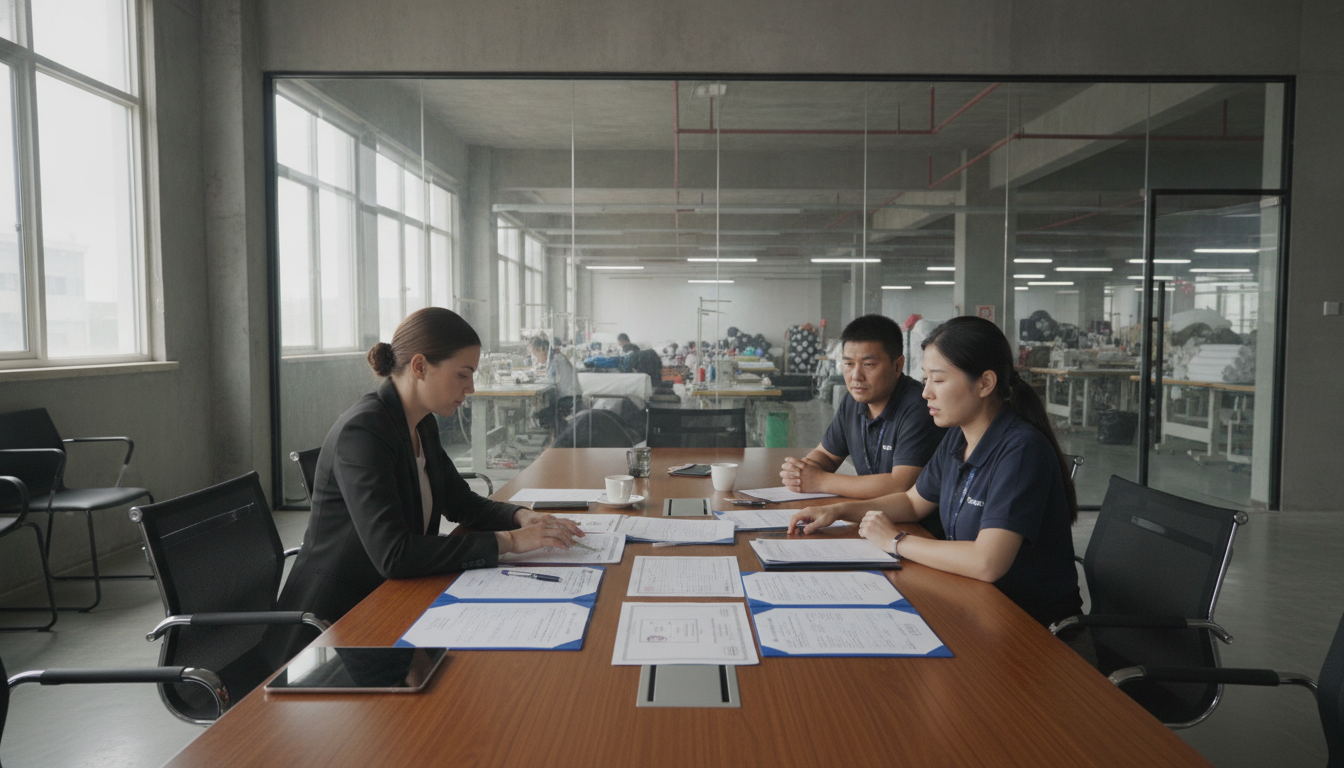
Red flags when vetting chinese activewear supplier include refusal to provide a business license or audit report, requests for payment to personal bank accounts, quotes significantly below market rates, inability to answer technical fabric questions, and resistance to sampling. Legitimate activewear manufacturers hold GRS, OEKO-TEX, or BSCI certifications, offer 1-piece sample MOQs, and can demonstrate in-house cut-and-sew capacity through facility tours or verifiable production documentation.
📋 Table of Contents

Trading companies often claim factory status to secure margins, but lack production control and transparency. Verifying entity legitimacy before committing deposits protects you from middleman markups, delayed communication, and quality inconsistencies. Ask for a business license with the registered company name, address, and scope of operations. Cross-check the license number on the National Enterprise Credit Information Publicity System if the supplier operates in China.
BSCI, SEDEX, or SA8000 audit reports confirm the supplier operates a physical factory with documented labor and safety standards. These audits include facility photographs, worker-count verification, and production-line layouts. A trading company cannot produce an audit report under its own name unless it owns the factory. Request a report dated within the past 12 months to ensure current validity.
Schedule a video walkthrough of the cut-and-sew floor, fabric-inspection area, and finished-goods warehouse. Ask the contact to show specific machinery such as overlock machines, coverstitch stations, and heat-press units used for activewear labels. Trading companies will deflect or offer generic factory footage that does not match their claimed capacity. A custom yoga apparel manufacturer with in-house production can demonstrate real-time operations and answer equipment-specific questions on the spot.
Compare the business license address with the shipping address on sample invoices and the location listed on Alibaba or the supplier website. Mismatched addresses suggest the supplier operates from an office and outsources production to unknown subcontractors. Use Google Maps or Baidu Maps to confirm the registered address corresponds to an industrial zone, not a residential or commercial office building.
Payment structures reveal how a supplier manages cash flow and risk distribution. Requests for personal bank accounts, off-platform transfers, or 100% upfront payment before sampling indicate financial instability or outright fraud. Legitimate factories accept 30% deposits for sampling and bulk orders, with the balance due before shipment, and route payments through company accounts that match the business license name.
Any request to wire funds to an individual account instead of a registered company account is a critical red flag when vetting chinese activewear supplier operations. Personal accounts bypass corporate taxation and audit trails, making fund recovery impossible if the supplier disappears or delivers defective goods. Insist on a company account with a name that exactly matches the business license and all signed contracts.
Suppliers who push buyers off Alibaba Trade Assurance, PayPal Goods & Services, or Escrow.com eliminate buyer-protection mechanisms. Off-platform payments via Western Union, MoneyGram, or direct bank transfer offer zero recourse for non-delivery or quality disputes. Stick to protected channels for the first three orders until you establish trust through consistent delivery and quality performance.
Requiring 100% payment before producing even a single sample locks your cash without validating fit, fabric hand-feel, or construction quality. Standard practice for low MOQ yoga manufacturer relationships is a 30% deposit for samples, with the remaining 70% due upon approval and before bulk production begins. Full upfront payment shifts all risk to the buyer and signals the supplier lacks working capital or confidence in their product.
Quotes 30% to 50% below competitor pricing reflect cost-cutting in fabric weight, seam construction, or compliance. Activewear production involves specific input costs for moisture-wicking polyester, four-way stretch nylon-spandex blends, flatlock seaming, and dye-sublimation printing. A supplier quoting significantly below these baseline costs either sources substandard materials or plans to introduce hidden charges after deposit payment.
Standard yoga leggings use 240-280 GSM nylon-spandex or polyester-spandex blends with 15% to 25% spandex content for squat-proof stretch and recovery. Low-cost suppliers substitute 180-200 GSM fabrics with 8% to 12% spandex, resulting in sheerness, poor shape retention, and visible seam puckering after washing. Request fabric specifications in writing, including GSM, fiber content percentages, and stretch-recovery test results before accepting a quote.
Flatlock seams lie flat against the skin and prevent chafing during movement, but require specialized machines and skilled operators. Suppliers offering rock-bottom pricing often use standard overlock seams that create raised ridges and irritation points. Ask for sample close-up photos of inseam and waistband construction, and specify flatlock or coverstitch requirements in your tech pack to prevent post-production surprises.
Initial quotes may exclude costs for custom labels, hangtags, poly-bag packaging, carton labeling, or inland shipping to the port. These add-ons can increase the per-unit cost by 15% to 25% after you have paid the deposit and approved samples. Request an all-in landed cost quote that itemizes every charge from fabric procurement to port delivery, so you can compare suppliers on equal terms.
Realistic cost baseline: A quality 240 GSM nylon-spandex legging with flatlock seams, heat-transfer labels, and poly-bag packaging typically costs between $6.50 and $9.00 FOB per piece at 500-unit order volumes, depending on trim complexity and fabric certifications.
Activewear differs from casual apparel in performance requirements such as moisture wicking, four-way stretch, squat-proof opacity, and seam durability under tension. A supplier who cannot discuss these technical details lacks the specialized equipment, testing protocols, and material-sourcing relationships needed for yoga and gym apparel. Test competence through specific fabric and construction questions during initial conversations.
Ask how the supplier validates moisture-wicking performance and what AATCC test methods they reference. Capable manufacturers mention AATCC 195 for liquid moisture management or describe wicking-finish application processes. Inquire about stretch-recovery testing protocols and whether they measure permanent elongation after repeated stretch cycles. Vague answers or deflection to “our fabric is very good quality” signal limited technical depth.
Request the supplier’s process for ensuring leggings remain opaque during deep squats and forward bends. Experienced activewear manufacturers perform squat tests on live models under bright lighting and measure fabric opacity using a spectrophotometer or visual grading scale. Suppliers who have never tested squat-proof performance or cannot explain their opacity validation process will deliver see-through garments that damage your brand reputation on first wear.
Ask about seam-strength testing equipment and acceptable failure thresholds. Legitimate factories use tensile-strength testers to measure seam performance under load and reference standards such as ASTM D1683 for woven fabrics or ASTM D4964 for knits. Suppliers who cannot name a test method or describe their quality-control process for high-stress seams such as inseams and gussets lack the infrastructure to produce durable activewear.
Inquire where the supplier sources zippers, elastic waistbands, drawcords, and silicone grippers. Established activewear manufacturers maintain relationships with YKK or SBS for zippers and specialized elastic suppliers for no-slip waistbands. Trading companies or general-apparel factories source generic trims from local markets, resulting in zipper failures, elastic degradation, and inconsistent waistband tension across production runs.
In practice: A California DTC yoga brand asked three suppliers to explain their squat-proof testing process; two deflected to fabric-weight claims, while one described a standardized squat-test protocol with photo documentation and spectrophotometer opacity readings, revealing true activewear specialization
Sampling validates fit, fabric hand-feel, color accuracy, and construction quality before committing to bulk production. Suppliers who discourage sampling, delay sample timelines beyond 14 days, or refuse to produce samples without a bulk-order commitment lack confidence in their product or operate as trading companies without production control. Insist on a 1-piece sample MOQ and a 7- to 10-day turnaround to test responsiveness and manufacturing capability.
Legitimate factories charge $30 to $80 per sample piece depending on fabric complexity, trim details, and customization level, with costs refundable upon bulk-order placement. Suppliers quoting $150+ per sample or refusing to refund sample fees are either inflating costs to discourage small buyers or signaling they outsource production and cannot control pricing. Clarify sample-cost structure and refund terms in writing before placing a sample order.
Standard sampling timelines for private label yoga clothing run 7 to 10 days from tech-pack approval to finished sample shipment. Suppliers who quote 3 to 4 weeks for a single sample either lack in-house production or prioritize large-volume clients over emerging brands. Chronic delays signal poor project management, capacity constraints, or reliance on external subcontractors who do not prioritize your timeline.
Factories that refuse to produce samples unless you commit to a 500-unit or 1,000-unit bulk order eliminate your ability to validate product-market fit before scaling. This practice transfers all risk to the buyer and indicates the supplier targets high-volume clients only. Partner with manufacturers offering 1-piece sample MOQs and 30-piece bulk MOQs, allowing you to test designs with real customers before locking capital into large inventory buys.
Certifications verify a supplier’s commitment to material traceability, chemical safety, and ethical labor practices. GRS, OEKO-TEX Standard 100, and BSCI certifications are the three most relevant for activewear brands entering US, UK, EU, Canada, and Australia markets. Request current certificates with scope documents that list the specific factory location and product categories covered, not generic certificates that could belong to a different facility.
GRS certification confirms a product contains verified recycled content and meets environmental and social criteria throughout the supply chain. The standard requires a minimum of 20% recycled material content before a product can carry the GRS label, with full chain-of-custody documentation from fiber to finished garment. Request the supplier’s GRS scope certificate and transaction certificates for specific fabric batches to verify recycled-polyester or recycled-nylon claims.
OEKO-TEX Standard 100 testing screens textiles against a list of harmful substances including formaldehyde, heavy metals, pesticides, and phthalates. Certification applies to finished fabrics and garments, not raw fibers, so request certificates for the specific fabric types and colors you plan to order. Certificates expire annually and must be renewed, so verify the issue date falls within the past 12 months.
BSCI audits assess labor conditions, worker safety, and management systems at production facilities. The audit report includes a rating from A (excellent) to E (unacceptable) and identifies non-conformities that must be corrected within specified timelines. Request a copy of the most recent BSCI audit report and verify the factory address matches the business license and your shipping address to confirm the audit applies to the facility producing your goods.
The business license confirms the supplier’s legal registration, operational scope, and registered capital. Export licenses or customs-registration certificates prove the supplier can handle international shipments and customs clearance. Cross-check the company name on all certificates, contracts, invoices, and bank-account details to ensure consistency and prevent payment fraud or entity misrepresentation.
In practice: A UK activewear startup requested GRS certificates from two suppliers; one provided a valid scope certificate listing the factory address and product categories, while the other sent a generic certificate with no scope document, revealing they likely sourced recycled fabric from a certified mill but lacked their own GRS certification
Request a business license and verify the registered scope of operations includes manufacturing, not just trading or consulting. Ask for a third-party audit report such as BSCI or SEDEX that confirms the supplier operates a physical factory with documented production lines. Conduct a live video tour of the cut-and-sew floor, fabric-inspection area, and finished-goods warehouse, and ask to see specific machinery such as overlock machines and heat-press units. Trading companies will deflect or offer generic factory footage that does not match their claimed capacity.
A legitimate manufacturer provides a business license with registered company name and address, a third-party audit report dated within the past 12 months, relevant certifications such as GRS or OEKO-TEX Standard 100 with scope documents listing the factory location and product categories, and export licenses or customs-registration certificates proving international-shipment capability. Request sample invoices and confirm the company name on all documents, contracts, and bank-account details matches exactly to prevent payment fraud or entity misrepresentation.
Bank transfer is safe only when the beneficiary account is a registered company account with a name that exactly matches the business license and all signed contracts. Never wire funds to a personal bank account, as this eliminates corporate audit trails and makes fund recovery impossible if disputes arise. For the first three orders, use protected payment channels such as Alibaba Trade Assurance, PayPal Goods and Services, or Escrow.com to maintain buyer-protection mechanisms. Avoid off-platform transfers via Western Union or MoneyGram, which offer zero recourse for non-delivery or quality issues.
Spot red flags early and partner with a verified activewear manufacturer that proves legitimacy through documentation, sampling, and transparent communication.
Request Your 1-Piece Sample →
Written by the Walundi Export Team.
Sample 1 piece · bulk from 30 · OEKO-TEX & GRS certified · reply in 24h. No gatekeeping.
Low MOQ. Sustainable fabrics. OEM ready. Tell us your vision.
Click the button below to open WhatsApp. If you're not logged in to WhatsApp Web yet, scan the QR code first — then come back here and copy the message into the chat.