📋 Table of Contents
Starting a DTC activewear brand without a technical design background or a full tech pack creates a sourcing problem: most cut-and-sew factories expect you to arrive with finished patterns and graded specs. An ODM activewear manufacturer with design services handles concept development, pattern making, fabric sourcing, and sampling in-house, letting founders validate product-market fit without hiring a freelance designer or locking capital into 500-unit minimums before the first sale.
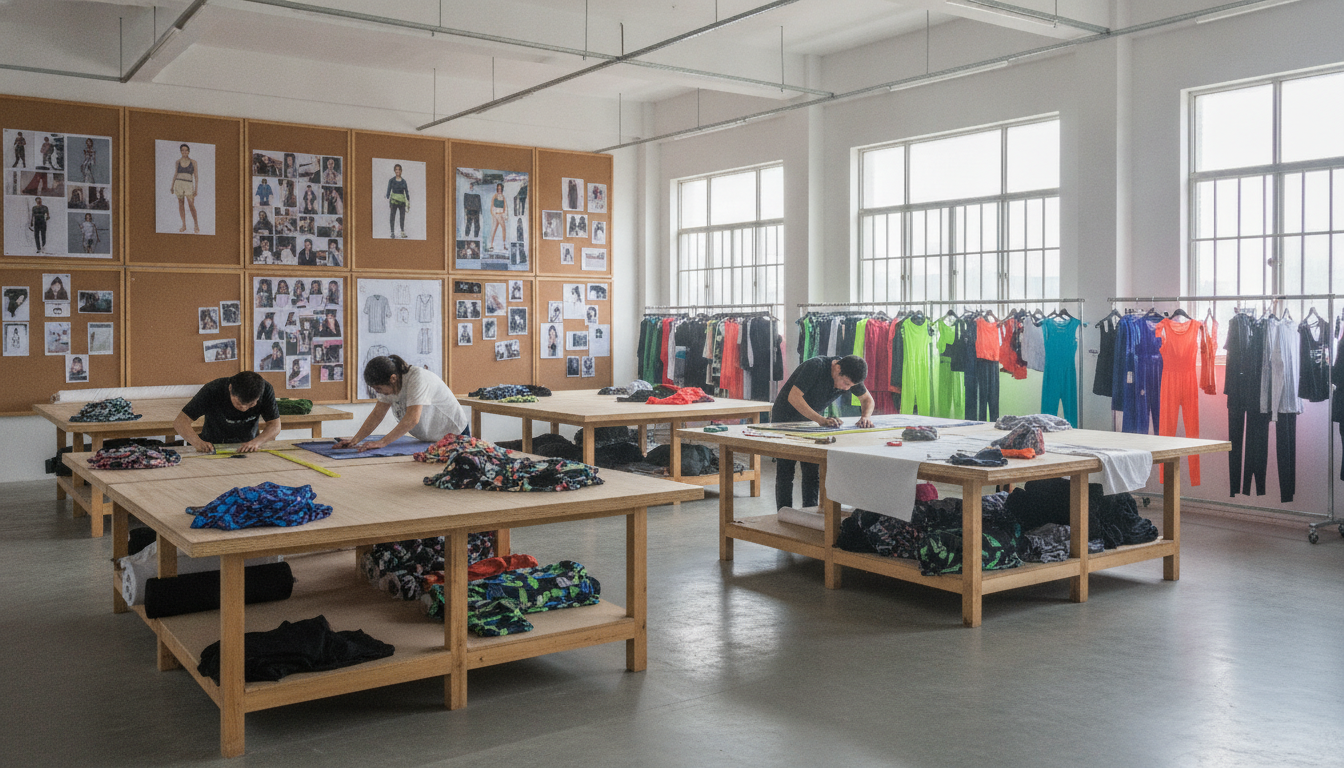
An ODM activewear manufacturer with design services owns the product development process from concept to finished goods. Unlike an OEM factory that executes your tech pack, an ODM partner provides pattern-making studios, fabric libraries, and technical designers who translate a mood board or reference sample into a production-ready garment.
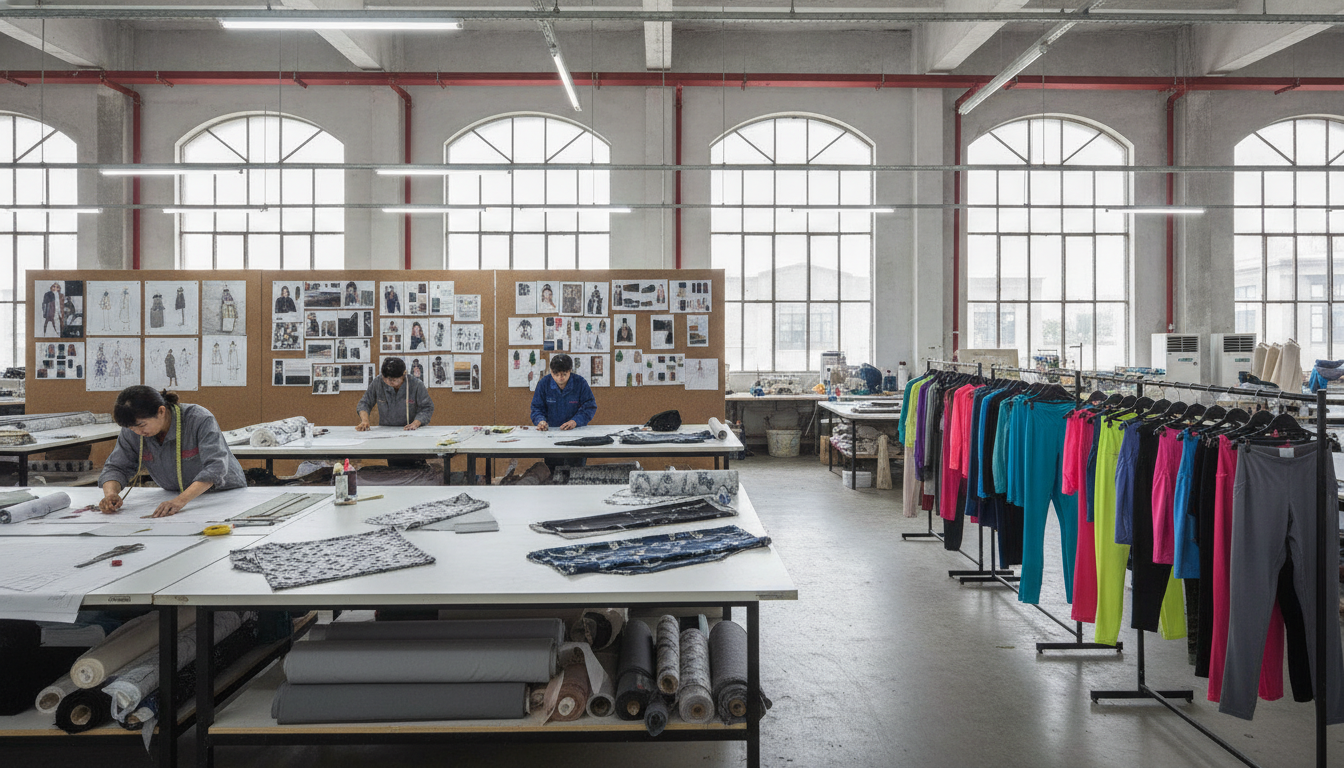
A vertically integrated ODM facility combines design, sampling, and production under one roof. Pattern makers draft first samples from sketches or reference images, grade patterns across your size range, and iterate fit based on wear testing. Fabric sourcing teams maintain relationships with mills for performance knits, recycled polyester, and organic cotton, so you select from tested swatches rather than sourcing yarn yourself.
Founders without apparel industry experience benefit most from ODM partnerships. If you have a clear brand aesthetic and target customer but lack technical skills to draft a flat sketch or write fabric specifications, an ODM manufacturer bridges that gap. Boutique yoga studios expanding into retail apparel and DTC startups validating their first three SKUs avoid hiring a $5,000-per-collection freelance designer by working directly with the factory’s in-house team.
An ODM partner executes your creative direction but does not replace brand strategy. You still define your target customer, price point, and product assortment. The factory translates those inputs into technical specs, but decisions about colorways, trim details, and final fit approval remain with you.
Choosing between ODM, OEM, and private-label models depends on how much design control you need and whether you have technical documentation ready.
OEM production costs 10-15% less per unit than ODM because you absorb design labor, but you pay that upfront through freelance designers or salaried staff. ODM spreads design cost across the production run, making it viable for smaller first orders. Lead times for ODM run 2-3 weeks longer than OEM due to sampling iterations, but you avoid the 4-8 week external design phase before production starts.
In an ODM arrangement, the factory retains pattern ownership unless you negotiate an exclusivity clause. That means the same silhouette may appear in another brand’s line with different fabric or trim. If design uniqueness is critical, request exclusive rights to specific patterns in your contract and expect a 15-20% cost premium or higher MOQ to compensate the factory for restricting future use.
A capable ODM activewear manufacturer with design services provides structured support from concept to pre-production approval, not just ad-hoc sampling.
Submit mood boards, competitor samples, or sketches during the initial consultation. The factory’s design team translates those inputs into technical flat sketches with callouts for seam placement, pocket construction, and waistband style. Reference sampling lets you physically test a similar garment from the factory’s archive before committing to a new pattern, saving one sampling round.
Pattern makers draft the first sample pattern in your base size, typically a US size Small or Medium. After you approve fit and construction, the pattern is graded across your full size range. Standard activewear grading covers XS through XL in 2-inch increments for tops and 1-inch increments for bottoms, but custom grading for petite, tall, or plus-size ranges requires additional sampling to verify proportions.
ODM manufacturers maintain fabric libraries with performance knits tested for stretch recovery, moisture wicking, and colorfastness. You select from in-stock swatches or request custom dyeing for brand-specific colors. Fabric minimums for custom dye lots typically start at 300-500 meters, enough for 150-250 leggings depending on size distribution, so small first orders use stock colors unless you consolidate multiple styles onto one custom dye run.
Elastic waistbands, drawcords, zipper pulls, and logo labels are specified during the sampling phase. The factory sources these components, but you approve swatch cards before bulk production. Custom woven labels and hang tags require separate minimums, often 500-1,000 pieces, so brands ordering under 200 units typically use generic size labels and add branded packaging post-production.
Minimum order quantities and sampling terms determine whether you can test product-market fit before committing five-figure inventory budgets.
A common complaint buyers raise is that most low-MOQ manufacturers they find are Pakistan-based and quality consistency becomes a concern. Vertically integrated facilities in China’s Zhejiang and Guangdong provinces offer 1-piece sample minimums, letting you order a single legging or sports bra in your base size to evaluate fabric hand-feel, construction quality, and fit before placing a bulk order. Sample costs run $40-80 per piece depending on complexity, with 7-10 day turnaround for in-stock fabrics.
Sample MOQ: 1 piece. Bulk MOQ: 30 pieces per SKU. Sampling time: 7-10 days for in-stock fabric, 14-18 days for custom dye lots.
Bulk production minimums at Walundi start at 30 pieces per SKU, meaning 30 units of one style in one colorway distributed across sizes. A typical size curve for women’s activewear allocates 10% XS, 25% S, 35% M, 20% L, 10% XL. For a 30-piece minimum, that translates to 3 XS, 8 Small, 10 Medium, 6 Large, 3 XL. Factories round fractional quantities up, so actual minimums may land at 32-35 pieces to accommodate full-size runs.
Brands launching with three styles (high-waist legging, sports bra, cropped tank) can place a 90-piece first order: 30 units per style. This approach validates multiple products without the capital lock of 300-500 unit minimums common at OEM factories. Consolidating styles into one production run also reduces per-unit costs by 8-12% compared to placing three separate 30-piece orders over three months.
Sample charges are typically deducted from your bulk order when you proceed to production. If you order three samples at $60 each and place a 90-piece bulk order, the $180 sample cost is credited against your final invoice. Factories that do not offer sample refunds often signal a transactional relationship rather than a partnership model.
Activewear performance depends on fabric composition, weight, and finishing treatments. A common factory-owner complaint is that thinner stretch fabric causes see-through issues, white shows sweat, and going thicker kills the stretch while raising cost.
Squat-proof leggings require fabrics with at least 250 GSM (grams per square meter) and four-way stretch with 60-80% elongation and full recovery. Blends of 75-80% polyester or nylon with 20-25% spandex provide the structure and stretch needed for deep squats without sheerness. Factories test swatches under tension using a light box to verify opacity at full stretch before approving for production.
Polyester and nylon fibers naturally wick moisture to the fabric surface, but finishing treatments enhance drying speed. Hydrophilic finishes applied during dyeing improve wicking performance by 20-30%, critical for high-intensity workouts. These treatments add $0.30-0.50 per meter to fabric cost but differentiate performance leggings from fashion athleisure.
Light colors, especially white and pale pink, show sweat and require heavier fabric weights or engineered mesh panels to manage moisture visibility. Heather and marled yarns camouflage sweat better than solid colors. Sublimation printing for all-over patterns works only on polyester-dominant fabrics (minimum 85% polyester) and adds 3-5 days to production lead time plus $2-4 per piece in print cost.
Recycled polyester from post-consumer PET bottles costs 15-20% more than virgin polyester but qualifies for GRS certification when the recycled content exceeds 20%. Organic cotton costs 30-40% more than conventional cotton and requires GOTS certification to make marketing claims. Brands targeting eco-conscious buyers need to budget for both higher fabric cost and certification fees, typically $1,500-3,000 annually for GRS and GOTS combined.
Selling activewear in the US, EU, UK, Canada, and Australia requires compliance with chemical safety, labor standards, and product labeling regulations.
OEKO-TEX Standard 100 certification verifies that finished garments contain no harmful levels of restricted substances. The test protocol screens for more than 1,000 chemicals, including carcinogenic azo dyes, formaldehyde, and phthalates. Factories maintain annual certification and test each new fabric before production. Certification costs run $1,200-2,500 per year depending on facility size, and test reports accompany each shipment for customs clearance.
The Global Recycled Standard requires a minimum of 20% recycled material content before a product can carry the GRS label. Certification tracks the supply chain from recycled input through spinning, knitting, dyeing, and cut-and-sew production. Each handler in the chain must hold GRS certification, so working with a vertically integrated facility simplifies compliance. Brands pay $800-1,500 annually for transaction certificates that document recycled content percentages for each production batch.
BSCI audits cover working hours, wages, freedom of association, health and safety, and environmental management. Factories undergo on-site audits every 12-24 months, and audit reports are shared with buyers. Major EU retailers and corporate wellness programs require BSCI or equivalent (SA8000, WRAP) as a condition of doing business. Non-compliant factories face delisting from approved-supplier rosters.
The US requires fiber content, country of origin, and care instructions on a permanent label. The EU adds importer contact details and RN (Registered Identification Number) for US-based brands. Canada mandates bilingual English-French labels. Australia requires fiber content in descending order by weight and country of manufacture. Your ODM partner should provide compliant labels as part of the production package, but you verify final label copy before bulk production starts.
Understanding total landed cost helps you set retail prices that cover all expenses and deliver target margins.
FOB (Free On Board) cost includes fabric, trims, labor, factory overhead, and profit margin. For a mid-weight performance legging with a 30-piece MOQ, FOB costs typically range from $8-14 per unit depending on fabric quality, construction complexity, and trim specifications. Adding custom labels, hang tags, and polybags adds $0.80-1.50 per unit. A sports bra with molded cups and adjustable straps runs $6-10 FOB, while a seamless knit tank costs $4-7.
Ocean freight from Ningbo to the US West Coast costs approximately $1.20-1.80 per kilogram for consolidated LCL (less than container load) shipments under 500 kilograms. A 100-piece legging order weighs roughly 60-80 kilograms, so freight adds $1.00-1.50 per unit. US customs duty on knit activewear from China is 16.5-28.2% depending on HS code and fiber content. Duty is calculated on FOB value plus freight, so a $10 FOB legging with $1.50 freight incurs $1.90-3.25 in duty.
Total landed cost equals FOB plus freight plus duty plus inland delivery. For the example legging, landed cost is $10 + $1.50 + $2.50 + $0.50 = $14.50. DTC brands targeting a 2.5-3x markup price the legging at $36-43 retail. Wholesale brands selling to studios or boutiques at 50% off retail need a 5-6x markup, requiring FOB costs under $7 to hit a $35-42 wholesale price and $70-84 suggested retail.
Factories offer tiered pricing based on order size. A 30-piece first order may cost $12 FOB per legging, while a 300-piece reorder drops to $9.50-10.50 FOB due to fabric-buying economies and reduced setup cost per unit. Brands planning seasonal collections negotiate annual volume commitments (e.g., 1,200 pieces across four drops) to lock in lower per-unit pricing from the first order.
Standard payment terms are 30% deposit on order confirmation, 70% balance before shipment. Factories offering net-30 or net-60 terms after the first order help manage cash flow, but those terms typically require a credit application and minimum order history. Plan for 45-60 days from deposit to goods arriving at your warehouse: 7-10 days sampling, 14-21 days production, 25-35 days ocean transit, 3-5 days customs clearance and inland delivery.
In practice: A Toronto-based yoga studio owner validated three legging styles with 1-piece samples in different fabrics, then placed a 90-piece first order (30 per style) to test retail sales before committing to 300-unit reorders
An ODM activewear manufacturer provides design services including pattern making, fabric sourcing, grading, and sampling in addition to cut-and-sew production. Unlike an OEM factory that requires you to supply finished tech packs, an ODM partner translates your concept or reference samples into production-ready garments, making it ideal for founders without technical design backgrounds.
ODM manufacturers handle design, pattern making, and fabric sourcing based on your creative brief, while OEM factories execute production from your complete tech pack and graded patterns. ODM suits startups validating product-market fit without in-house design teams, whereas OEM works for established brands with technical designers who provide finished specs. ODM typically requires lower minimums but costs 10-15% more per unit due to design labor.
Look for vertically integrated facilities with in-house pattern studios, fabric libraries, and certifications like OEKO-TEX, GRS, and BSCI. Request sample work to evaluate construction quality, ask for client references in your product category, and verify the factory can accommodate your MOQ and lead-time requirements. Manufacturers offering 1-piece sample MOQs and 30-piece bulk minimums signal DTC-friendly terms that support product validation before large capital commitments.
ODM activewear minimums vary by factory, but DTC-focused manufacturers offer 30-100 pieces per SKU for bulk orders and 1-5 pieces for sampling. A 30-piece minimum lets you test one style in one colorway across a full size run (XS-XL) without locking up the capital required for 300-500 unit OEM minimums. Multi-style first orders of 90-120 pieces (three styles at 30-40 each) validate product assortments before scaling.
Yes, that is the core value of an ODM activewear manufacturer with design services. You provide mood boards, reference samples, or sketches, and the factory’s design team drafts technical flats, selects fabrics from their library, and produces samples for your approval. This model eliminates the need to hire a freelance designer or learn pattern-making software, making it accessible for founders launching their first collection.
Written by the Walundi Export Team.
Ready to validate your activewear concept without locking up capital in 500-unit minimums?
Request 1-Piece Samples →
Sample 1 piece · bulk from 30 · OEKO-TEX & GRS certified · reply in 24h. No gatekeeping.
Low MOQ. Sustainable fabrics. OEM ready. Tell us your vision.
Click the button below to open WhatsApp. If you're not logged in to WhatsApp Web yet, scan the QR code first — then come back here and copy the message into the chat.