
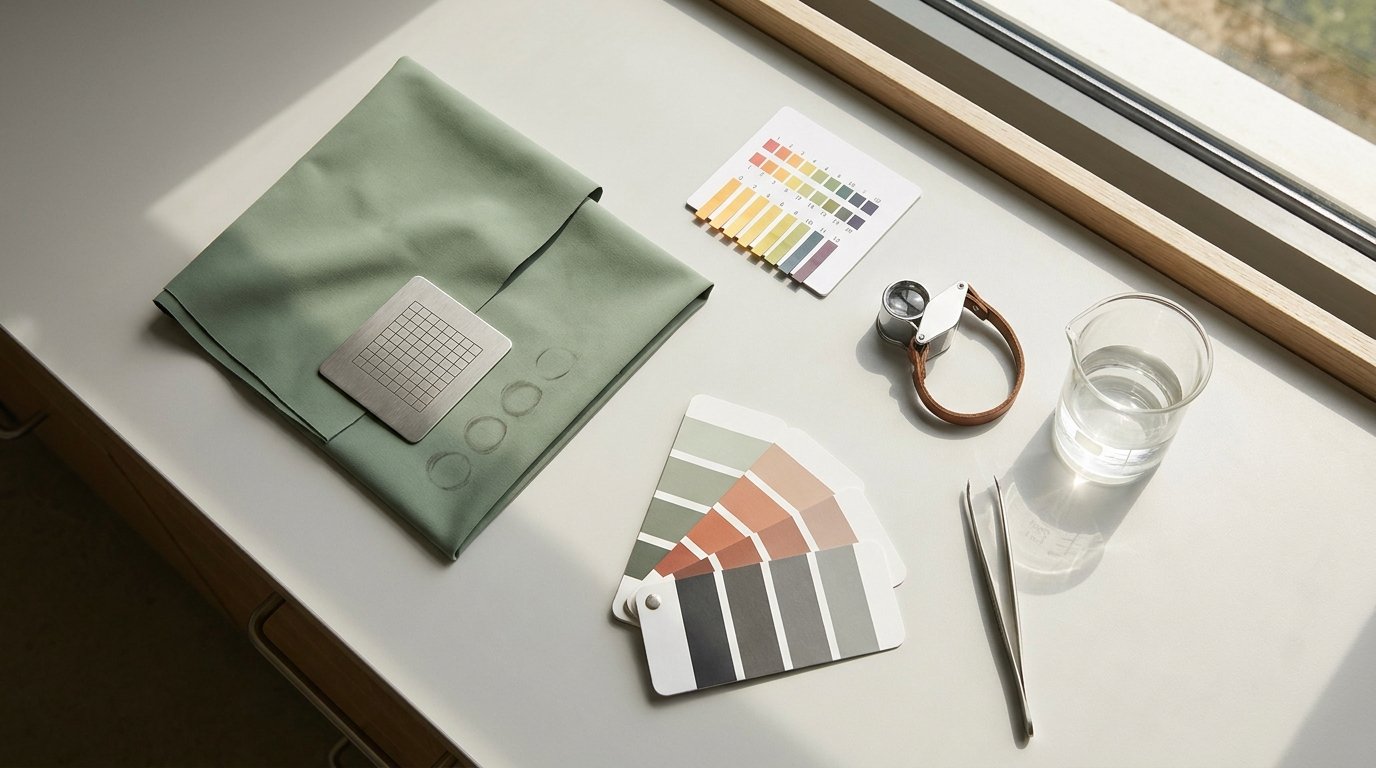
For procurement teams managing international activewear supply chains, textile colorfastness is not merely an aesthetic preference; it is a critical variable in consumer lifetime value. Garments that experience pigment degradation or color bleeding after standard domestic laundering cycles generate high return rates and erode brand equity. Sourcing a wholesale eco-friendly yoga wear manufacturer requires auditing their dye house infrastructure to ensure chemical compliance and fixation efficacy.
A persistent structural issue in lower-tier athletic apparel manufacturing is the interference between heavy synthetic dyes and the fabric’s capillary action. Traditional dispersed dyes used on polyester and nylon substrates can effectively block the micro-grooves engineered into moisture-wicking fibers. This compromises the garment’s ability to transport sweat away from the epidermis, nullifying the technical performance of the athletic wear.
Procurement directors must demand technical specifications on the dye classes utilized by their suppliers. Walundi resolves this paradox by utilizing reactive, low-impact dye methodologies. These formulations chemically bond with the polymer chain of the fabric at a molecular level, rather than coating the fiber surface. This ensures that the hydrostatic properties of the moisture-wicking athletic wear remain intact, preserving breathability while achieving deep, saturated colorways.
The global regulatory landscape governing textile imports is tightening, particularly within the European Union (REACH regulations) and North America. Importers of record bear the legal liability for trace heavy metals, formaldehyde, and azo colorants present in bulk inventory.
Partnering with an OEKO-TEX certified activewear factory is a non-negotiable risk mitigation strategy for B2B apparel buyers. Walundi enforces strict chemical screening protocols across its entire supply network. Raw materials and finished dye lots undergo objective third-party laboratory testing to verify the absence of restricted substances. This proactive compliance framework shields client brands from customs seizures and consumer safety litigation.
High-demand athletic palettes—specifically deep blacks, navy blues, and high-visibility neon variants—require specialized thermal fixation processes. Insufficient curing time on the stenter frame leads to excess unfixed dye molecules remaining trapped in the knitted loops.
To guarantee consistency in custom athleisure bulk orders, Walundi executes a proprietary multi-stage scouring and colorfastness testing protocol. Production samples are subjected to standardized friction (crocking) and simulated accelerated laundering tests before the lot is approved for export. This data-driven approach guarantees that the visual integrity of the product survives the rigors of high-intensity workouts and repeated washing cycles.
The expansion of the activewear market into inclusive sizing presents a complex geometric challenge for apparel designers and buyers. Scaling an athletic garment from a baseline size (typically a Medium) to a 3XL cannot be achieved through linear proportioning. Sourcing a custom plus size activewear supplier demands a partner with advanced technical grading capabilities, capable of re-engineering tension distribution to accommodate diverse biomechanical structures.
Standard grading rules fail when applied to high-compression garments because human adipose tissue and muscle mass do not scale symmetrically. If a factory merely adds uniform inches to a standard tech pack, the resulting garment will exhibit critical failure points: rolling waistbands, severe crotch drop, and restricted kinetic mobility in the joints.
Effective size-inclusive fitness apparel requires specialized block patterns. Walundi calibrates its digital CAD grading algorithms to adjust the anatomical pitch of the garment. For extended sizes, the back rise is mathematically increased relative to the front rise, and the thigh-to-calf compression ratios are recalibrated. This structural redesign prevents lateral shifting during squats and high-impact movements, delivering a functional, secure fit for the end-user.
The mechanical load placed on fabrics in plus-size garments is exponentially higher. A standard 220 GSM 80/20 Nylon-Spandex blend that performs adequately in smaller sizes may suffer from immediate elastane degradation and opacity failure (sheering) when subjected to the prolonged tension of larger frames.
Procuring B2B bulk orders for this demographic requires upgraded material sciences. Walundi engineers specific textile blends for its extended-size clients, pushing fabric density to the 280-320 GSM threshold. Furthermore, Walundi specifies high-denier spandex yarns that exhibit a superior modulus of elasticity. This ensures the high-stretch retention fabric maintains its recovery memory, preventing the garment from bagging out at the knees or losing its compression profile over time.
The failure of a seam in athletic wear destroys consumer trust instantly. In plus-size applications, the burst strength of the stitching must exceed the maximum elongation of the specialized fabric.
Walundi addresses this mechanical vulnerability by upgrading the stitching architecture on the factory floor. Standard overlock stitching is replaced or reinforced with 4-needle 6-thread flatlock machines using high-tensile polyester thread. This specific manufacturing directive flattens the seam allowance to eliminate friction chafing while simultaneously doubling the seam’s threshold for tensile stress. By isolating and fortifying these structural stress points, Walundi provides B2B clients with highly durable, inclusive athletic wear that commands premium retail pricing.
Sample 1 piece · bulk from 30 · OEKO-TEX & GRS certified · reply in 24h. No gatekeeping.
Fill in your details and we'll connect on WhatsApp instantly.
Click the button below to open WhatsApp. If you're not logged in to WhatsApp Web yet, scan the QR code first — then come back here and copy the message into the chat.