📋 Table of Contents
Many emerging activewear brands stall before their first production run because manufacturers demand 500-piece minimums before they will cut a single sample. When you are validating product-market fit on a tight budget, locking up $8,000-$12,000 in inventory for one untested SKU is a non-starter. An ODM activewear manufacturer with pattern making services solves this by offering ready-made design blocks you can customize with your branding and fabric choices, plus in-house pattern studios that produce samples at single-unit minimums so you can test the market without betting the farm.
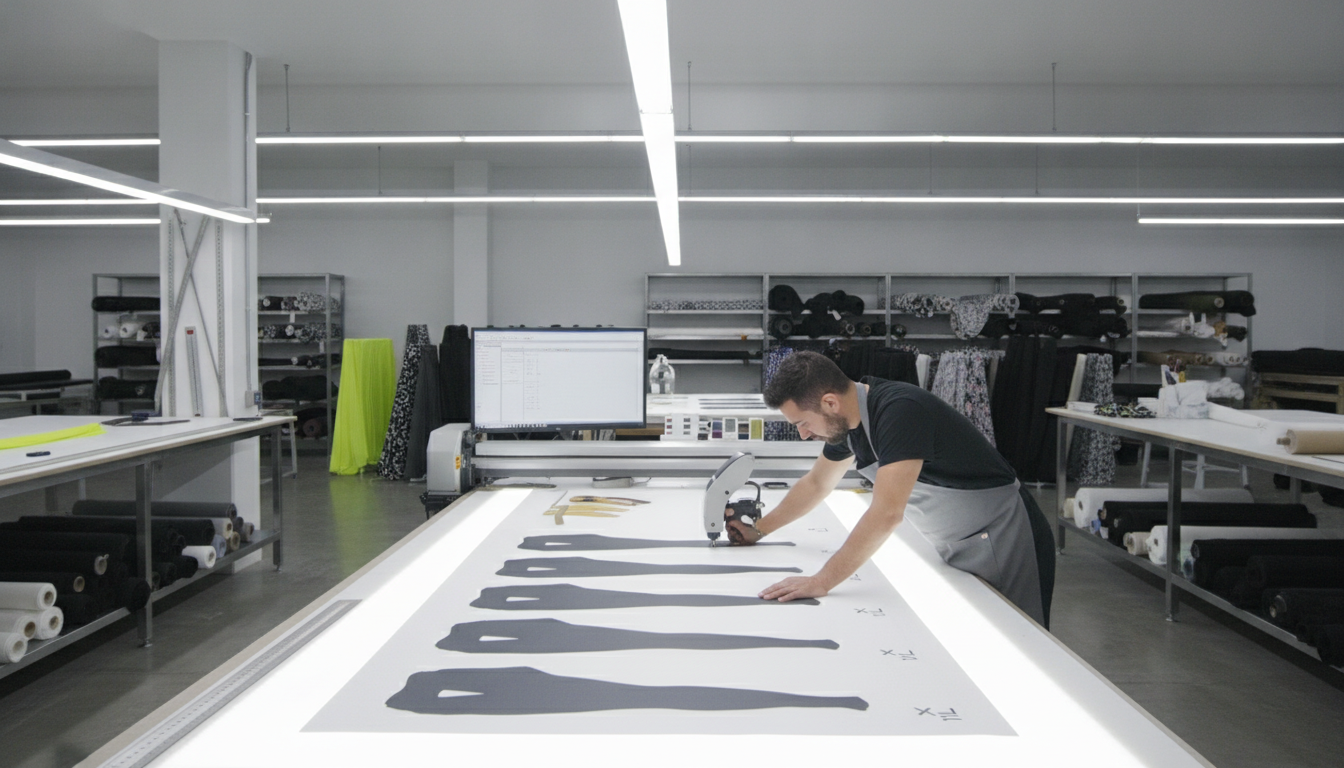
ODM (Original Design Manufacturer) means the factory owns the product design, pattern blocks, and technical specifications. You select from their catalog of existing styles, then customize branding, colors, fabric blends, and trims. The manufacturer handles all technical development, grading, and fit testing because the patterns already exist.
Speed to market is the primary benefit. Because pattern blocks are proven and graded across size runs, you skip the 4-6 week pattern-development phase that custom OEM orders require. Your first sample ships in 7-10 days instead of 6 weeks.
Lower sample costs follow naturally. The factory does not bill you for pattern-making hours or fit-sample iterations. You pay only fabric, trims, and cut-and-sew labor for the single sample piece.
Design exclusivity is the trade-off. Other brands can order the same base silhouette. Your differentiation comes from fabric choices, colorways, branding, and go-to-market execution, not proprietary cuts.
Fit adjustments are constrained. Minor tweaks like inseam length or waistband height are possible, but major pattern changes (like converting a high-waisted legging to mid-rise) push you into custom OEM territory with corresponding time and cost increases.
Pattern making is the technical blueprint that translates a design sketch into a garment that fits real bodies across six or eight size grades. Poor pattern work is the number-one driver of high return rates in activewear. Buyers cite inconsistent fit across sizes, crotch seams that shift during squats, and armholes that bind during overhead stretches.
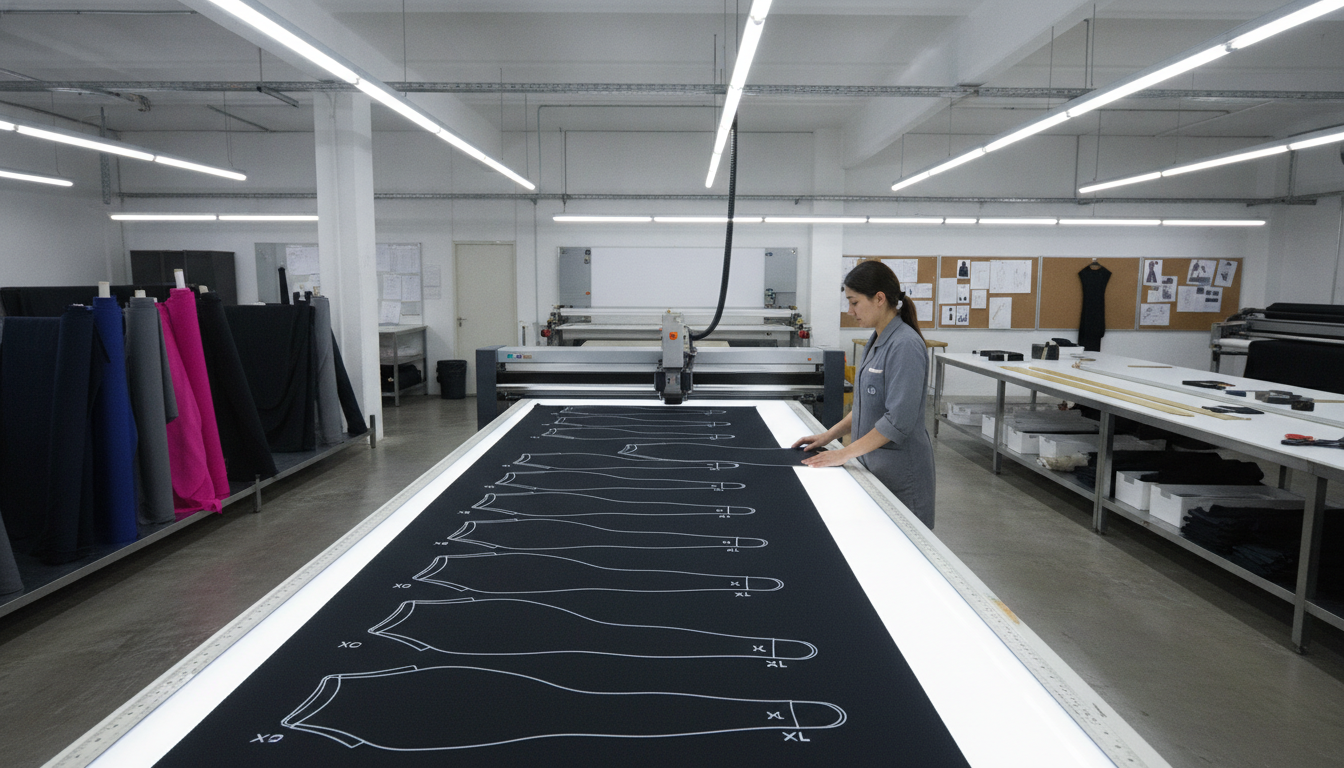
A skilled pattern maker grades each size proportionally so the garment fits a size XS body and a size 2XL body with the same intended ease and compression. Amateur grading simply scales the entire pattern up or down, which distorts proportions. The result is a size S that fits well but a size L where the rise is too short and the leg openings gap.
In our 12+ years manufacturing yoga apparel in Yiwu, we have seen DTC brands lose 18-25% of first orders to fit returns when they skip professional pattern grading and rely on factory default grades.
Activewear patterns must account for fabric stretch under load. A legging that looks opaque when standing can turn sheer across the glutes during a deep squat if the pattern does not allow enough ease in the seat and thigh. Pattern makers test this by draping the fabric on a dress form in squat position, then adjusting dart placement and seam curves.
Buyers frequently raise concerns about thinner stretch fabrics causing see-through issues, especially in white and light colors. Proper pattern ease combined with squat testing during sampling catches these problems before bulk production.
Sports bras and tops require pattern ease at the underarm, across the shoulders, and through the bust to allow overhead reaches and twisting without riding up or binding. Pattern makers test this by fitting samples on live models who perform yoga flows, burpees, and arm circles. Adjustments to armhole depth, strap placement, and side-seam curves follow from these fit sessions.
The ODM versus OEM decision hinges on three variables: budget, timeline, and design differentiation goals. Neither is universally better. The right choice depends on your current stage and competitive positioning.
Custom OEM pattern development typically costs $800-$1,500 per style for the initial pattern, plus $300-$600 per fit-sample iteration. Brands ordering three styles with two fit rounds each invest $3,000-$5,000 before placing the first bulk order.
ODM eliminates these upfront fees. You pay only for the 1-piece sample at material and labor cost, usually $45-$85 per piece depending on fabric and construction complexity.
ODM sampling completes in 7-10 days because the pattern studio pulls existing blocks, adjusts sizing tags, and sends directly to the sample room. Custom OEM requires 4-6 weeks for initial pattern draft, first fit sample, adjustment, second fit sample, and final approval.
Brands launching for a seasonal window (back-to-school, holiday, New Year fitness wave) often cannot absorb a 6-week pattern phase. ODM lets you sample, test, and order bulk within 8 weeks total.
If your brand positioning relies on proprietary silhouettes (unique strap configurations, architectural seaming, signature pocket placements), custom OEM is the only path. The pattern is yours, and competitors cannot replicate it without reverse-engineering.
If your differentiation comes from sustainable fabric stories, community building, or targeted sizing (petite, tall, plus), ODM works well. You use proven fit blocks and compete on material innovation and brand narrative.
In practice: A Los Angeles yoga instructor launched a three-piece capsule using ODM legging and sports-bra blocks with custom GRS-certified recycled nylon. She validated demand with 1-piece samples sent to five local studios, then placed a 90-unit first order (30 pieces across three SKUs) without pattern-development fees.
Understanding the end-to-end workflow helps you plan timelines and budget accurately. The process differs slightly between ODM and custom OEM, but both follow a similar sampling cadence.
You submit a design brief with reference images, target fabric specs (weight, stretch percentage, fiber content), and size range. For ODM, the manufacturer shares their catalog of existing styles with technical flats and spec sheets. You select base styles and note customization requests (logo placement, waistband width, inseam length).
For custom OEM, you provide sketches or tech packs with detailed construction notes. The pattern maker translates this into a first-draft pattern.
The factory cuts and sews one sample garment in your chosen fabric and size (usually size M for fit reference). This proto sample ships within 7-10 days for ODM orders, 4-6 weeks for custom OEM first drafts.
You fit the sample on a live model, checking ease through the waist and hips, strap tension, hem length, and seam placement during movement. Document any adjustments with photos and written notes.
Custom OEM orders typically require 1-2 fit-sample rounds. The pattern maker adjusts the pattern based on your feedback, cuts a second sample, and ships for approval. Each round adds 10-14 days.
ODM orders skip this phase unless you request a major modification that requires pattern redrafting, which converts the order to custom OEM pricing and timeline.
Once the base pattern is approved, the pattern maker grades it across your full size range (XS to 2XL, for example). The factory produces a size-set sample run (one garment in each size) so you can verify proportional fit.
Size-set sampling is optional for ODM if you trust the manufacturer’s existing grade rules. Most DTC founders skip it to save time and cost, then order the full size range in bulk and handle any minor fit tweaks in the second production run.
The final pre-production sample uses bulk-order fabric, trims, and labels. It serves as the golden sample that the production line references for color, construction, and finishing details. Approve this sample in writing before the factory cuts bulk fabric.
Minimum order quantities and per-unit costs are the two variables that determine whether a new brand can afford to launch. Many manufacturers set 500-1,000 piece minimums per style, which prices out founders with under $20,000 in inventory budget. Finding an ODM activewear manufacturer with pattern making services that accepts lower minimums changes the economics entirely.
Sample MOQ is the minimum quantity the factory will produce for a proto or fit sample. Industry standard is 1-5 pieces, though some manufacturers require 10-20 pieces even for sampling.
Bulk MOQ is the minimum per-SKU quantity for production orders. This is where founders hit the wall. A 500-piece minimum across five sizes and two colors means 1,000 total units and $15,000-$25,000 in upfront cost.
Sample MOQ: 1 piece. Bulk MOQ: 30 pieces per SKU. Sampling time: 7-10 days.
Walundi’s 30-piece bulk MOQ per SKU lets a founder launch three SKUs with 90 total units and $1,800-$3,200 in inventory investment, leaving budget for marketing and fulfillment.
Per-unit cost in activewear manufacturing splits into fabric, trims, labor, and overhead. Fabric typically represents 40-50% of the total, trims (elastic, labels, hang tags, poly bags) another 10-15%, cut-and-sew labor 25-30%, and factory overhead 10-15%.
Unit cost drops 12-18% when order volume increases from 100 to 500 pieces because fabric mills offer better pricing at higher meterage and the factory amortizes setup time across more units.
DTC activewear brands typically apply a 2.5x to 3.5x markup from landed cost to retail price. Landed cost includes unit cost, shipping, duties, and fulfillment-center receiving.
Example: A legging with $7.00 factory cost, $1.20 shipping and duties, and $0.80 fulfillment cost has an $9.00 landed cost. At 3x markup, retail price is $27.00. Subtract payment processing (2.9%), returns (8-12%), and marketing cost (20-30% of revenue for new brands), and net margin lands at 18-28%.
Founders often underprice in year one to drive trial, then raise prices 10-15% once they have proof of repeat purchase rates and can justify premium positioning.
Lower MOQs let you test more SKUs without tying up cash in slow-moving inventory. A founder with $5,000 in inventory budget can order five SKUs at 30 pieces each instead of one SKU at 500 pieces. This diversification reduces the risk that a single style flops and leaves you with $4,000 in dead stock.
Reorder velocity improves too. Selling through 30 units in 6 weeks and reordering gives you market feedback faster than waiting 5 months to move 500 units.
In practice: A Toronto-based activewear startup used Walundi’s 30-piece MOQ to launch six SKUs (two leggings, two bras, two tops) with $3,200 in initial inventory. They sold through in 9 weeks, identified the two best sellers, and placed a 150-unit reorder focused on those SKUs while phasing out the slower styles.
Sustainable-material certifications add cost but unlock premium positioning and retail partnerships. GRS certification for recycled fabrics requires third-party audits of the supply chain and costs the factory $2,000-$5,000 annually, which they amortize across all GRS orders.
OEKO-TEX Standard 100 testing costs $1,200-$2,500 per fabric type and must be renewed annually. Factories with existing OEKO-TEX certification can add your order to their certified fabric library at no extra charge, but custom dye lots may require separate testing.
BSCI (Business Social Compliance Initiative) audits verify labor practices and factory safety. Annual audit costs run $1,500-$3,000 and are typically absorbed by the factory, not passed to the buyer.
When sourcing from a sustainable activewear manufacturer, confirm that their GRS, OEKO-TEX, and BSCI certificates are current and request copies before placing your deposit.
OEM (Original Equipment Manufacturer) means you own the design and provide tech packs or patterns, and the factory produces to your specifications. ODM (Original Design Manufacturer) means the factory owns the design library, and you select existing styles to customize with your branding, fabrics, and colors. ODM is faster and cheaper upfront because pattern development is already complete, while OEM offers full design exclusivity.
Yes, most ODM manufacturers maintain in-house pattern studios to develop and refine their design catalog. If you need modifications to an existing ODM style or want to transition to custom OEM development later, the same pattern makers can handle those requests. The distinction is that ODM uses existing patterns as the starting point, while custom pattern making builds from scratch.
Industry-standard bulk MOQ ranges from 300 to 1,000 pieces per style, though this varies by factory size and specialization. Manufacturers focused on large brands often require 500-1,000 pieces, while factories serving DTC startups may accept 100-300 pieces. Walundi’s bulk MOQ is 30 pieces per SKU, designed specifically for emerging brands validating product-market fit on limited budgets.
For ODM orders using existing pattern blocks, expect 7-10 days for a proto sample. Custom OEM pattern development takes 4-6 weeks for the initial pattern draft and first fit sample, plus another 10-14 days per additional fit round. Most custom styles require two fit samples before final approval, so total timeline is 6-8 weeks from brief to approved pattern.
Prioritize three factors: MOQ alignment with your budget, certifications that match your brand positioning (GRS for recycled materials, OEKO-TEX for clean fabrics, BSCI for ethical labor), and production capacity that can scale with you. Request samples to evaluate fabric quality and construction consistency, verify certifications are current, and confirm lead times fit your launch calendar. A manufacturer experienced with startups will offer flexible minimums and hands-on sampling support.
Ready to validate your activewear designs without locking up $15,000 in untested inventory?
Request 1-Piece Samples →
Written by the Walundi Export Team.
Sample 1 piece · bulk from 30 · OEKO-TEX & GRS certified · reply in 24h. No gatekeeping.
Low MOQ. Sustainable fabrics. OEM ready. Tell us your vision.
Click the button below to open WhatsApp. If you're not logged in to WhatsApp Web yet, scan the QR code first — then come back here and copy the message into the chat.