
📋 Table of Contents
Understanding yoga clothing sample cost and turnaround time is the first step for DTC founders and boutique studio owners validating product-market fit without locking up cash. Sample fees range from $50 to $500 per style depending on complexity and region, while turnaround times stretch from 7 days for proto samples to 4+ weeks for revised fit samples. Hidden costs like pattern making, fabric mill delays, and wash testing can add $200 and two weeks to your timeline if not negotiated upfront.
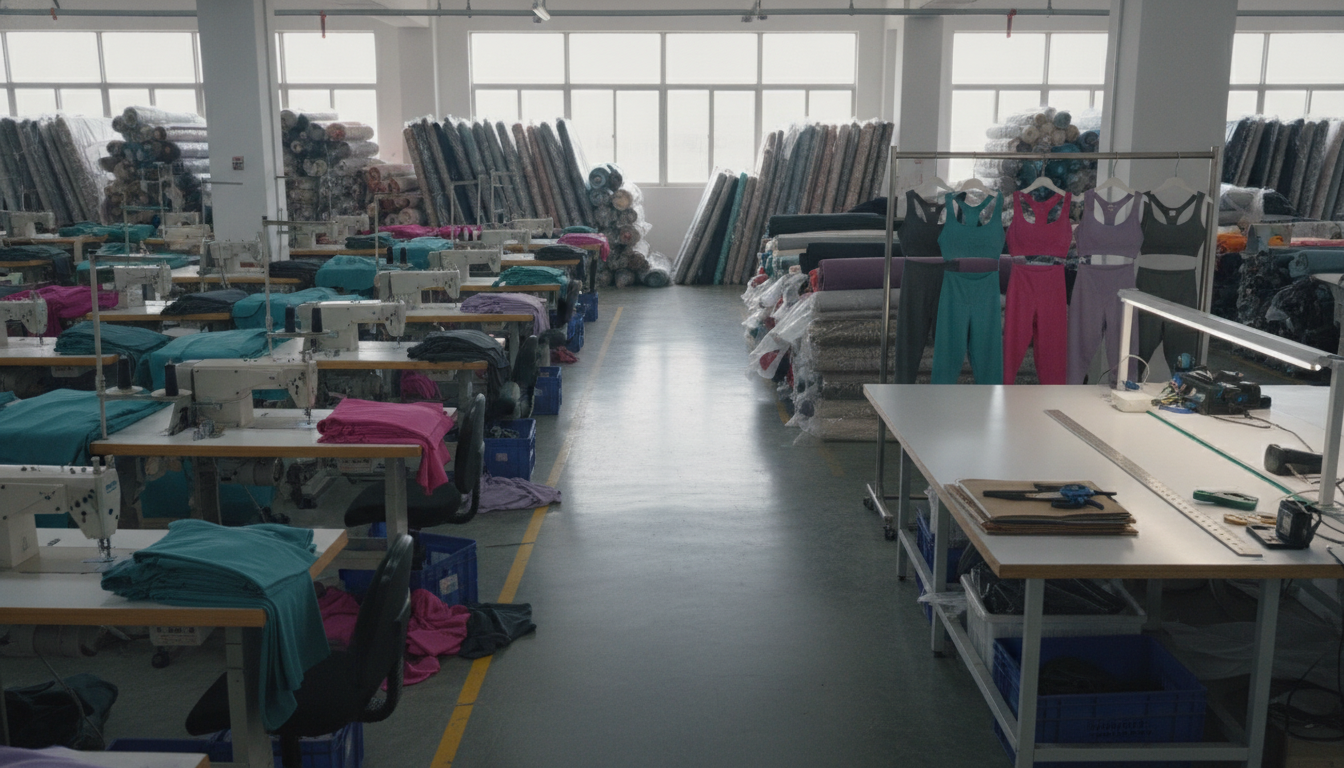
Yoga apparel sampling follows three distinct phases, each with different costs and validation goals. Knowing which sample type you need prevents paying for unnecessary rounds.
The proto sample is a first-draft garment built from your tech pack and fabric swatch. Factories use it to confirm pattern accuracy, fabric behavior, and construction feasibility. Cost ranges from $50 for a simple tank top to $150 for a four-way stretch legging with multiple seam types. Turnaround is typically 7-10 days once fabric is in-house. A common complaint buyers raise is that proto samples often skip wash testing, so shrinkage above 3% only surfaces after you approve the sample and move to bulk production. At our 18,000m² Yiwu facility, we run pre-production wash tests on proto samples to catch shrinkage and color migration before you commit to fit samples.
After proto approval, the fit sample validates sizing across your full size run. Factories produce one garment per size (XS, S, M, L, XL) to check grade rules and ensure consistent fit curves. Cost is $200, $400 for a five-size set, with 10-14 day turnaround. Fit samples reveal whether your M fits like a competitor’s L or if the waistband digs in at XL. Buyers often need two fit-sample rounds to dial in sizing, adding 2-4 weeks to the timeline.
The PP sample is the final sign-off garment, produced with approved fabrics, trims, and packaging. It mirrors the bulk production run in every detail. Cost is $100, $200 per piece, with 7-10 day turnaround. This sample confirms that your factory can execute the approved spec at scale, including label placement, hangtag attachment, and polybag packing. Skipping the PP sample to save cost is a frequent regret; buyers discover trim color mismatches or incorrect label sizes only when the first 500 units arrive.
In practice: A US yoga brand founder validated three legging styles with 1-piece proto samples at $120 each, then ordered fit samples for two finalists, spending $800 total before placing a 30-unit-per-SKU first order
Turnaround time for yoga clothing sample cost and turnaround time depends on fabric availability, factory workload, and whether you request revisions. The timeline below assumes fabric is in stock and no major design changes occur mid-process.
Once you submit a complete tech pack with fabric specs, the factory sources fabric swatches and cuts the first proto. If the fabric is in stock at the mill, expect 7-10 days. If the mill must dye or knit a custom batch, add 1-3 weeks. A frequent pain point is that factories quote 7-day turnarounds but fail to mention fabric lead time, pushing your first sample to 4+ weeks. Before paying the sample fee, ask for written confirmation of fabric availability and total end-to-end timeline.
After you approve the proto or request changes, the factory adjusts the pattern and produces the fit sample set. Turnaround is 10-14 days for straightforward revisions like adjusting inseam length or waistband width. Complex changes such as switching from flatlock to coverstitch seams or adding mesh panels can push this to 3 weeks. Buyers often underestimate revision time, assuming factories keep all fabrics and trims on hand. If your revision requires a new fabric swatch or a different elastic grade, the factory restarts the sourcing cycle.
Once sizing is locked, the PP sample turnaround is 7-10 days. This stage is faster because no pattern changes occur; the factory simply executes the approved spec with final trims and packaging. Delays at this stage usually stem from trim supplier issues, such as out-of-stock woven labels or delayed hangtag printing. Specify all trim details (label size, hangtag material, polybag thickness) in your initial tech pack to avoid last-minute sourcing scrambles.
Total sample cycle: 3-6 weeks for a single proto-to-PP validation with no revisions. Two fit-sample rounds push this to 6-8 weeks. Plan your product launch timeline accordingly.
The quoted sample price rarely includes every cost. Pattern making, fabric marking, and wash testing are often unbundled charges that surface after you approve the proto sample.
Most custom yoga apparel manufacturers charge $75, $200 per style for pattern making and an additional $50, $100 for grading across five sizes. If you provide a detailed tech pack with measurement specs, some factories waive the pattern fee, but grading is almost always separate. Ask upfront whether the sample quote includes pattern and grading, or budget an extra $150, $300 per style.
Marking is the process of laying out pattern pieces on fabric to minimize waste. Factories charge $50, $150 per style for marking setup, especially for complex multi-panel designs like color-blocked leggings or bras with five seam lines. This fee is separate from the sample cost and applies even if you order only one proto. For DTC founders validating multiple styles, marking fees can add $300, $600 to your total sample budget.
Shrinkage above 3% after the first wash requires pattern adjustment, but factories rarely include wash testing in the proto sample phase. You discover the issue only after approving the sample and washing your first bulk unit. Adding wash testing costs $30, $50 per sample and extends turnaround by 2-3 days, but it prevents the need for a second fit-sample round due to unexpected shrinkage. Specify wash testing in your initial sample request to avoid this hidden cost later.
Many factories advertise refundable sample fees, but the fine print reveals they deduct fees only after bulk orders of 500+ units. For DTC founders running 50-200 piece pilot runs, this means sample costs are effectively non-refundable.
A typical refund policy states that sample fees are deducted from your first bulk order if you place a minimum of 300-500 units per style. If your pilot run is 100 leggings across five sizes (20 units per size), the factory keeps the $400 sample fee. This disconnect between advertised refundability and actual MOQ thresholds is one of the most common complaints buyers voice. Before paying for samples, request written confirmation of the exact unit count required for refund eligibility.
Some low MOQ yoga manufacturers offer tiered refund policies that align with startup budgets. For example, a factory might refund 50% of sample fees for orders of 50-100 units and 100% for orders above 100 units. This structure lets you validate product-market fit with a small pilot run without losing your entire sample investment. Walundi refunds sample fees for bulk orders starting at 30 pieces per SKU, matching the reality of early-stage DTC validation cycles.
Sample fees are never refundable if you do not place a bulk order, switch to a different factory, or request samples for styles you ultimately do not produce. If you are validating five legging designs and plan to produce only two, budget for non-refundable sample costs on the three rejected styles. Total sample-cycle cost for a three-round validation (proto, fit, PP) across three styles typically runs $1,000, $1,500, which is capital you will not recover unless all three styles go into production.
Sample cost and turnaround time vary significantly by region. Los Angeles factories offer faster communication and shorter shipping but charge premium prices. China-based manufacturers provide lower sample costs and access to a broader fabric ecosystem, but international shipping adds 5-7 days.
LA-based yoga apparel manufacturers charge $200, $285 per sample for leggings and sports bras, with 10-14 day turnaround. The higher cost reflects domestic labor rates and smaller production scale. Shipping within the US takes 2-3 days via standard courier. LA factories are ideal for founders who need in-person fittings or rapid iteration, but the premium pricing makes multi-round sampling expensive. Total sample-cycle cost for three styles with two rounds each can exceed $2,500.
China-based manufacturers in Guangdong and Zhejiang provinces charge $50, $150 per sample, with 7-10 day turnaround once fabric is sourced. Shipping to the US via DHL or FedEx adds 5-7 days and $40, $60 per shipment. The lower sample cost and access to a vast fabric supply chain (OEKO-TEX certified stretch knits, GRS recycled polyester, organic cotton blends) make China the preferred region for DTC brands validating multiple styles on tight budgets. The tradeoff is longer total lead time due to international shipping and potential communication delays across time zones.
Vietnam and Bangladesh factories charge $80, $180 per sample, with 12-18 day turnaround. These regions are emerging as alternatives to China for buyers seeking diversified supply chains, but fabric sourcing is less mature. If your design requires specialty fabrics like moisture-wicking nylon-spandex blends or anti-pilling polyester, the factory may need to import fabric from China or South Korea, adding 2-3 weeks to the timeline. Shipping to the US takes 6-8 days via express courier.
For sustainable yoga clothing manufacturers, fabric certification (GOTS, OEKO-TEX Standard 100, GRS) can add $20, $50 per sample if the factory must source certified fabric from a specialty mill. OEKO-TEX Standard 100 certification screens textiles against more than 1,000 harmful substances, ensuring your samples meet EU and US safety standards. GRS certification requires a minimum of 20% recycled content and full chain-of-custody documentation from fiber to finished garment. If your brand targets eco-conscious buyers, budget for certified-fabric sample costs and confirm the factory holds valid GRS or GOTS certificates before ordering.
Ready to validate your yoga apparel designs without locking up capital in high-MOQ orders?
Request 1-Piece Samples Today →
Yoga wear sample costs range from $50 to $150 for basic proto samples (leggings, sports bras) and $200 to $500 for complex designs like seamless knit or multi-panel color-blocked pieces. Fit sample sets across five sizes cost $200, $400. Hidden costs such as pattern making ($75, $200) and fabric marking ($50, $150) are often charged separately, so request an itemized quote before ordering.
Turnaround time for yoga clothing samples is 7-10 days for proto samples if fabric is in stock, 10-14 days for fit samples, and 7-10 days for pre-production samples. If the factory must source rare or custom-dyed fabric, add 1-3 weeks. Revisions add 1-2 weeks per round, so a full proto-to-PP validation cycle typically takes 3-6 weeks with no changes or 6-8 weeks with two fit-sample rounds.
Many yoga clothing manufacturers advertise refundable sample fees but deduct them only after bulk orders of 300-500 units per style, not the 50-200 piece pilot runs common for DTC startups. Request written confirmation of the exact unit threshold for refund eligibility before paying sample fees. Some low-MOQ manufacturers offer tiered refunds, such as 50% back for 50-100 unit orders and 100% for orders above 100 units.
Most DTC yoga brands need three sample rounds before production: one proto sample to validate pattern and construction, one or two fit samples to finalize sizing across the full size run, and one pre-production sample to confirm final fabrics, trims, and packaging. Brands with detailed tech packs and prior manufacturing experience may compress this to two rounds (proto and PP), while new founders often require four rounds if significant design changes occur after the first fit sample.
Proto samples validate pattern accuracy and construction methods, costing $50, $150 with 7-10 day turnaround. Fit samples check sizing across your full size run (XS-XL), costing $200, $400 for a five-size set with 10-14 day turnaround. Pre-production (PP) samples are final sign-off garments produced with approved fabrics, trims, and packaging, costing $100, $200 per piece with 7-10 day turnaround. Each sample type serves a distinct validation purpose and cannot be skipped without risk.
Written by the Walundi Export Team.
Sample 1 piece · bulk from 30 · OEKO-TEX & GRS certified · reply in 24h. No gatekeeping.
Low MOQ. Sustainable fabrics. OEM ready. Tell us your vision.
Click the button below to open WhatsApp. If you're not logged in to WhatsApp Web yet, scan the QR code first — then come back here and copy the message into the chat.