

Suppliers claiming GRS-certified fabrics but refusing to provide Transaction Certificates when you request samples is one of the most common red flags DTC founders encounter. When you’re building a yoga brand around sustainability, verifying that your manufacturer’s recycled-content claims are legitimate protects both your brand reputation and your customers’ trust.
This guide walks through the exact verification steps to confirm a yoga apparel manufacturer holds valid Global Recycled Standard (GRS) certification, from requesting documentation before you place an order to spotting fake certificates and validating recycled percentages through independent testing.
The Global Recycled Standard is a third-party certification managed by Textile Exchange that verifies recycled content in textiles and tracks the chain of custody from raw material to finished product. For yoga leggings, sports bras, and activewear, GRS certification covers both post-consumer recycled polyester (rPET from plastic bottles) and post-industrial recycled nylon.
GRS requires a minimum of 50% recycled material by weight in the final product. Products containing 20-49% recycled content can qualify for the Recycled Claim Standard (RCS), a related but less stringent certification. If a manufacturer claims “GRS-certified fabric” but the final garment contains only 30% recycled polyester, the product does not meet GRS labeling requirements.
GRS certification tracks the entire supply chain. A yoga manufacturer must hold valid GRS certification, and every supplier in the chain (the recycled yarn spinner, the fabric knitter, the dye house) must also be GRS-certified. If any link in the chain lacks certification, the Transaction Certificate cannot be issued for the finished garment.
Beyond recycled content, GRS includes requirements for wastewater treatment, chemical restrictions, and worker health and safety. This differentiates GRS from RCS, which focuses solely on recycled-content verification without the broader environmental and social compliance criteria.
Verification happens in three stages: before you request samples, during production, and before you approve final shipment. Each stage addresses a specific risk point where non-compliant manufacturers typically fail.
Before you place a sample order, ask the manufacturer for their GRS certificate number and the name of the certifying body (Control Union, ECOCERT, ICEA, or another accredited third-party). A legitimate GRS-certified factory will provide this within 24 hours. If the supplier hesitates, claims the certificate is “in renewal,” or offers to send it “after you place an order,” treat this as a red flag.
Textile Exchange maintains a public GRS certificate database at textileexchange.org. Enter the certificate number and manufacturer name. The database will show the certification scope (which product categories are covered), the expiration date, and the certifying body. Confirm that “yoga apparel” or “knitted sportswear” falls within the listed scope. Certificates are valid for one year and must be renewed annually.
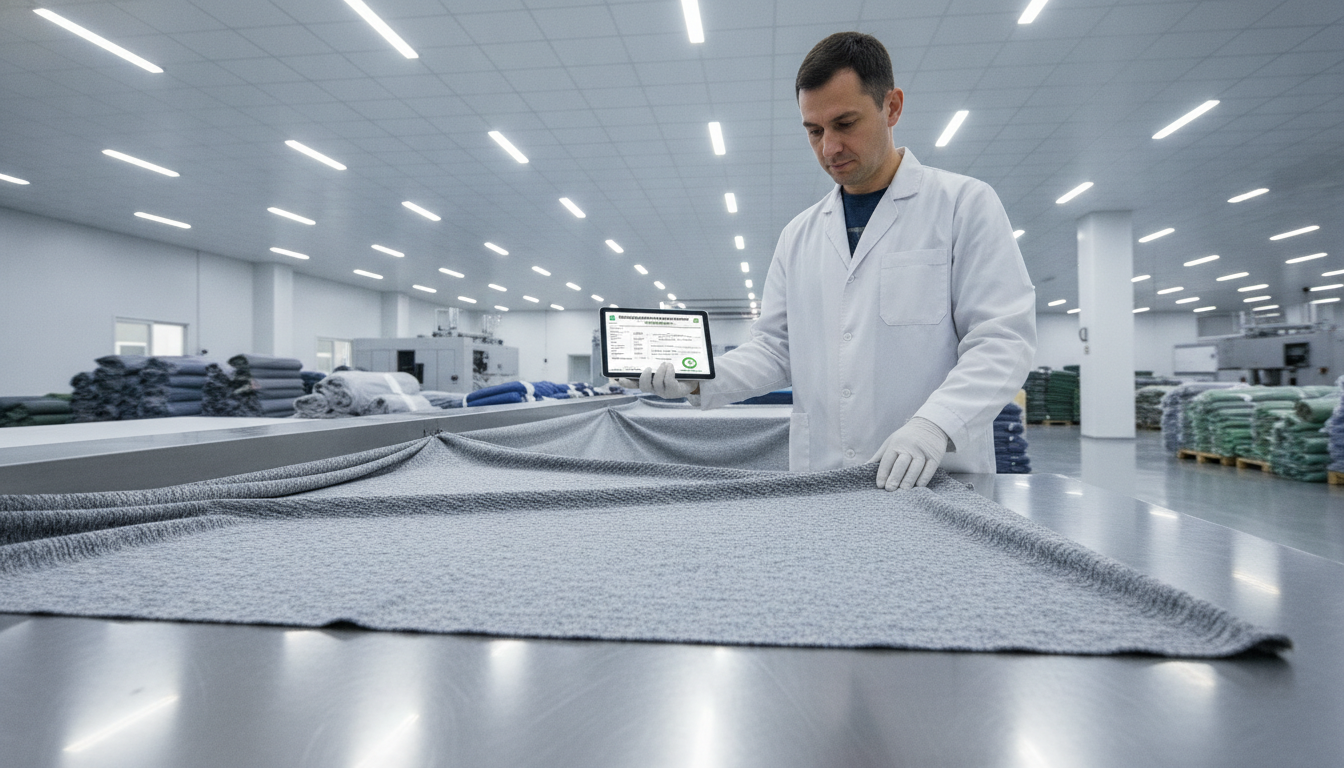
A Transaction Certificate is the document that links a specific order to GRS-certified material. Before you approve bulk production, request a sample TC or a draft TC that lists your brand name, the product description (e.g., “women’s yoga leggings, 75% recycled polyester”), and the certified material supplier. The TC should reference the manufacturer’s GRS certificate number and include a unique TC number you can cross-check.
If you’re ordering more than 500 units or launching a product line with prominent recycled-content marketing claims, commission independent lab testing. Send a sample from your production batch to a textile testing lab (SGS, Intertek, Bureau Veritas) and request a recycled-content analysis. The lab report will confirm whether the fabric contains the claimed percentage of recycled polyester or nylon. This step catches manufacturers who provide GRS-certified fabric at the start but substitute non-certified material mid-production to cut costs.
Manufacturers who lack legitimate GRS certification often use specific tactics to delay or avoid providing documentation. Recognizing these patterns early saves you from investing in samples or deposits with a non-compliant supplier.
Some suppliers send PDF certificates with altered expiration dates, mismatched certificate numbers, or logos from non-accredited certifying bodies. Always verify the certificate number in the Textile Exchange database rather than relying on a PDF alone. If the certificate number does not appear in the database or shows a different factory name, the document is fraudulent.
A manufacturer may source GRS-certified recycled polyester fabric but lack GRS certification for their own cut-and-sew facility. In this scenario, the fabric is certified, but the finished yoga leggings are not. The Transaction Certificate must cover the entire production chain, including the final garment assembly. If the manufacturer holds OEKO-TEX or BSCI certification but not GRS, they cannot issue a TC for your order.
GRS certificates specify which product categories are covered. A factory certified for “woven outerwear” cannot issue a TC for knitted yoga leggings. Check the scope section of the certificate in the Textile Exchange database to confirm that knitted sportswear or activewear is explicitly listed.
A manufacturer provides GRS-certified fabric for your initial sample, then substitutes non-certified polyester during bulk production to reduce costs. This is why independent lab testing on production samples is critical for orders above 500 units. The lab report will reveal whether the recycled content percentage matches the TC claim.
Both GRS and RCS verify recycled content, but they serve different brand positioning and compliance needs. Understanding the difference helps you set the right certification requirement in your manufacturer RFQ.
GRS requires a minimum of 50% recycled material by weight. RCS (Recycled Claim Standard) covers products with 5-100% recycled content but does not enforce a minimum threshold for certification. If your yoga leggings contain 30% recycled polyester and 70% virgin polyester, the product qualifies for RCS but not GRS.
GRS includes requirements for wastewater treatment, restricted chemical use, and worker health and safety. RCS focuses solely on chain-of-custody verification for recycled content and does not include environmental or social compliance criteria. For brands marketing sustainability beyond just recycled fabric (e.g., “ethically made with recycled materials”), GRS provides stronger third-party validation.
Major activewear retailers and marketplaces increasingly require GRS certification for products marketed as “recycled” or “sustainable.” RCS may not meet retailer compliance standards if your distribution strategy includes wholesale partnerships. If you’re launching DTC-only and your recycled content is below 50%, RCS may be sufficient for initial product validation before scaling to GRS-certified production.
One of the most common complaints from DTC founders is that manufacturers refuse to issue Transaction Certificates for orders under 200 units, citing cost or administrative burden. Understanding TC mechanics helps you negotiate terms or find alternative suppliers who accommodate small-batch GRS orders.
A TC is issued for each specific order and links your brand to the GRS-certified material used in that production batch. The TC includes your company name, the product description, the recycled content percentage, the GRS certificate number of the manufacturer, and a unique TC number. The certifying body (Control Union, ECOCERT, etc.) issues the TC after verifying the manufacturer’s records for that order.
Certifying bodies charge manufacturers a fee for each TC issued, typically in the range of 50 to 150 USD per certificate depending on the certifying body and the complexity of the supply chain. For a 100-unit order, this fee represents a significant per-unit cost increase. Some manufacturers absorb this cost for large orders but refuse to issue TCs for small batches, leaving DTC brands without the documentation needed to substantiate recycled-content claims.
Before you place a sample order, confirm in writing that the manufacturer will issue a Transaction Certificate for your initial bulk order, even if it falls below their typical MOQ. Some GRS-certified factories that specialize in startup and DTC clients build TC issuance into their pricing for all orders. At Walundi’s Yiwu facility, our GRS certification covers knitted activewear, and we issue Transaction Certificates for orders as small as 30 pieces per SKU, ensuring DTC founders can validate recycled-content claims from their first production run.
In practice: A California yoga brand founder ordered 90 units across 3 styles (30 per SKU) in GRS-certified recycled polyester, received Transaction Certificates for all 3 SKUs, and used the TCs to meet Amazon’s sustainability documentation requirements for the Climate Pledge Friendly badge
Many yoga brands layer multiple certifications to address different aspects of sustainability and safety. GRS verifies recycled content and environmental compliance, but it does not test for harmful chemicals in finished garments or certify organic cotton content. Combining GRS with OEKO-TEX Standard 100 and GOTS (Global Organic Textile Standard) provides comprehensive third-party validation.
OEKO-TEX Standard 100 tests finished textiles against more than 1,000 harmful substances, including azo dyes, formaldehyde, and heavy metals. A yoga legging can be GRS-certified for recycled polyester content but still fail OEKO-TEX testing if the dye or finishing chemicals exceed safety thresholds. Requiring both certifications ensures your recycled-fabric leggings are free from skin-contact hazards.
GOTS certifies organic cotton and other organic natural fibers. If your yoga apparel line includes blended fabrics (e.g., 60% organic cotton, 40% recycled polyester), you need both GOTS certification for the organic cotton component and GRS certification for the recycled polyester component. The manufacturer must hold both certifications and issue separate transaction documents for each certified material.
When you require multiple certifications, request all certificate numbers upfront and verify each in the respective database (Textile Exchange for GRS, OEKO-TEX for Standard 100, GOTS for organic). Confirm that the manufacturer’s certification scope covers the specific product category and fabric blend you’re ordering. For a 70% recycled nylon, 30% organic cotton sports bra, the manufacturer needs GRS certification for knitted activewear and GOTS certification for organic knitted goods.
GRS-certified recycled polyester and nylon typically cost 10-20% more than virgin polyester at the raw material level. Understanding where this cost appears in your per-unit pricing helps you budget accurately and avoid surprises during production.
Recycled polyester yarn (rPET) produced from post-consumer plastic bottles costs approximately 1.80 to 2.20 USD per kilogram, compared to 1.50 to 1.80 USD per kilogram for virgin polyester, depending on global oil prices and recycled-material supply. For a pair of yoga leggings weighing 250 grams, the raw material cost increase is roughly 0.10 to 0.15 USD per unit.
Manufacturers pass through a portion of their annual GRS certification audit cost (typically 2,000 to 5,000 USD per year) and per-order TC issuance fees. For a 500-unit order, the TC fee might add 0.10 to 0.30 USD per unit. For a 100-unit order, the per-unit TC cost can reach 0.50 to 1.50 USD, which is why some suppliers resist issuing TCs for small batches.
For a mid-weight yoga legging with a base production cost of 8.00 USD per unit (virgin polyester, 500-unit order), switching to GRS-certified recycled polyester typically increases the per-unit cost to 8.50 to 9.00 USD. The premium is lower for high-volume orders (1,000+ units) and higher for small batches (under 200 units) due to fixed TC fees.
The concentration of GRS-certified yoga apparel manufacturers varies by country. China leads in both the number of GRS-certified factories and the availability of GRS-certified recycled polyester and nylon supply chains. Vietnam and Bangladesh have growing GRS capacity but fewer suppliers who accommodate low-MOQ DTC orders.
China accounts for the largest share of global GRS-certified textile production, with concentrated hubs in Zhejiang (Yiwu, Shaoxing) and Jiangsu provinces. The proximity of recycled yarn spinners, fabric knitters, dye houses, and garment factories within these regions simplifies chain-of-custody documentation and reduces lead times for GRS-certified orders. Our Yiwu facility sources GRS-certified recycled polyester yarn from spinners within a 50-kilometer radius, ensuring full traceability and faster TC issuance.
Vietnam has a growing number of GRS-certified activewear factories, particularly in the Hanoi and Ho Chi Minh City regions, but recycled yarn supply chains are less developed than in China. Many Vietnamese manufacturers import GRS-certified yarn from China or Taiwan, which adds lead time and complicates chain-of-custody verification. Bangladesh has fewer GRS-certified knitted-activewear factories, and most focus on high-volume orders (1,000+ units) for large brands rather than small-batch DTC production.
When sourcing from China, request the GRS certificate number and verify it in the Textile Exchange database before requesting samples. Chinese suppliers are accustomed to providing TCs for small orders if you establish the requirement upfront. For Vietnam and Bangladesh, confirm that the manufacturer can issue TCs for your order size and ask for the contact information of their certifying body to verify the certificate directly if the database lookup is unclear.
Certain patterns in a manufacturer’s responses signal that their GRS certification may be invalid, expired, or limited in scope. Recognizing these red flags early prevents wasted time and sample costs.
If a manufacturer says “we have GRS” but cannot provide the certificate number within 24 hours, or claims the certificate is “being renewed” or “in process,” treat this as a strong red flag. GRS certificates are valid for one year, and manufacturers receive the renewed certificate before the expiration date. A legitimate factory will share the certificate number immediately.
Some suppliers claim their fabric is “recycled polyester” or “eco-friendly” but cannot provide GRS or RCS certification. Without third-party certification, there is no verification that the fabric contains any recycled content. This is particularly common with small Chinese OEMs who source low-cost “recycled blend” fabric that may contain only 5-10% post-industrial waste mixed with virgin polyester.
A manufacturer may hold a valid GRS certificate but only for woven products (e.g., jackets, pants) rather than knitted activewear (leggings, sports bras). Check the scope section of the certificate in the Textile Exchange database. If “knitted sportswear” or “knitted activewear” is not listed, the manufacturer cannot issue a TC for your yoga apparel order.
A manufacturer who holds GRS certification but refuses to issue a TC for your order (citing cost, administrative burden, or claiming it is “not necessary for small orders”) is a red flag. The TC is the only document that links your specific order to GRS-certified material. Without it, you cannot substantiate recycled-content claims in your marketing or meet retailer compliance requirements.
Before you request samples from any yoga manufacturer claiming GRS certification, create a verification checklist that includes the certificate number lookup, scope confirmation, and TC issuance terms. This checklist becomes part of your supplier RFQ and ensures you eliminate non-compliant factories before investing in samples or deposits.
For founders ordering fewer than 500 units, prioritize manufacturers who explicitly accommodate low-MOQ GRS orders and include TC issuance in their standard terms. Walundi’s 30-piece-per-SKU bulk MOQ and in-house GRS certification for knitted activewear let you validate recycled-content products without the cash-lock and TC-barrier issues common with high-MOQ suppliers.
Written by the Walundi Export Team.
The Global Recycled Standard requires a minimum of 50% recycled material by weight in the final product. Products with 20-49% recycled content can qualify for the Recycled Claim Standard (RCS) but not GRS. If a yoga legging contains only 30% recycled polyester, it does not meet GRS certification thresholds.
Visit the Textile Exchange public database at textileexchange.org and enter the manufacturer’s GRS certificate number and company name. The database displays the certification scope, expiration date, and certifying body. Confirm that “knitted activewear” or “yoga apparel” is listed in the scope section before placing an order.
A GRS Transaction Certificate is a document issued by an accredited certifying body for each specific order, linking your brand to the GRS-certified material used in that production batch. The TC includes your company name, product description, recycled content percentage, and a unique TC number. Without a TC, you cannot substantiate recycled-content claims for that order.
No. GRS requires a minimum of 50% recycled content and includes environmental and social compliance criteria such as wastewater treatment and worker safety. RCS (Recycled Claim Standard) covers products with 5-100% recycled content but does not enforce a minimum threshold or include environmental and social requirements. GRS provides stronger third-party validation for brands marketing sustainability.
The most common GRS-certified fabrics for yoga apparel are recycled polyester (rPET) made from post-consumer plastic bottles and recycled nylon from post-industrial waste. Blended fabrics such as 70% recycled polyester with 30% spandex or 60% recycled nylon with 40% elastane are also widely available with GRS certification for activewear applications.
Ready to verify GRS certification for your next yoga apparel order?
Request GRS Documentation →
Planning logo placement on bottoms? See our custom yoga pants with logo guide.
Sample 1 piece · bulk from 30 · OEKO-TEX & GRS certified · reply in 24h. No gatekeeping.
Low MOQ. Sustainable fabrics. OEM ready. Tell us your vision.
Click the button below to open WhatsApp. If you're not logged in to WhatsApp Web yet, scan the QR code first — then come back here and copy the message into the chat.